Author name: Zikra Tayab

Meet Zikra, and Asst. Content Manager known for her analytical thinking and structured approach to complex topics. She writes to inform decisions, not chase attention.

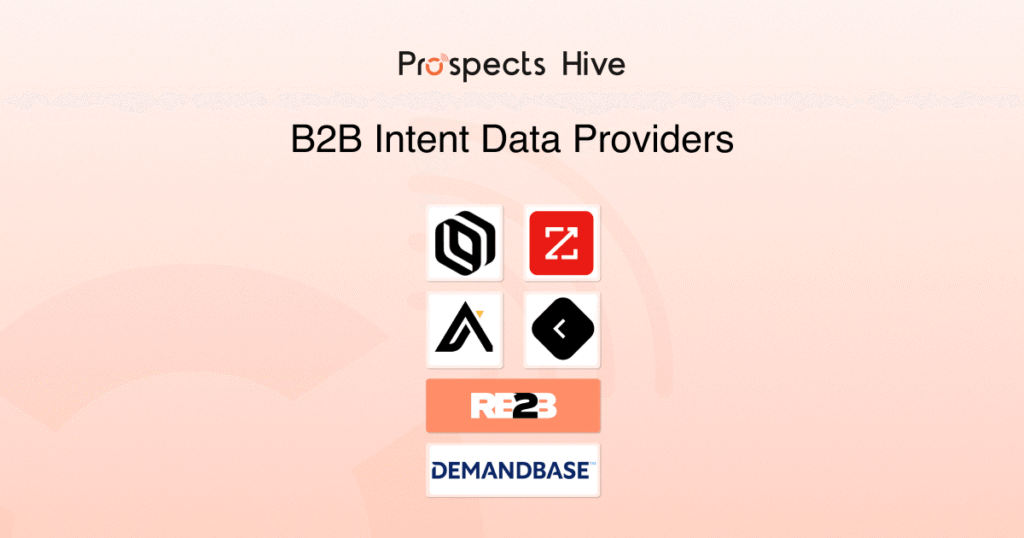
B2B Intent Data Providers
Intent Data & Signals

B2B Intent Data Providers (2026 Guide): How to Choose the Right One for Your GTM Motion

In 2026, B2B growth is no longer about volume. It’s about timing. Your buyers are researching long before they even speak to sales. The companies winning in 2026 aren’t guessing who might buy. They’re tracking who is already looking. That’s why B2B intent data providers have become central to modern GTM strategy.  Unlike traditional B2B data companies that sell static B2B contact data, today’s intent data platforms and buyer intent data tools reveal real-time buying signals.  The right buyer intent data provider doesn’t just give you names, it gives you momentum. In this blog, we’ll break down what B2B intent data really means, how it works behind the scenes, and how to evaluate the best B2B intent data providers for your GTM motion. Key Notes  In 2026, B2B growth is driven by timing, not volume. Intent data shows who’s actively researching your category. Intent data identifies accounts that are in-market and signaling buying intent. The right intent provider depends on your GTM motion, whether ABM, SDR outbound, PLG, or RevOps. Signal quality beats quantity. Evaluate source depth and behavior accuracy before investing. Intent data drives pipeline only when integrated with CRM, automation, and outbound workflows. Intent data is fuel. Without structured execution and prioritization, it won’t generate revenue. What Are B2B Intent Data Providers and Why They Matter? B2B intent data providers collect and analyze behavioral signals to identify companies actively researching specific topics, products, or solutions.  They matter because they help your GTM motion prioritize B2B intent data so that your outreach is focused on buyers who are more likely to convert. Now, what exactly is B2B intent data and why does it matter? B2B intent data is behavioral data that signals when a company is actively researching products or services within a specific category.  Instead of just identifying who fits your ideal customer profile, intent data B2B reveals who is currently in-market. Traditional B2B data vendors provide firmographic and demographic information: Company size Industry Revenue Job titles Email addresses This type of B2B contact data is essential for targeting. But it’s static. It tells you who your ideal customer is but not whether they’re ready to buy. Intent data B2B, on the other hand, captures behavioral signals that indicate purchase research.  It shows: Which accounts are reading content related to your category What topics they’re researching How frequently they’re engaging Whether their activity is increasing Reaching out when a buyer is actively researching increases response rates and shortens sales cycles. Without intent signals, even the most accurate B2B contact data becomes guesswork. In 2026, competitive advantage doesn’t come from having more data. It comes from having the right signals at the right time. And that’s exactly what modern buyer intent data providers deliver. This shift is why modern GTM teams are investing in: Intent data tools Advanced intent software AI-driven buyer intent software Integrated intent data platforms Because timing changes everything. Best 15+ B2B Intent Data Providers in 2026 (Quick Overview) Before we jump into the detailed review of the best B2B intent data providers, here is a quick overview to skim through: Intent Data Provider Free Trial Starting Price Best for Rating DemandBase One ❌ $18,000-$65,000+ per year Enterprise ABM teams running multi-channel intent programs. 4.4 ZoomInfo ✅ $14,995 to $15,000 per year Sales teams needing data plus light intent signals. 4.1 RB2B ✅ $79 /month Companies identifying anonymous website visitors in real time 4.5 Common Room ❌ $1k/month Product-led growth teams tracking community engagement signals. 4.5 Apollo.io ✅ $49 Per user per month, billed annually Startups combining prospecting, outreach, and basic intent. 4.5 Unify ✅ $1740 per month, billed annually Modern GTM teams automating signal-based outbound workflows. 5.0 6sense ✅ $25000/year Enterprise revenue teams using predictive, account-based selling. 4.4 LeadIQ ✅ $200/month SDR teams sourcing contacts directly from LinkedIn. 4.4 LeadFeeder ✅ $99/month Marketing teams revealing companies visiting their website. 4.3 Cognism ❌ $1,000 to $1,500 per month European-focused sales teams needing compliant contact data. 4.7 G2 ✅ $2,999/year SaaS vendors targeting high-intent comparison stage buyers. 4.7 Lead Forensics ✅ customized pricing B2B firms identifying anonymous website traffic at scale. 4.5 Maximise.ai ✅ $59/month AI-driven outbound teams prioritizing behavioral buying signals. 3.6 Bombara ❌ approximately $2,500 per month Teams targeting accounts researching specific industry topics. 4.4 Foundry ❌ customized pricing Tech vendors leveraging publisher-level content consumption intent. 4.3 Seamless ✅ $147/month High-volume outbound teams needing fast contact data. 4.4 Lusha ✅ $37.45 USD / month SMB sales teams who need to enrich contacts quickly. 4.0 SalesIntel ✅ $18,000/year for teams Best for teams wanting human-verified B2B contact data. 4.3 Lead Onion ✅ $100 per month Best for smaller teams tracking company-level website visitor activity. 4.2 TrustRadius ✅ $30k/product per year Best for vendors targeting bottom-funnel buyers reading in-depth reviews. 4.4 6 Best B2B Intent Data Providers (Deep Comparison) After a quick eye-check of tools, let’s discuss each of these in more detail to find out the best one for your GTM motion:  1. Demandbase Pricing: Although no fair trial is available, it offers custom enterprise pricing with starting price from $18,000-$65,000+ per year.  Best For: Enterprise ABM teams running multi-channel, account-based programs. Overview Demandbase is a full-scale account-based go-to-market platform designed for enterprise revenue teams. It combines account intelligence, advertising, sales insights, and intent data into a unified system. Instead of just giving you contact data, it focuses on identifying which accounts are actively researching your category and helps orchestrate coordinated engagement across marketing and sales. Key Intent Signals Third-party account-level topic intent First-party website engagement Buying group activity signals Predictive scoring based on account behavior Pros and Cons of DemandBase Pros Cons  Strong ABM orchestration Expensive for SMBs Enterprise-grade integrations Complex onboarding Deep account visibility Requires mature GTM team 2. ZoomInfo Pricing: Offers quote-based pricing, with annual contracts typically starting around $14,995–$15,000 for the Professional tier, $24,995+ for Advanced, and $35,995–$45,000+ for Elite. Best For: Sales teams needing both contact data and intent signals in one platform. Overview ZoomInfo is primarily a large B2B

GDPR rules for Cold Emailing
Cold Email & Outreach

GDPR Rules for Cold Emailing: What Every B2B Outbound Team Needs to Know

GDPR does not ban cold email. It regulates how you collect, store, and use the personal data behind it. Understanding the GDPR rules for cold emailing comes down to one distinction: if your outreach targets other businesses, you have a workable path forward under legitimate interest. If you are emailing individual consumers, you almost always need consent first. That distinction is the single most important thing to understand before you send another cold email to anyone in the EU or EEA. Key GDPR Rules for Cold Emailing at a Glance Cold emailing B2B contacts is legal under GDPR’s legitimate interest basis. B2C cold email generally needs prior consent. You need a documented Legitimate Interest Assessment (LIA), not just an opt-out link. Country rules differ. Germany is stricter than France or the UK. Non-compliance fines can reach €20 million or 4% of global annual revenue, whichever is higher. Does GDPR Actually Ban Cold Emailing? No, it does not. This is the most common myth around GDPR and outbound sales, and it stops a lot of teams from running perfectly legal campaigns. What GDPR actually does is set rules for processing personal data. A cold email involves personal data the moment it goes to a named individual. So GDPR applies, but applying it does not mean forbidding. Most B2B teams rely on legitimate interest as their legal basis. That means you can email a business contact without asking for consent first, as long as your outreach is relevant to their role and you follow a specific set of conditions. We will cover those conditions below. 💡 Also Read: Is Cold Email Illegal? The Complete Legal Guide for 2026 When Does GDPR Even Apply to Your Cold Emails? GDPR applies to your outreach if any of the following are true: Your prospect is based in the EU or EEA, regardless of where your company is located. You are processing personal data, meaning information that can identify a specific person. You use tools or platforms that track or profile individuals in the EU. Here is where it gets practical. Not every email address counts as personal data. info@company.com is a generic address. It is not tied to one identifiable person, so GDPR’s personal data rules generally do not apply to it. jane.doe@company.com identifies a specific individual. This counts as personal data, and GDPR applies. If your list is full of named work emails, assume GDPR applies and plan your outreach accordingly. The Legal Basis You Need Before You Hit Send Consent vs. Legitimate Interest, and Why Most B2B Teams Pick the Latter GDPR gives you 6 possible legal bases for processing personal data. 2 matters for cold email. Consent means the person actively agreed to be contacted. It has to be freely given, specific, and clearly documented. It is the safest basis, but it does not scale for cold outreach, since you cannot get consent from someone before you have contacted them. Legitimate interest lets you contact someone without prior consent, provided your reason for reaching out is genuine, relevant to their role, and does not override their right to privacy. This is the basis most B2B outbound teams rely on, and it is the reason cold email remains viable at scale. 💡 Also Read: AI GTM in Outbound Marketing: The 2026 Playbook for Scalable Growth  The 3-Part Test for Legitimate Interest Before you can rely on legitimate interest, your outreach needs to pass 3 checks: Relevance. Does your offer directly relate to the recipient’s professional role? Necessity. Is email the most direct way to reach them for this purpose? Balancing. Would a reasonable person in that role expect this kind of email, or would they find it intrusive? A quick way to apply this test: Scenario Pass the test? Pitching sales automation software to a Head of Sales Yes Pitching HR software to an HR Director Yes Pitching office cleaning services to a Software Engineer No Pitching generic SEO services to an unrelated department head No If the connection between your offer and the recipient’s job is a stretch, it will not hold up under this test. What a Legitimate Interest Assessment (LIA) Actually Looks Like An LIA is the documentation that proves you thought this through before sending, not after a complaint lands. A basic LIA should record: Your purpose for the outreach, stated specifically (for example, “offering a sales engagement tool to sales leaders at mid-size SaaS companies”) Why this is necessary and proportionate for that purpose Why the recipient’s privacy rights do not override your interest in reaching out One detail matters here. Document this per campaign, not once as a company-wide checkbox. A campaign targeting CFOs about financial software needs its own reasoning, separate from a campaign targeting IT Directors about security tools.  A one-time blanket LIA does not hold up if a regulator asks you to justify a specific send. The Non-Negotiables Every Compliant Cold Email Needs Every cold email you send under legitimate interest should include these 4 elements. Say Who You Are: State your name, your company name, and include a physical business address in your signature. Do not hide behind a generic sender name or a no-reply address. Say How You Found Them: Tell the recipient how you got their information. A line like “I came across your profile on LinkedIn” or “I found your details on your company’s team page” builds trust and shows transparency, which GDPR requires. Link to Your Privacy Policy: Include a link showing how your company collects, stores, and processes personal data. This does not need to be in the email body itself, but it should be one click away. Give Them an Easy Way Out: Every email needs an obvious opt-out. This can be as simple as “reply STOP to be removed” or a dedicated unsubscribe link. Whatever method you choose, it has to work the first time. 💡 Also Read: Cold Email Templates Guide for B2B Teams  What Happens the Moment Someone Opts Out GDPR gives recipients

How to find emails for cold emailing
Cold Email & Outreach

How to Find Emails for Cold Emailing (Without Killing Your Deliverability)

If you’re figuring out how to find emails for cold emailing, it comes down to three things. Define who you want to reach. Source their emails through tools or manual research. Verify every address before you send. Skip any of these steps and your outreach falls apart. A list of the wrong people gets ignored. A list of guessed emails that were never checked bounces and damages your sender reputation. This guide walks through the full process, the tools worth using, and the mistakes that quietly kill reply rates. Key Notes Define your ideal customer profile before you search for a single email Use tools like Apollo, Hunter, or Snov.io for scale. Use manual research for small, high-value lists Guess the email pattern when you have a name and a domain but no tool access Never skip verification. Keep your bounce rate under a few percent Stay compliant with CAN-SPAM, GDPR, and the terms of service of any platform you pull data from Start With Who You’re Actually Trying to Reach Before you open a single tool, decide who is worth emailing. This step gets skipped more than any other, and it is the reason most cold email lists underperform. Building Your Ideal Customer Profile Your ideal customer profile (ICP) narrows your search before it starts. Define it by: Industry Company size Revenue Technology stack Job title Decision-making authority “Marketing professionals” is not a target. “Marketing Directors at SaaS companies with 50 to 500 employees” is. The narrower your ICP, the more relevant your list, and the higher your reply rate tends to be. Turning Your ICP Into a Company List Once you know who you’re targeting, build a list of companies that match. Good sources include: LinkedIn Google search Crunchbase, for funded startups by industry and stage Clutch or GoodFirms, for agencies and service providers Google Maps, for local businesses AngelList (Wellfound), for startups and tech companies Record the company name, website, industry, and employee count as you go. This becomes the backbone of your prospect list. 💡 Also Read: 20+ Best LinkedIn Automation Tools (2026): Ranked by Safety, Features & ROI  Finding the Right Person at the Company A company is not a contact. You still need a real person to email. Common Job Titles Worth Targeting Depending on your offer, look for: Founder or Owner CEO VP Sales or Sales Director Marketing Director or Head of Growth Operations Manager Why LinkedIn Is Still the Fastest Way to Identify Decision-Makers LinkedIn Sales Navigator remains one of the most direct ways to find decision-makers at scale. It lets you filter by: Industry Company size Seniority Location Keywords You can build and save lead lists directly inside the tool, which makes it easier to keep your targeting consistent across a campaign instead of starting over each time. 💡 Also Read: How Do I Develop an Email List from LinkedIn Contacts? The Tools That Actually Find the Email Address Once you know who you’re targeting, you need the actual email address. This is where dedicated tools come in. 💡 Also Read: Cold Emailing Tools: Best Software for Scalable B2B Outbound  All-in-One B2B Databases These platforms combine contact data with company data, so you can filter and export in one place.Domain and Pattern-Based Finders These tools work best when you already know a company’s domain or a specific person’s name. Tool Best For Hunter.io Finding emails by domain, pattern detection Snov.io Email finding, verification, and campaigns Voila Norbert Single-contact lookups Findymail Verified B2B email discovery RocketReach Executive and professional contacts Apollo’s own data is broad but not flawless. Independent reviews report bounce rates in the 15 to 35% range depending on industry and geography, which is why verification still matters even with a paid database. Domain and Pattern-Based Finders These tools work best when you already know a company’s domain or a specific person’s name. Tool Best For Hunter.io Finding emails by domain, pattern detection Snov.io Email finding, verification, and campaigns Voila Norbert Single-contact lookups Findymail Verified B2B email discovery RocketReach Executive and professional contacts Hunter’s Domain Search works by crawling a company’s public web presence for existing email addresses, then detecting the pattern used across the rest of that domain. Its Email Finder, by contrast, takes a specific name and domain and returns a single predicted or verified address with a confidence score. Clay deserves a separate mention here. It’s not a standalone email finder. It’s a data enrichment and workflow automation platform that connects to more than 150 data providers, including Clearbit, Hunter, and Apollo, and lets you build automated workflows that pull, clean, and route contact data into a CRM or outreach sequence.  That’s why teams running outreach at scale tend to build around it rather than use it as a single-purpose lookup tool. Chrome Extensions That Pull Emails Right Off LinkedIn LinkedIn hides personal contact info by default, so extensions bridge that gap directly from a profile or search results page. ContactOut Kaspr Snov.io’s Chrome extension EmailChaser The workflow is simple. Find the prospect on LinkedIn, run the extension, and it surfaces an email tied to that profile. 💡 Also Read: Cold Email vs LinkedIn: The Real Outbound Performance Breakdown  No Tool? Here’s How to Guess (and Still Get It Right) If you don’t have access to a paid tool, or you’re working on a small, high-value list, you can often work out the email yourself. Cracking the Email Pattern Most companies use one consistent format across their whole team. Once you spot the pattern from one known email, you can apply it to everyone else at that company. john@company.com john.smith@company.com johnsmith@company.com jsmith@company.com j.smith@company.com Check a company’s “Team” or “About” page, a press release, or a public speaker bio. Any one confirmed email tells you the pattern for the rest. Google Search Tricks That Surface Public Emails A few search operators can surface emails that are already public but not indexed anywhere obvious: “Firstname Lastname” “@companydomain.com” site:companywebsite.com “contact” OR “email” These work because some pages, PDFs, or

is cold email illegal
Cold Email & Outreach

Is Cold Email Illegal? The Complete Legal Guide for 2026

So… Is Cold Email Actually Illegal? Here’s the Honest Answer: You just hit send on your first cold email sequence. Maybe it was 50 emails. Maybe 500. And now, somewhere in the back of your mind, a little voice is asking: “Wait… was that legal?” You’re not alone. Thousands of founders, sales reps, and marketers ask this exact question every single day. Here’s the good news: cold email is not illegal. But (and this is important) the line between legal and illegal is thinner than most people think. Whether your cold email is legal depends on 3 things: (whom, where, how) At Prospects Hive, we help sales teams prospect smarter AND safer. That’s exactly why we wrote this guide. By the end, you’ll know exactly what the law says, what it costs to get it wrong, and how to keep every email you send 100% compliant. Before You Read: 5 Things You Need to Know Cold email is legal in most countries, but rules vary by location. The US (CAN-SPAM) uses an opt-out model; no consent is needed before sending. The EU (GDPR) and Canada (CASL) are stricter, consent or legitimate interest required The biggest legal risk isn’t your subject line; it’s where your list came from Email authentication (SPF, DKIM, DMARC) is now a hard legal and technical requirement. Is Cold Email Illegal? No. Cold email is not illegal. In most countries, sending an unsolicited email to a business contact for a real, relevant reason is completely lawful. But legality is conditional. Cold email crosses the line in the following situations: Your subject line is deliberately misleading. You ignore unsubscribe requests. Your email list was obtained illegally or unverifiably. You’re sending mass, impersonal blasts with no relevance to the recipient Here’s what most people don’t realize: if you’re emailing relevant people, identifying yourself honestly, and letting people opt out, you’re already doing it right. The law isn’t trying to stop cold emails. It’s trying to stop spam. And those 2 things are very different. Cold Email vs. Spam: They’re Not the Same Thing Most people think cold email and spam are the same. They’re not, and the law agrees. Spam meets all 3 of these legal conditions: Sent in bulk to a large list Not personalized; the same message works for anyone. Unsolicited; the recipient never gave any form of consent. A single, personalized, relevant email to a researched contact? That is not spam under any major legal framework in the world. Here’s a simple breakdown: Factor Cold Email Spam Targeting Specific, researched Mass, random Personalization Tailored to recipient Generic copy-paste Sender identity Transparent Hidden or fake Opt-out Clearly provided Missing or broken Data source Verifiable Bought or scraped Spam complaints don’t just create legal risk; they also create reputational risk. They destroy your deliverability, too. Gmail, Outlook, and Yahoo now use real-time complaint rates to decide where your emails land. If your complaint rate exceeds 0.3%, your emails start going to spam or being blocked entirely. Staying legally compliant and landing in the inbox are one and the same. How to Avoid Getting Marked as Spam Only email people who would genuinely benefit from your offer Personalize every single email. Do not copy-paste blasts. Warm up new sending domains before scaling. Avoid trigger words like “free,” “urgent,” or “guaranteed.” Stick to 3–4 follow-up emails per prospect. Always include a one-click unsubscribe and honor it immediately. 💡Also Read: Cold Email Templates Guide for B2B Teams  Cold Email Laws Around the World Here’s the truth: the same email can be perfectly legal in one country and a 6-figure liability in another. Let’s break it down by region. 🇺🇸 United States: What CAN-SPAM Actually Says Notably, prior approval is not required. CAN-SPAM is an opt-out model, unlike global peers. Businesses in America can email contacts without prior consent if they follow the rules. Many senders may overlook this advantage. The 7 Rules You Cannot Ignore: Use accurate “From,” “To,” and “Reply-To” information. Never use deceptive subject lines. Identify the email as a commercial message. Include a valid physical mailing address. Provide a clear, working opt-out option. Honor opt-out requests within 10 business days You’re accountable even if you outsourced email delivery. What happens if you ignore these rules? The fine is up to $53,088 per individual email. For example, consider Verkada. In 2024, Verkada was fined $2.95 million, the largest CAN-SPAM penalty to date. The violation: missing unsubscribe links. They also received 20 years of mandatory FTC oversight. Two decades of scrutiny for a broken opt-out button. Often, the most expensive mistakes are also the most avoidable. 🇪🇺 European Union: What GDPR Actually Means for Cold Email First, let’s kill the biggest myth in email marketing: GDPR did NOT ban cold email. GDPR regulates how you handle and process personal data, and an email address like john@company.com qualifies as personal data. Most B2B senders in the EU use something called “legitimate interest.” To rely on legitimate interest, you need to pass 3 tests: Necessity test: Is email a reasonable way to do it? Balancing test: Do your interests outweigh the recipient’s right to privacy? Freelancers, sole traders, and independent consultants are legally classified as individuals under GDPR, not businesses. That means emailing a freelance designer in Frankfurt is treated as a consumer (B2C) cold email, not a B2B one. Different rules apply. Most senders don’t know this until it’s too late. To see the real-world impact of these rules, here are some actual fines that happened (2024–2025): BBVA (Spain): €2 million for SMS marketing without consent Unnamed SaaS company: Formal compliance order for buying a list with unverifiable data sourcing. They didn’t even send a deceptive email. The list purchase alone was the violation. 🇨🇦 Canada: CASL, the World’s Strictest Anti-Spam Law Canada plays by completely different rules. Under CASL, you cannot email first and apologize later. You need permission upfront, either express or implied consent. Express consent: The person actively agreed to receive emails from you Implied consent: You

What is Allbound Marketing
Business

What is Allbound Marketing: A Guide for Modern B2B Growth

B2B growth is no longer a 2-lane highway, it’s a convergence zone. For years, teams ran inbound and outbound as if they were “different worlds in B2B marketing” with different playbooks, different tools, and zero shared intelligence. Thus, growth feels busy but inconsistent. But modern buyers don’t move in straight lines anymore and your revenue engine can’t either. Now that’s where Allbound enters, not as an industry buzzword but as a model that unifies inbound, outbound, and partner-led growth into one coordinated system. No silos. No data black holes.  Instead of isolated campaigns, you build a full-funnel, signal-driven growth system that actually compounds. This blog helps you get started with allbound marketing as a system that connects inbound, outbound, data, and CRM into one unified engine to ramp up your B2B growth. TL;DR Allbound marketing combines inbound + outbound + data + CRM into one system It aligns sales and marketing around shared signals, data, and execution It replaces disconnected campaigns with a coordinated GTM strategy It uses intent data, automation, and multichannel marketing to drive results The goal isn’t more activity. It’s predictable revenue growth What is Allbound Marketing and Why it Matters? Allbound marketing is a modern B2B marketing strategy that combines: Inbound marketing (content, SEO, demand generation) Outbound marketing (cold outreach, SDR motions, LinkedIn outreach) Data layers (firmographic, technographic, behavioral data) CRM and automation systems All working together inside one integrated marketing and sales system. Instead of treating inbound and outbound as separate plays, Allbound connects them through: Buyer intent signals Lead scoring Website visitor tracking Multichannel execution Shared CRM visibility At its core, Allbound is not about channels. It’s about alignment + timing + system design. The Core Idea of Allbound Marketing The core idea of Allbound marketing is to connect every touchpoint instead of relying on a single channel. The goal is not just generating leads.mThe goal is creating a system where: signals trigger outreach, content builds trust, automation keeps follow-ups moving, CRM tracks everything, and sales focuses on conversations instead of manual admin. In short: Outbound creates attention. Inbound builds trust. Automation keeps momentum. CRM keeps context. Together, they create predictable pipeline growth. The Core 5 Components of Allbound Marketing To build a real Allbound strategy, you need more than channels. You need layers that form distinct components of a complete allbound marketing strategy.  Here are the 5 core components of allbound marketing,each forming an essential layer in your strategy: 1. Signal Layer Buyer intent signals Website visitor tracking Engagement data This tells you when to act. 2. Data & Enrichment Layer Firmographic data Technographic data Behavioral data This tells you who to target and how to personalize. 3. Execution Layer Content marketing Cold outreach LinkedIn outreach Social selling This is how you engage across touchpoints. Also Read: Combining Social Selling and Outbound: A Blueprint for B2B Growth 4. CRM & Automation Layer CRM (HubSpot, Attio) Automation workflows Lead scoring This ensures nothing breaks after first touch. 5. Measurement Layer Attribution models A/B testing Pipeline tracking This shows what actually drives revenue. How Allbound Marketing Works Allbound marketing works by connecting every major part of your growth system into one coordinated flow. Instead of running outbound, inbound, content, CRM, and follow-ups separately, Allbound brings them together so every touchpoint supports the next one. Here’s how the allbound system works: 1. Start With a Unified Data Foundation Allbound starts with clean, connected data. Most teams have prospect data spread across LinkedIn, CRM, website analytics, outreach tools, and spreadsheets. The problem is that none of it talks to each other. In an Allbound system, you bring together: ICP data firmographic data technographic data behavioural signals enriched contact data CRM activity For example, you can pull target accounts from LinkedIn Sales Navigator, enrich them through Clay, add company size, tech stack, hiring trends, funding updates, and buyer signals. Now you are not targeting random lists but context-rich accounts. 2. Connect Sales and Marketing Around the Same Buyer Journey Allbound only works when sales and marketing operate from the same system. That means both teams need shared visibility into: CRM activity lead scoring website visits content engagement outreach history pipeline stage For example, if a company visits your pricing page twice, that signal should appear inside the CRM and trigger the right sales follow-up. 3. Use Content to Build Familiarity Before Outreach Outbound works better when the prospect has already seen your thinking. That is where content creates air cover. Your LinkedIn posts, case studies, short-form insights, and thought leadership help prospects understand your expertise before they ever reply. For example, a prospect receives your cold email. Before replying, they tend to check your profile. If they see clear positioning, useful insights, and relevant content, your outreach feels less cold and more contextual. 4. Layer Multiple Touchpoints Across Channels Allbound is not single-channel marketing. It combines email, LinkedIn, content, website visits, retargeting, and CRM follow-ups into one connected motion. A simple flow might look like this: A prospect receives a cold email → sees your LinkedIn content → gets a connection request → visits your website → sees a relevant retargeting ad → receives a follow-up based on their engagement. That is how Allbound creates momentum. Also Read: Cold Emailing Tools: Best Software for Scalable B2B Outbound 5. Run Account-Based Plays Based on Signals Not every lead deserves the same level of attention. Allbound helps you prioritise accounts based on fit, timing, and intent. This is where you can leverage ABM and outbound together. For example, a SaaS company raises funding, starts hiring SDRs, and visits your website. Instead of sending generic outreach, you can personalise the message around their current growth stage, hiring activity, and likely pipeline challenges. Also read: How SaaS Companies Can Scale Faster by Combining ABM and Allbound Marketing This makes outreach more signal-driven, not random. 6. Measure What Actually Moves Pipeline Allbound is not measured by vanity metrics alone. Opens, clicks, and impressions can help, but they do not tell the full story.

What is a sales Funnel
GTM & Growth

What is a Sales Funnel? The Complete Beginner’s Guide

You’re getting traffic, running ads, and posting content. But sales still aren’t following. The problem might not be your product. It might be that you have no funnel. A sales funnel is the structured path that takes a stranger and turns them into a paying customer. Think of it as a filter: wide at the top, narrow at the bottom. Many people enter, but only the most interested ones convert. In this guide, you’ll learn exactly what a sales funnel is, how each stage works, real-world examples, and how to build one from scratch. Key Takeaways A sales funnel is a structured pathway that guides prospects from awareness to purchase, ensuring predictable growth. The 6 funnel stages: Awareness, Interest, Evaluation, Intent, Purchase, and Loyalty; each requires tailored tactics and optimization. Common mistakes such as weak messaging, poor follow-ups, or friction at checkout can cause funnel leakage and lost opportunities. Sales funnels differ from sales pipelines: funnels track conversion rates, while pipelines focus on seller actions. What is a Sales Funnel and Why Does it Matter? A sales funnel is a step-by-step model that maps your customer’s journey from first discovering your brand to making a purchase. It is called a “funnel” for a simple reason: a large number of people enter at the top, but only a fraction make it all the way to the bottom and buy. Not every person who sees your ad is ready to buy. Not every visitor who reads your blog is a qualified lead. The funnel helps you accept that and work with it. But here is where most businesses miss the point. A sales funnel is not just a marketing diagram. It is a model of human behavior. It reflects how people actually make decisions slowly, with research, comparison, and hesitation. Understanding that changes how you sell. Without a defined funnel, you are essentially winging it. You cannot tell if your messaging is failing at the awareness stage or if people are dropping off right before checkout. With a funnel in place, the picture changes completely. You can spot exactly where customers are dropping off and fix those weak points. Your marketing and sales teams stop working in silos. Marketing fills the top, sales close the bottom. You can set up automated email sequences that move leads through stages while you focus on other things. And once you know your conversion rate at each stage, you can forecast revenue with real confidence. 💡 The Ultimate Guide to Email Conversion Rate  The Stages of a Sales Funnel: What’s Actually Happening at Each Step? Every funnel has a story. Here is how it unfolds. Stage 1: Awareness (They Just Found You) This is the “handshake” stage. The prospect did not know you existed 5 minutes ago. Now they do. They found you through a Google search, a social media post, a YouTube video, a paid ad, or a friend’s recommendation. They have not made any commitment. They are simply aware. What the customer is thinking: “Hmm, this looks interesting. Let me see what this is about.” What works here: Blog posts and SEO content Short-form video (TikToks, Reels, YouTube Shorts) Infographics and social media posts Paid ads (Google, Meta) Word of mouth and referrals Your goal at this stage: Get noticed. Nothing more. Do not try to sell here. Stage 2: Interest (They’re Curious, Not Committed) At this stage, the prospect is paying attention. They clicked your link, read your blog, or followed your page. They are not ready to buy, but they want to know more. This is where the mindset shifts from passive to active. They start comparing. They read reviews. They consume your content to decide if you are worth their time. What the customer is thinking: “This might solve my problem. Let me dig deeper.“ What works here: Email newsletters How-to guides and tutorials Case studies Comparison content (“X vs. Y”) Webinars and free resources Your goal at this stage: Build trust and capture contact information. A lead magnet (a free guide, checklist, or template) offered in exchange for an email address is one of the most effective tools here. Stage 3: Consideration (They’re This Close to Buying) The prospect is serious now. They are not just browsing. They are evaluating. They are looking at your pricing page, reading your testimonials, and comparing you to competitors. This is where purchase intent is highest, and where most businesses lose deals by going quiet or failing to provide the right information. What the customer is thinking: “Is this the right choice for me? Can I trust them?“ What works here: Free trials and product demos Discount codes or limited-time offers Customer testimonials and case studies Detailed FAQ pages Live chat and direct sales outreach Your goal at this stage: Prove you are the best choice. Use trust signals and social proof to remove doubt. A strong, clear call to action (CTA) is essential. Stage 4: Action (The Finish Line) The prospect clicks “Buy Now.” The deal is done. They are officially a customer. But this stage is not just about celebration. It is about execution. A clunky checkout process, a confusing payment page, or a slow-loading site can kill a sale that was already won. What the customer is thinking: “Okay, I’m doing this. Please make it easy.“ What works here: Streamlined checkout process Multiple payment options Clear order confirmation and next steps Immediate onboarding or delivery Your goal at this stage is to remove every possible barrier to purchase. Friction is your enemy. Stage 5: Retention (The Stage Most Blogs Skip) Acquiring a new customer costs 5 times as much as retaining an existing 1. Yet most businesses pour all their energy into the top of the funnel and neglect what happens after the sale. Retention is where real profitability lives. A customer who buys 2x is more valuable than 2 customers who each buy 1x. And a customer who refers others? That is the flywheel model in action. The flywheel

GTM & Growth

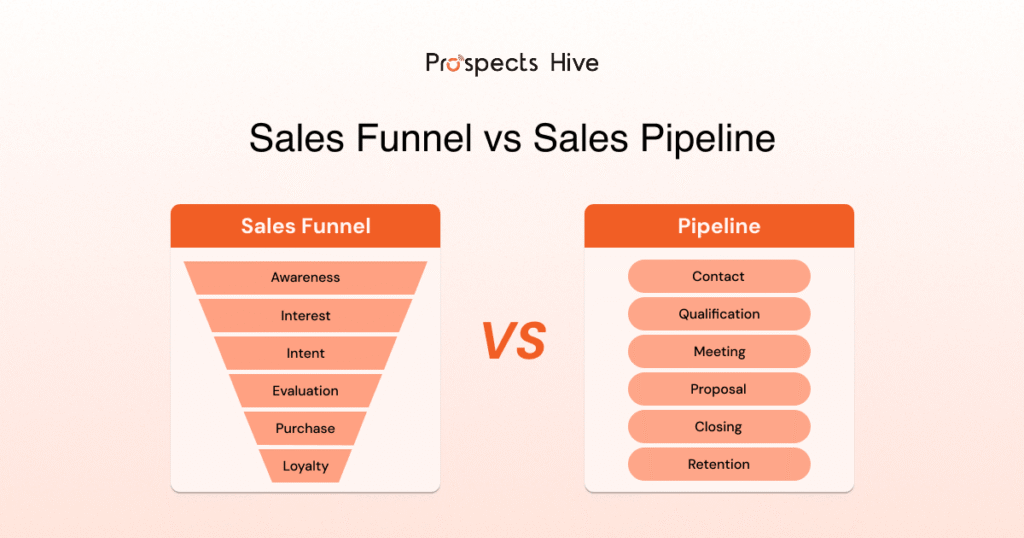
Sales Funnel vs Sales Pipeline: A Clear Guide for B2B Sales Teams

In B2B sales, the words ‘funnel’ and ‘pipeline’ get tossed around so often that it’s easy to think they mean the same thing. But while the terms sound alike, they play very different roles in your sales strategy and mixing them up can cost you heavily.  Knowing the difference when it comes to the sales funnel vs sales pipeline conversation can make or break your long-term growth results. Grasping the nuances is crucial for designing a sales strategy that keeps your prospects engaged from discovery to deal. In this article, we explain all the key differences between a sales pipeline and a funnel, as well as when to use which one and how these go hand in hand for the growth of any business.  Key Takeaways A sales funnel shows the buyer journey, while a sales pipeline shows the sales team’s deal process. Funnels track buyer behavior. Pipelines track sales activity. Funnels generate qualified leads. Pipelines turn those leads into revenue. Funnel metrics measure marketing performance. Pipeline metrics measure sales efficiency. Growth improves when marketing and sales align on definitions, metrics, and tools. Sales Pipelines vs Sales Funnels: Where the Difference Lies A sales funnel shows the buyer’s journey while a sales pipeline maps the internal sales steps reps take to close deals. While the sales pipeline and funnel are closely related, they serve distinct purposes and focus on different aspects of the sales process.  What is a Sales Funnel? The sales funnel is a customer-focused model that maps the buyer’s journey from awareness to purchase. It mainly: Represents how leads progress through different stages of interaction with your business. Highlights the buyer’s perspective rather than internal sales activities. Shows how prospects engage with your brand at each stage. Tracks how many leads remain as they move toward purchase. Helps identify gaps or drop-offs in the customer journey. The funnel highlights the prospect’s perspective and helps you understand where and why people drop off, enabling you to refine your marketing and sales strategies to improve conversions. Different Stages of the Sales Funnel Awareness This first, widest stage is where people learn about the company and what the product even is.  Awareness comes from blogs, social media posts, ads or short campaigns.  Interest This one is crucial if you want prospects to actually turn into customers. Usually it starts when you share more product detail using webinars, newsletters  or email sequences.  Testimonials and case studies help build that curiosity and trust at the same time.  Intent Here the prospect shows real intent to make a purchase, like adding to cart or asking for more information. This is where your sales team steps in, handles queries, and steers them towards buying.  Evaluation In the evaluation stage, prospects compare their options, weigh value and decide if your service matches their needs or not.  Sales teams may help with demonstrations, trial access, or deeper explanations that feel more clear.  Purchase This is the final and narrowest step where the prospect actually purchases the product. A smooth checkout, quick issue resolution, and helpful post-purchase benefits can really build loyalty in the post purchase stage. Loyalty Loyalty is more about keeping customers, through strong service and the ongoing post-purchase engagement.  It pushes repeat buying and long term brand advocacy, not just one time usage. For example, the funnel tracks how a prospect moves from discovering your product to making a purchase decision (e.g. first becoming aware, requesting a callback). What is a Sales Pipeline?  The sales pipeline is an essential internal step-by-step framework for managing and optimising your sales process.  It mainly:  Visualises the stages your sales team follows from initial contact to a closed deal. Focuses on your sales activities rather than customer behavior. Helps your team manage workflow efficiently. Enables prioritisation of efforts for higher conversion. Provides a clear way to measure performance and progress. Think of the pipeline as a map of actions your sales team must take to move opportunities through the process. It’s about what your team does to close more deals. Different Stages of the Sales Pipeline Lead Generation Attracting potential customers and turning them into paying customers Methods: cold emails, calls, social media engagement AI tools increasingly used for personalization and higher-quality leads Lead Qualification Filtering leads to assess potential based on time, need, and budget Helps eliminate low-potential prospects and saves time for the sales team Contact Reaching out to qualified leads to address queries and offer solutions Personalized communication increases conversion chances Shapes the prospect’s impression of future customer service Negotiation Customers may request discounts, perks, or propose terms Includes discussions on contracts, pricing, and delivery Sales team must balance persuasion with customer needs for a win-win outcome Closing the Deal Final stage where the prospect agrees to purchase A smooth closing process leaves the customer satisfied Builds the foundation for long-term business relationships For example, the sales pipeline tracks what the sales rep does to move a lead to the next stage (e.g. calls, appointments, formal proposals). Sales Funnel vs Sales Pipeline: Key Differences  Here is what sets a sales funnel apart from a sales pipeline:  Attribute Sales Funnel Sales Pipeline Perspective Customer’s Sales Representative’s Focus Buyer’s journey and decision-making Sales team activities and deal progression Stages Awareness, interest, evaluation, intent, purchase, loyalty Prospecting, lead qualification, meeting setup, proposal sent, negotiation, deal closing Visualization The gradual narrowing of leads through the journey The stages of various deals being worked on  Purpose Understand customer behavior and conversion rates Manage and track sales activities Goal Enhance the customer’s buying experience Optimize the sales team’s activities Tracking Conversion rates between stages, retention, satisfaction, CLV Revenue forecast, deals closed, sales performance metrics Tools Marketing automation platform, content management system, sales engagement platform CRM (Customer Relationship Management) system, sales enablement tools Both of these provide incredible value for sales team efficiency, but the real magic happens when your sales team combines them together.  In doing this, the sales team gains a 360-degree view of your sales process empowering your team

GTM Automation for Investment Firms
GTM & Growth

GTM Automation for Investment Firms: The 2026 Playbook PE, VC & Hedge Funds Are Actually Using

The average deal cycle for an investment firm runs about 14 months without automation. That is a long time to rely on spreadsheets, manual follow-ups, and gut instinct. Here is the reality: your competitors are not just working harder. They are building systems that work while their analysts sleep. GTM automation for investment firms is not a buzzword. It is a real operating shift happening across private equity, venture capital, and hedge funds right now. Firms that get this right close deals faster, engage LPs more consistently, and build the kind of revenue infrastructure that buyers reward at exit. This guide breaks down how it works, what tools are actually worth using, and where to start if you are building from scratch. Quick Wins box Automated nurture reduces deal cycles by roughly 30%.  AI-scored ICP lists generate 3 to 5 times more qualified leads than manual database searches. The modern GTM stack runs on 4 layers: Data, Research, Engagement, and CRM. Investment GTM is not like SaaS GTM. Relationship cycles are longer, compliance is real, and timing matters more than volume. The right starting sequence: CRM setup first, then ICP scoring, then signal monitoring, then outbound sequences. What is GTM Automation for Investment Firms, and Why Does It Feel Different? GTM automation for investment firms means using software, AI workflows, and data systems to handle the repeatable parts of deal sourcing, investor outreach, fundraising, and relationship management. But here is what most general guides miss: investment GTM is a different animal. A SaaS company can blast 10,000 cold emails and convert 2%. That math works there. It does not work when you are trying to get a founder to take your call or an LP to wire $50 million. PE, VC, and Hedge Funds Each Have Different GTM Needs Firm Type Primary GTM Goal Key Relationship Private Equity Deal origination, add-on sourcing Founders, M&A advisors, intermediaries Venture Capital Early-stage deal flow, founder access Founders, co-investors, scouts Hedge Funds LP capital, prime broker relationships Institutional LPs, family offices, allocators Each of these firms needs a different automation approach. The signals that matter are different. The compliance constraints are different. And the relationship depth required before any transaction closes is much higher. 💡Signal Based Selling: How Modern GTM Teams Build Pipeline Without Guesswork The 12 to 18 Month Reality is, most B2B SaaS deals close in weeks. Investment transactions close in quarters or years. That changes everything about how you automate. Your automation cannot just focus on conversion. It has to maintain presence, build credibility, and deliver value consistently over a very long runway. Compliance is also real here. Financial services firms operate under SEC, FINRA, and other regulatory frameworks. Any outreach automation has to account for supervised communications, recordkeeping requirements, and consent management. Ignoring this is not a shortcut. It is a liability. The 4-Layer GTM Automation Stack That Modern Investment Firms Are Building Right Now Think of your GTM automation infrastructure as 4 layers stacked on top of each other. Each one feeds the next. Layer 1: The Data Layer (Waterfall Enrichment) This is your foundation. Without clean, complete data, every automation downstream produces garbage. Modern firms use “waterfall” enrichment logic. If ZoomInfo does not have a founder’s mobile number or a company’s latest funding round, the system automatically queries 50 or more additional sources until it finds a match. Tools like Clay and Databar do this natively. No single provider has everything. The waterfall approach ensures you do not stop at the first dead end. Layer 2: The Research Layer (AI Agents) Instead of analysts spending hours browsing LinkedIn and reading news alerts, AI agents now do continuous research. These agents scan recent news articles, GitHub commit activity, patent filings, and job postings. They score companies against your specific investment thesis. They run 24 hours a day without taking a lunch break. Tools like Perplexity API or Claude Code can be connected to your research pipeline to surface relevant targets in real time. Layer 3: The Engagement Layer (Signal-Based Outreach) This is where most firms get it wrong. They still send outreach based on cold lists. The better approach: trigger outreach based on live signals. A key executive hire. A competitor losing market share. A mid-market firm switching from a legacy ERP to a cloud system. These signals tell you that a company is at an inflection point. Platforms like Smartlead and Sendr enable signal-triggered sequences. You define the event. The system fires the outreach within 24 hours. Layer 4: The CRM Layer (Intelligence Hub) Your CRM is no longer just a database. In 2026, it is an AI-native intelligence hub. Attio and HubSpot now automatically record meeting insights and update deal stages without manual entry. You come out of a call. The system logs it, extracts the key points, and moves the deal to the next stage. That means your pipeline data is actually accurate. Which means your reporting is actually useful. 💡 10+ Best CRM for Outbound Sales in 2026: The Ultimate Decision Framework The Core Use Cases for GTM Automation in Investment Firms This is the most practical section. Here is where automation actually creates leverage. Deal Sourcing and Origination Automation Manual database searches are a 2022 workflow. Here is what replaces them: Predictive company scoring: AI matches companies against your thesis criteria automatically. AUM range, sector, geography, growth signals, team background. Intent signal tracking: Monitor SEC filings, Crunchbase funding events, LinkedIn job postings, and web traffic changes for trigger events.  Founder and company monitoring: Set persistent watches on target companies. Get alerted when something changes. Enrichment workflows: Pull contact data, firmographics, and technographics automatically as new targets are identified. Automated prioritization: Score and rank targets so your partners spend time on the highest-fit opportunities first. The result: your team stops hunting and starts responding to a ranked queue of warm targets. Investor Relations and LP Outreach Automation Fundraising communication is one of the highest-leverage areas to automate because it is also one of the

How Investment Firms Use Content to Generate Deal Flow
GTM & Growth

How Investment Firms Use Content to Generate Deal Flow (And Why Most Get it Wrong)

Imagine a founder building a Series A fintech startup. She opens Google and types: “best VC for fintech in the US.” One firm keeps appearing. Not because of paid ads. Not because of a warm intro. But because they published a detailed white paper on embedded finance 6 months ago. She reads it. Then read another piece. By the time she fills out their contact form, she already trusts them. That is how content generates deal flow in 2026. Investment firms no longer rely only on referrals, banker networks, or cold outreach. Content now plays a direct role in deal origination. The best firms use it to become visible before a founder is even thinking about fundraising. Strong content acts as both a trust signal and a filter. It attracts the right founders. And it quietly turns away the wrong ones. Key Takeaways at a Glance Insight What it Means Content is now a primary deal flow engine Not just a “nice-to-have” marketing tool anymore Information Gain beats volume Unique data and original perspectives win in 2026 Inbound deals from content are founder-direct Less competitive, higher fit Top firms treat content as investment work a16z, Sequoia, 25madison have content inside their investment function AI-digestible content is non-negotiable SearchGPT and Gemini now decide which firms get cited Why Content Has Become the New Deal Flow Pipeline For years, firms leaned on 3 main channels: referrals banker relationships outbound sourcing Those channels still matter. But they are no longer enough on their own. Founders now research investors before they reply, before they book, and often before they fundraise.  That shift has changed how investment pipeline development works. Visibility now starts online. Trust starts earlier. And investor brand positioning shapes opportunity sourcing long before formal outreach begins. Many firms still treat content like a volume game. They publish generic founder tips, broad market commentary, or recycled advice. That rarely helps with sourcing high quality deals. What works better is useful content with a differentiated point of view: niche market insights operator experience market intelligence content original data clear industry commentary This is where thought leadership becomes a competitive asset. Not because it looks smart. Because it helps the right founders decide, “These people understand my business.“ When a founder has already read your report, listened to your podcast, or seen your partner’s analysis on LinkedIn, the first conversation changes. You do not start from zero. The founder already understands: your investment thesis your sector focus your check size your view of the market your value-add beyond capital That shortens the trust cycle. It also improves qualification. In many cases, it leads to better inbound deal sourcing than cold outreach alone. Why Content Matters in Modern Deal Origination Founders do not just want capital. They want the right partner. Before they contact a firm, they often look for: sector understanding investment philosophy portfolio fit reputation expertise and authority proof of expertise That is why content matters in relationship-driven deal origination. It helps firms show what they know, how they think, and where they can help. Trust usually takes time. Content speeds that up. A well-written article, benchmark report, or founder education guide can do a lot of work before a meeting happens. It creates audience trust. It signals expertise. It shows that the firm has a real point of view. This is especially important in markets where founders have multiple funding options. Brand credibility can influence whether a founder responds, refers, or keeps your firm on the shortlist. High traffic means very little if the wrong companies keep reaching out. The best content supports: attract better-fit founders increase qualified deal flow improve pipeline quality reduce reliance on cold outreach strengthen sourcing efficiency Clear messaging also helps filter out poor-fit target companies. That saves time for both sides. How Content Actually Turns Into Deal Flow This is the basic engine. Step What happens Why it matters 1 Content creates visibility More founders and intermediaries discover the firm 2 Visibility builds credibility The firm becomes familiar and trusted 3 Credibility attracts inbound interest Founders, advisors, and strategic partners engage 4 Clear messaging filters for fit The right opportunities rise to the top 5 Better-fit conversations enter the pipeline Higher-quality meetings and stronger conversion potential Step 1: Content Creates Visibility Common channels include: blog posts newsletters LinkedIn podcasts reports webinars These formats expand organic search visibility and improve brand recall across niche audiences. Step 2: Visibility Builds Credibility Consistency matters. So does substance. Credibility comes from: thoughtful insights expertise-driven marketing original analysis clear editorial strategy value-first marketing This is how firms build investor credibility with founders, portfolio company executives, and deal intermediaries. Step 3: Credibility Attracts Inbound Interest Once a firm becomes known for useful insights, the market starts responding. That can mean: founders reach out directly investment bankers remember the firm advisors and brokers include the firm in conversations strategic partners share the content limited partners notice the firm’s public presence Step 4: Clear Messaging Filters for Fit Good content does more than attract attention. It clarifies fit. The best firms explain: stage sector geography check size support model target verticals This improves conversion-focused content and leads to more qualified opportunities. Step 5: Better-Fit Conversations Move Into the Pipeline This is where content starts to affect the acquisition pipeline. The results often include: warmer founder outreach faster qualification stronger relationships more relevant investment opportunities better pipeline development The Content Formats Investment Firms Use Most Different formats do different jobs. The strongest content distribution strategy uses several, not one. Thought Leadership Thought leadership content helps firms explain how they think. Examples: investment philosophy deep-dives partner-authored essays market frameworks industry commentary long-form content around major trends This type of content is effective because it helps with founder self-selection. Founders can quickly tell whether the firm’s view aligns with their business. Sector Reports and Original Research Original research can outperform almost any other format for authority building. Useful formats include: benchmark reports market maps funding trend reports sector

Best LinkedIn Outreach Strategies for Investment Firms
LinkedIn Prospecting

Best LinkedIn Outreach Strategies for Investment Firms (2026 Guide)

LinkedIn has over 1 billion members. But for investment firms, that number means nothing if your outreach lands in the ignored pile. The truth? Most investment firms are doing LinkedIn outreach wrong. They send generic messages, pitch too early, and treat a relationship-driven platform like a cold email blast. In 2026, that approach doesn’t just underperform. It actively damages your firm’s reputation. This guide breaks down what actually works. You will learn how to build credibility before you say a word, target the right people with precision, write messages that get replies, and measure what moves the needle. No fluff. No theory. Just a practical playbook built for firms that take relationship capital seriously. Quick-Win Summary Before diving into tactics, keep these fundamentals in your back pocket: LinkedIn outreach for investment firms is relationship-building, not sales automation The 300-character rule: brevity signals professionalism in 2026 Warm engagement before cold DMs consistently improves response rates Your profile credibility directly affects whether anyone replies Compliance is not optional it’s financial advertising regulations apply to LinkedIn outreach too If you remember nothing else from this guide, remember this: every touchpoint you create on LinkedIn should feel like the start of a long relationship, not a shortcut to a transaction. Best LinkedIn Outreach Strategies for Investment Firms Here is the full framework, in the order that actually matters. 1. Start With Your LinkedIn Presence Before You Reach Out This is not optional groundwork. It is the foundation everything else depends on. When a prospect receives your connection request, the first thing they do is visit your profile. If what they see does not inspire confidence, the conversation ends before it starts. Your Personal Profile is Your First Impression, Make it Count. Decision-makers respond to people, not company logos. Your personal profile carries more weight than your firm’s page ever will. Here is what needs to be in place: Professional headshot and banner that reflect your firm’s brand and focus Headline that communicates your investment focus, not just your job title About section that tells your firm’s story such as, who you back, why, and what you bring beyond capital Featured section with your pitch deck, notable portfolio companies, press mentions, or a relevant market report Consistent posting activity. An inactive profile signals an inactive firm. One thing many profiles still get wrong: the About section reads like a resume. Write it like you are talking to a founder or LP who just landed on your page for the first time. Make it clear, direct, and specific. Your Company Page Should Work as Hard as You Do Your company page is not just a placeholder. It is a 24/7 signal of what your firm stands for. Make sure it clearly communicates: Your investment thesis and what stage you focus on Industries served and geographic focus Portfolio highlights and notable wins Team expertise and what differentiates your firm A clear CTA whether that is a contact link, a newsletter sign-up, or an investor inquiry form Consider adding LinkedIn Showcase Pages if your firm serves distinct segments, for example, one for LP relations and another for founder-facing deal sourcing. 2. Know Exactly Who You are Talking to Mass outreach is expensive in time, reputation, and results. The firms getting the best response rates are the ones who know exactly who they want to reach and why. Build Your Ideal Investor Profile Before Anything Else Before you open Sales Navigator or draft a single message, define your Ideal Customer Profile (ICP). For investment firms, that means segmenting by: Fund stage (seed, growth, late-stage) Ticket size Sector thesis Geography Recent activity on LinkedIn Your outreach personas likely fall into one of these buckets: Persona What They Care About Limited Partners (LPs) Track record, thesis, team stability Founders Value-add beyond capital, network, sector expertise Family Offices Discretion, long-term alignment, trust Co-investors Deal structure, speed, strategic fit M&A Prospects Timing, valuation logic, exit path The tighter your ICP, the better your response rates. This is not an opinion. It is a pattern every serious outreach practitioner has observed. Use LinkedIn Sales Navigator Like a Pro Sales Navigator is the sharpest targeting tool available on LinkedIn. For investment firms doing serious deal flow or LP development, it is worth the investment. The filters that matter most for investment firms: Job title and seniority Geography and market Sector and firm type Company size and growth signals Activity level on LinkedIn Trigger events that make outreach feel timely instead of cold: Funding announcements Exits and acquisitions Market expansion announcements New senior hires or leadership changes Speaking appearances or podcast interviews Public commentary on industry trends Why trigger-based outreach earns better replies: When your message arrives right after a relevant event, it does not feel like cold outreach. It feels like a natural continuation of something already happening in their world. That is a completely different psychological experience for the recipient. Use Sales Navigator’s alert system to track these signals on your target list automatically. 💡 learn more about, Intent Signals: The Missing Link in Your B2B Sales Strategy 3. Warm Up the Relationship Before the Connection Request Here is an analogy that makes this click: think of LinkedIn like attending the same industry dinner a few times before asking someone for their business card. You would not walk up cold and launch into a pitch on the first night. You would show up, contribute to conversations, and let familiarity do its quiet work. The same logic applies here. Do not send a connection request as your first move. Run this sequence first: Day 1: Follow the target’s profile. Like a recent post that genuinely resonates with you Day 3: Leave a thoughtful comment that adds something to the conversation, not just “Great post!“ Day 6: Send the connection request. Reference the specific post you engaged with or a mutual connection Day 10: If connected, send a short soft message, share a relevant resource, no pitch attached This sequence transforms cold outreach into something

Scroll to Top