GTM & Growth

Explore the strategies, frameworks, and systems that drive go-to-market success. This category covers GTM planning, funnel strategy, allbound marketing, demand generation, growth operations, and scalable approaches for acquiring and converting B2B customers.

What is a sales Funnel
GTM & Growth

What is a Sales Funnel? The Complete Beginner’s Guide

You’re getting traffic, running ads, and posting content. But sales still aren’t following. The problem might not be your product. It might be that you have no funnel. A sales funnel is the structured path that takes a stranger and turns them into a paying customer. Think of it as a filter: wide at the top, narrow at the bottom. Many people enter, but only the most interested ones convert. In this guide, you’ll learn exactly what a sales funnel is, how each stage works, real-world examples, and how to build one from scratch. Key Takeaways A sales funnel is a structured pathway that guides prospects from awareness to purchase, ensuring predictable growth. The 6 funnel stages: Awareness, Interest, Evaluation, Intent, Purchase, and Loyalty; each requires tailored tactics and optimization. Common mistakes such as weak messaging, poor follow-ups, or friction at checkout can cause funnel leakage and lost opportunities. Sales funnels differ from sales pipelines: funnels track conversion rates, while pipelines focus on seller actions. What is a Sales Funnel and Why Does it Matter? A sales funnel is a step-by-step model that maps your customer’s journey from first discovering your brand to making a purchase. It is called a “funnel” for a simple reason: a large number of people enter at the top, but only a fraction make it all the way to the bottom and buy. Not every person who sees your ad is ready to buy. Not every visitor who reads your blog is a qualified lead. The funnel helps you accept that and work with it. But here is where most businesses miss the point. A sales funnel is not just a marketing diagram. It is a model of human behavior. It reflects how people actually make decisions slowly, with research, comparison, and hesitation. Understanding that changes how you sell. Without a defined funnel, you are essentially winging it. You cannot tell if your messaging is failing at the awareness stage or if people are dropping off right before checkout. With a funnel in place, the picture changes completely. You can spot exactly where customers are dropping off and fix those weak points. Your marketing and sales teams stop working in silos. Marketing fills the top, sales close the bottom. You can set up automated email sequences that move leads through stages while you focus on other things. And once you know your conversion rate at each stage, you can forecast revenue with real confidence. 💡 The Ultimate Guide to Email Conversion Rate  The Stages of a Sales Funnel: What’s Actually Happening at Each Step? Every funnel has a story. Here is how it unfolds. Stage 1: Awareness (They Just Found You) This is the “handshake” stage. The prospect did not know you existed 5 minutes ago. Now they do. They found you through a Google search, a social media post, a YouTube video, a paid ad, or a friend’s recommendation. They have not made any commitment. They are simply aware. What the customer is thinking: “Hmm, this looks interesting. Let me see what this is about.” What works here: Blog posts and SEO content Short-form video (TikToks, Reels, YouTube Shorts) Infographics and social media posts Paid ads (Google, Meta) Word of mouth and referrals Your goal at this stage: Get noticed. Nothing more. Do not try to sell here. Stage 2: Interest (They’re Curious, Not Committed) At this stage, the prospect is paying attention. They clicked your link, read your blog, or followed your page. They are not ready to buy, but they want to know more. This is where the mindset shifts from passive to active. They start comparing. They read reviews. They consume your content to decide if you are worth their time. What the customer is thinking: “This might solve my problem. Let me dig deeper.“ What works here: Email newsletters How-to guides and tutorials Case studies Comparison content (“X vs. Y”) Webinars and free resources Your goal at this stage: Build trust and capture contact information. A lead magnet (a free guide, checklist, or template) offered in exchange for an email address is one of the most effective tools here. Stage 3: Consideration (They’re This Close to Buying) The prospect is serious now. They are not just browsing. They are evaluating. They are looking at your pricing page, reading your testimonials, and comparing you to competitors. This is where purchase intent is highest, and where most businesses lose deals by going quiet or failing to provide the right information. What the customer is thinking: “Is this the right choice for me? Can I trust them?“ What works here: Free trials and product demos Discount codes or limited-time offers Customer testimonials and case studies Detailed FAQ pages Live chat and direct sales outreach Your goal at this stage: Prove you are the best choice. Use trust signals and social proof to remove doubt. A strong, clear call to action (CTA) is essential. Stage 4: Action (The Finish Line) The prospect clicks “Buy Now.” The deal is done. They are officially a customer. But this stage is not just about celebration. It is about execution. A clunky checkout process, a confusing payment page, or a slow-loading site can kill a sale that was already won. What the customer is thinking: “Okay, I’m doing this. Please make it easy.“ What works here: Streamlined checkout process Multiple payment options Clear order confirmation and next steps Immediate onboarding or delivery Your goal at this stage is to remove every possible barrier to purchase. Friction is your enemy. Stage 5: Retention (The Stage Most Blogs Skip) Acquiring a new customer costs 5 times as much as retaining an existing 1. Yet most businesses pour all their energy into the top of the funnel and neglect what happens after the sale. Retention is where real profitability lives. A customer who buys 2x is more valuable than 2 customers who each buy 1x. And a customer who refers others? That is the flywheel model in action. The flywheel

GTM & Growth

Sales Funnel vs Sales Pipeline: A Clear Guide for B2B Sales Teams

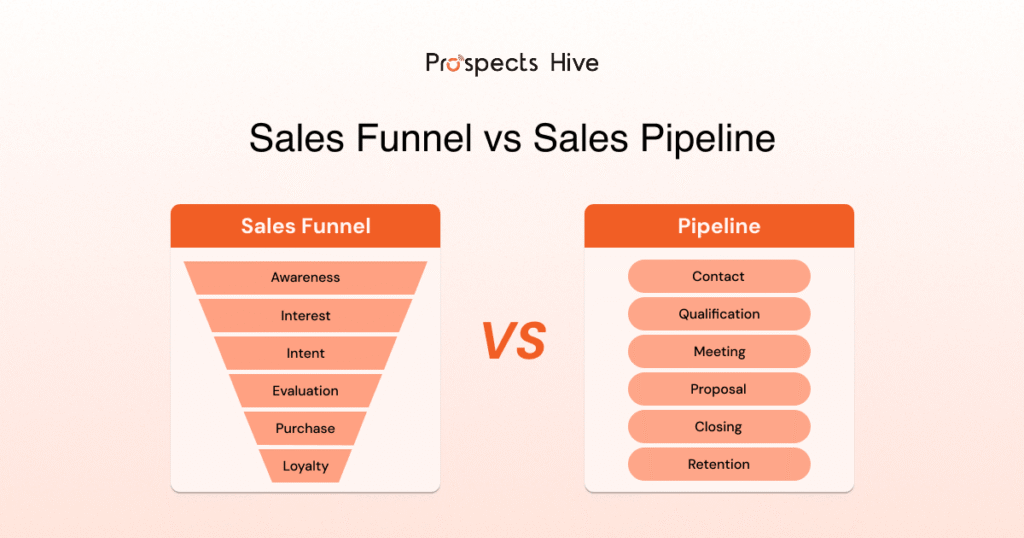
In B2B sales, the words ‘funnel’ and ‘pipeline’ get tossed around so often that it’s easy to think they mean the same thing. But while the terms sound alike, they play very different roles in your sales strategy and mixing them up can cost you heavily.  Knowing the difference when it comes to the sales funnel vs sales pipeline conversation can make or break your long-term growth results. Grasping the nuances is crucial for designing a sales strategy that keeps your prospects engaged from discovery to deal. In this article, we explain all the key differences between a sales pipeline and a funnel, as well as when to use which one and how these go hand in hand for the growth of any business.  Key Takeaways A sales funnel shows the buyer journey, while a sales pipeline shows the sales team’s deal process. Funnels track buyer behavior. Pipelines track sales activity. Funnels generate qualified leads. Pipelines turn those leads into revenue. Funnel metrics measure marketing performance. Pipeline metrics measure sales efficiency. Growth improves when marketing and sales align on definitions, metrics, and tools. Sales Pipelines vs Sales Funnels: Where the Difference Lies A sales funnel shows the buyer’s journey while a sales pipeline maps the internal sales steps reps take to close deals. While the sales pipeline and funnel are closely related, they serve distinct purposes and focus on different aspects of the sales process.  What is a Sales Funnel? The sales funnel is a customer-focused model that maps the buyer’s journey from awareness to purchase. It mainly: Represents how leads progress through different stages of interaction with your business. Highlights the buyer’s perspective rather than internal sales activities. Shows how prospects engage with your brand at each stage. Tracks how many leads remain as they move toward purchase. Helps identify gaps or drop-offs in the customer journey. The funnel highlights the prospect’s perspective and helps you understand where and why people drop off, enabling you to refine your marketing and sales strategies to improve conversions. Different Stages of the Sales Funnel Awareness This first, widest stage is where people learn about the company and what the product even is.  Awareness comes from blogs, social media posts, ads or short campaigns.  Interest This one is crucial if you want prospects to actually turn into customers. Usually it starts when you share more product detail using webinars, newsletters  or email sequences.  Testimonials and case studies help build that curiosity and trust at the same time.  Intent Here the prospect shows real intent to make a purchase, like adding to cart or asking for more information. This is where your sales team steps in, handles queries, and steers them towards buying.  Evaluation In the evaluation stage, prospects compare their options, weigh value and decide if your service matches their needs or not.  Sales teams may help with demonstrations, trial access, or deeper explanations that feel more clear.  Purchase This is the final and narrowest step where the prospect actually purchases the product. A smooth checkout, quick issue resolution, and helpful post-purchase benefits can really build loyalty in the post purchase stage. Loyalty Loyalty is more about keeping customers, through strong service and the ongoing post-purchase engagement.  It pushes repeat buying and long term brand advocacy, not just one time usage. For example, the funnel tracks how a prospect moves from discovering your product to making a purchase decision (e.g. first becoming aware, requesting a callback). What is a Sales Pipeline?  The sales pipeline is an essential internal step-by-step framework for managing and optimising your sales process.  It mainly:  Visualises the stages your sales team follows from initial contact to a closed deal. Focuses on your sales activities rather than customer behavior. Helps your team manage workflow efficiently. Enables prioritisation of efforts for higher conversion. Provides a clear way to measure performance and progress. Think of the pipeline as a map of actions your sales team must take to move opportunities through the process. It’s about what your team does to close more deals. Different Stages of the Sales Pipeline Lead Generation Attracting potential customers and turning them into paying customers Methods: cold emails, calls, social media engagement AI tools increasingly used for personalization and higher-quality leads Lead Qualification Filtering leads to assess potential based on time, need, and budget Helps eliminate low-potential prospects and saves time for the sales team Contact Reaching out to qualified leads to address queries and offer solutions Personalized communication increases conversion chances Shapes the prospect’s impression of future customer service Negotiation Customers may request discounts, perks, or propose terms Includes discussions on contracts, pricing, and delivery Sales team must balance persuasion with customer needs for a win-win outcome Closing the Deal Final stage where the prospect agrees to purchase A smooth closing process leaves the customer satisfied Builds the foundation for long-term business relationships For example, the sales pipeline tracks what the sales rep does to move a lead to the next stage (e.g. calls, appointments, formal proposals). Sales Funnel vs Sales Pipeline: Key Differences  Here is what sets a sales funnel apart from a sales pipeline:  Attribute Sales Funnel Sales Pipeline Perspective Customer’s Sales Representative’s Focus Buyer’s journey and decision-making Sales team activities and deal progression Stages Awareness, interest, evaluation, intent, purchase, loyalty Prospecting, lead qualification, meeting setup, proposal sent, negotiation, deal closing Visualization The gradual narrowing of leads through the journey The stages of various deals being worked on  Purpose Understand customer behavior and conversion rates Manage and track sales activities Goal Enhance the customer’s buying experience Optimize the sales team’s activities Tracking Conversion rates between stages, retention, satisfaction, CLV Revenue forecast, deals closed, sales performance metrics Tools Marketing automation platform, content management system, sales engagement platform CRM (Customer Relationship Management) system, sales enablement tools Both of these provide incredible value for sales team efficiency, but the real magic happens when your sales team combines them together.  In doing this, the sales team gains a 360-degree view of your sales process empowering your team

BFCM Checklist
GTM & Growth

The Ultimate BFCM Checklist: Week-by-Week, Phase-by-Phase

It’s mid-October. You open your laptop, check the calendar, and your stomach drops. Black Friday is 6 weeks away. You haven’t touched your inventory plan. Your email list hasn’t been warmed up. And your checkout hasn’t been tested since last spring. Sound familiar? Most ecommerce brands end up here. But the thing is, brands that win BFCM don’t have more resources. They just started earlier. This checklist moves you from reactive scrambling to controlled execution. Use it phase by phase, starting today. Key Notes Before You Start BFCM 2025 falls on November 28 to December 1 Best results come from starting prep 8 to 12 weeks early (September) This checklist is broken into 5 phases, each with a timeframe. Covers: Planning, Tech, Marketing, Execution, and Retention Built for: DTC brands, Shopify/WooCommerce merchants, and ecommerce marketing teams Phase 1: Build the Blueprint (8 to 12 Weeks Out: September) “You wouldn’t open a store on the busiest day of the year without unlocking the door first.” Before you think about discounts or ad creatives, you need a foundation. September is not too early. In fact, 50% of US consumers start holiday shopping as early as October. If your customers are already thinking about it, you need to be ahead of them. Phase 1 Checklists are,  Set revenue, AOV, and acquisition targets Audit last year’s performance data (including what failed) Identify 10 to 20 hero products Forecast demand and place supplier orders Define your discount structure (% off, BOGO, tiered, or bundles) Useful tools: Google Analytics 4, Triple Whale, Peel Insights Phase 2: Get Your Store “BFCM-Ready” (4 to 8 Weeks Out: October) “Your store is your storefront. If it’s slow, broken, or confusing, shoppers won’t wait around.” Site performance directly affects revenue. Ecommerce sites that load in 1 second convert 2.5x more visitors than those that take 5 seconds. That gap gets brutal during BFCM traffic spikes. Phase 2 Checklist are,  Run site speed audit (target: under 2 seconds) Fix broken links and remove unused apps Audit mobile checkout on multiple devices Load test for 5x to 10x normal traffic Enable one-click checkout options (Shop Pay, Apple Pay, BNPL) Test all discount codes in staging Set UTM parameters and tracking pixels (Meta, Google, TikTok) Phase 3: Fire Up Your Marketing Engine (4 to 6 Weeks Out: October to Early November) “November ad costs will make you cry. Build your audience now, while it’s still affordable.” Phase 3 Checklists are,  Launch Early Access pop-up for email and SMS capture Begin email warm-up sequence Build audience segments (VIP, lapsed, new) Pre-schedule all email and SMS sequences Finalize ad creative for Meta, Google, TikTok (mobile-first) A/B test offers and messaging with October traffic Map out a full content calendar with exact send dates Example: Campaign Timing Channel VIP Early Access teaser 2 to 3 weeks before Email + SMS Early Access launch 1 week before Email + SMS Black Friday launch Thursday night/Friday Email + SMS + Social Reminder send Saturday SMS Cyber Monday urgency Monday morning Email + SMS Last chance 2 hours before close Email + SMS Set up retargeting ads and abandoned cart flows Phase 4: Go Time: Running BFCM Weekend Like a Pro (November 28 to December 1) “This is the War Room phase. Your job now is to monitor, adapt, and execute, not build.” Phase 4 Checklists are,  Launch VIP Early Access Thursday evening Send Black Friday launch email and SMS Post across all social channels at launch Monitor site uptime every hour Hide out-of-stock products immediately Send cart abandonment SMS on Saturday and Sunday Re-engage non-openers with alternate subject lines Pivot Cyber Monday messaging to urgency/last-chance Send “2 hours left” final email before close Phase 5: The Sale Is Over. The Real Work Just Started. (December) “Anyone can run a sale. The brands that win long-term are the ones that keep those customers.” 59.71% of all BFCM purchases were made by new customers. That’s a massive opportunity. Most of them will never buy again unless you give them a reason to. ⚡how to increase customer lifetime value Phase 5 Checklists are, Send order confirmations and shipping updates Send founder thank-you email (non-promotional) Launch post-purchase upsell/cross-sell sequence Segment new BFCM buyers for nurture campaign Deploy bounce-back coupon valid for January Automate review requests (14 days post-delivery) Retarget BFCM cart abandoners Analyze CAC, ROAS, AOV, LTV, and conversion rate Document wins and losses for next year Plan January retention campaign Your BFCM Checklist is Only as Good as When You Start Using it Here’s the recap: Phase 1 (September): Set goals, audit data, pick hero products, lock inventory Phase 2 (October): Fix your site speed, mobile, and checkout Phase 3 (Oct to Early Nov): Build your list, warm up email, plan campaigns Phase 4 (BFCM Weekend): Monitor, adapt, and execute your plan Phase 5 (December): Retain new buyers and analyze everything The brands that win BFCM don’t have bigger budgets. They have better preparation. Bookmark this checklist, share it with your team, and start Phase 1 today, even if BFCM feels far away. At Prospects Hive, we help brands turn seasonal traffic into year-round revenue. Explore our resources on email marketing and Q4 growth strategy to keep the momentum going. FAQs 1. What does BFCM stand for? BFCM stands for Black Friday Cyber Monday 2. What is the most important part of a BFCM checklist? Technical readiness and marketing prep are equally critical. A slow or crashing site will kill your sales regardless of how strong your offer is. 3. How do I handle inventory for BFCM without overstocking? Use historical sales data to forecast demand. Identify your hero products and build a safety stock buffer of 15-20% above your projections. 4. What’s the difference between Black Friday and Cyber Monday strategy? Black Friday is about launch momentum and hero product deals. Cyber Monday is about urgency, last-chance messaging, and flash sales to convert final hesitant buyers. 5. How do I retain BFCM customers after the sale? Segment new buyers

Why GTM motion matters more than ever
GTM & Growth

Why GTM Motion Matters More Than Ever

A strong product is not enough anymore. In B2B, buyers have more options, more information, and less patience. They research on their own, involve more stakeholders, and expect a smoother buying experience across every touchpoint. That is why GTM motion matters more than ever. A go-to-market motion is not just a strategy slide. It is the operating model behind how a company attracts, converts, and grows customers. It shapes how marketing, sales, product, and customer success work together to drive revenue. When the motion is clear, growth becomes more repeatable. When the motion is weak, teams create noise, waste budget, and miss revenue. Before We Dive in Here’s What You Need to Know GTM motion turns strategy into execution Buyer journeys are now non-linear Sales, marketing, and product need tighter alignment Capital efficiency matters more than growth at any cost The best companies match motion to segment, deal size, and buying behavior What is a GTM Motion? A GTM motion is the practical system a company uses to acquire, convert, and retain customers. It includes: target segment messaging channels handoffs between teams sales process onboarding and expansion path In simple terms, it answers, How do we move customers from awareness to revenue in a repeatable way? GTM Strategy vs GTM Motion These terms are related, but not the same. Term What it answers GTM strategy Who we target, what we offer, and where we compete GTM motion How we sell, through which channels, with which teams and systems This distinction matters because many companies have a strategy, but no real operating model behind it. Why it Matters More Than Ever 1. Buyers Do not Move in a Straight Line Anymore The old funnel is less reliable than it used to be. Buyers now research on their own, compare vendors across multiple channels, and often talk to peers before they talk to sales. B2B buying groups typically involve 6-10 decision-makers. That alone changes how companies need to sell. What this means for GTM: 1 message is not enough 1 channel is not enough 1 persona is not enough A modern GTM motion helps teams respond to a more complex buying journey with the right content, proof, and outreach. 2. Attention is More Expensive Every market feels louder now. Outbound teams face lower response rates. Content teams compete with more AI-generated material. Paid acquisition costs keep pressure on budgets. 💡AI GTM in Outbound Marketing: The 2026 Playbook for Scalable Growth That changes the job. Growth is no longer about doing more activity. It is about building a motion that targets the right accounts, uses better signals, and improves conversion quality. For outbound-led teams, this is especially important. High-volume prospecting without targeting or context no longer performs the way it once did. Good outbound now depends on: clear ICP definition trigger-based outreach strong messaging close coordination with marketing fast feedback loops from sales calls and objections 💡 The Future of Outbound Sales: How to Adapt and Win 3. Efficiency Matters More Than Vanity Growth For years, many B2B teams could hide weak execution behind higher spend. That is harder now. Boards and leadership teams want: lower CAC stronger pipeline quality better conversion rates faster payback more predictable revenue A defined GTM motion improves efficiency because it reduces friction across the funnel. Instead of disconnected campaigns and random sales activity, teams work from the same playbook. 4. Product Advantage Alone is Not Enough A good product can still lose in the market. That happens when: positioning is unclear the wrong segment is targeted sales motions do not match deal complexity handoffs break down between teams proof of value comes too late In crowded categories, distribution and execution matter just as much as product quality. That is why GTM motion matters. It is what turns product value into market traction. 5. Alignment is Now a Growth Lever GTM is not owned by one team anymore. Marketing influences demand. Sales shapes conversion. Product affects adoption. Customer success drives retention and expansion. When these functions work in silos, revenue suffers. A strong GTM motion creates shared clarity around: who we target what problem we solve how we create demand when sales engages how success is measured This is not just an operations issue. It is a growth issue. 6. AI Raises the Stakes AI can speed up research, content creation, account prioritization, and workflow automation. But AI does not fix a broken motion. If targeting is weak, AI scales weak targeting. If messaging is generic, AI scales generic messaging. If teams are disconnected, AI adds more activity, not more traction. The real opportunity is not automation alone. It is better orchestration. Teams that win use AI to support a strong GTM foundation, not replace it. The Main Types of GTM Motion Different companies need different motions. Here is a simple view: GTM motion Best fit Main advantage Product-led High-volume, lower-friction products Fast adoption and lower sales cost Sales-led Complex B2B deals and high ACV Better for multi-stakeholder buying Founder-led Early-stage startups Fast feedback and strong market learning Partner-led New regions or verticals Faster trust and reach Community-led Niche or trust-driven categories Strong engagement and retention Hybrid Companies serving multiple segments Flexibility across deal sizes and journeys In practice, many companies do not rely on one motion alone. A SaaS company may use: PLG for SMB acquisition sales-led for enterprise partner-led for expansion That mix often works better than forcing one motion across every segment. How to Tell if Your GTM Motion Needs a Reset Here are common warning signs: pipeline volume is up, but revenue is flat CAC keeps rising sales says leads are weak marketing says sales follow-up is poor win rates drop in later stages prospects understand the product, but not the business value teams keep changing tactics without fixing the system If these patterns show up, the issue may not be effort. It may be motion. GTM Motion isn’t a Launch Tactic Anymore  GTM motion matters more than ever because growth is harder,

GTM Automation for Investment Firms
GTM & Growth

GTM Automation for Investment Firms: The 2026 Playbook PE, VC & Hedge Funds Are Actually Using

The average deal cycle for an investment firm runs about 14 months without automation. That is a long time to rely on spreadsheets, manual follow-ups, and gut instinct. Here is the reality: your competitors are not just working harder. They are building systems that work while their analysts sleep. GTM automation for investment firms is not a buzzword. It is a real operating shift happening across private equity, venture capital, and hedge funds right now. Firms that get this right close deals faster, engage LPs more consistently, and build the kind of revenue infrastructure that buyers reward at exit. This guide breaks down how it works, what tools are actually worth using, and where to start if you are building from scratch. Quick Wins box Automated nurture reduces deal cycles by roughly 30%.  AI-scored ICP lists generate 3 to 5 times more qualified leads than manual database searches. The modern GTM stack runs on 4 layers: Data, Research, Engagement, and CRM. Investment GTM is not like SaaS GTM. Relationship cycles are longer, compliance is real, and timing matters more than volume. The right starting sequence: CRM setup first, then ICP scoring, then signal monitoring, then outbound sequences. What is GTM Automation for Investment Firms, and Why Does It Feel Different? GTM automation for investment firms means using software, AI workflows, and data systems to handle the repeatable parts of deal sourcing, investor outreach, fundraising, and relationship management. But here is what most general guides miss: investment GTM is a different animal. A SaaS company can blast 10,000 cold emails and convert 2%. That math works there. It does not work when you are trying to get a founder to take your call or an LP to wire $50 million. PE, VC, and Hedge Funds Each Have Different GTM Needs Firm Type Primary GTM Goal Key Relationship Private Equity Deal origination, add-on sourcing Founders, M&A advisors, intermediaries Venture Capital Early-stage deal flow, founder access Founders, co-investors, scouts Hedge Funds LP capital, prime broker relationships Institutional LPs, family offices, allocators Each of these firms needs a different automation approach. The signals that matter are different. The compliance constraints are different. And the relationship depth required before any transaction closes is much higher. 💡Signal Based Selling: How Modern GTM Teams Build Pipeline Without Guesswork The 12 to 18 Month Reality is, most B2B SaaS deals close in weeks. Investment transactions close in quarters or years. That changes everything about how you automate. Your automation cannot just focus on conversion. It has to maintain presence, build credibility, and deliver value consistently over a very long runway. Compliance is also real here. Financial services firms operate under SEC, FINRA, and other regulatory frameworks. Any outreach automation has to account for supervised communications, recordkeeping requirements, and consent management. Ignoring this is not a shortcut. It is a liability. The 4-Layer GTM Automation Stack That Modern Investment Firms Are Building Right Now Think of your GTM automation infrastructure as 4 layers stacked on top of each other. Each one feeds the next. Layer 1: The Data Layer (Waterfall Enrichment) This is your foundation. Without clean, complete data, every automation downstream produces garbage. Modern firms use “waterfall” enrichment logic. If ZoomInfo does not have a founder’s mobile number or a company’s latest funding round, the system automatically queries 50 or more additional sources until it finds a match. Tools like Clay and Databar do this natively. No single provider has everything. The waterfall approach ensures you do not stop at the first dead end. Layer 2: The Research Layer (AI Agents) Instead of analysts spending hours browsing LinkedIn and reading news alerts, AI agents now do continuous research. These agents scan recent news articles, GitHub commit activity, patent filings, and job postings. They score companies against your specific investment thesis. They run 24 hours a day without taking a lunch break. Tools like Perplexity API or Claude Code can be connected to your research pipeline to surface relevant targets in real time. Layer 3: The Engagement Layer (Signal-Based Outreach) This is where most firms get it wrong. They still send outreach based on cold lists. The better approach: trigger outreach based on live signals. A key executive hire. A competitor losing market share. A mid-market firm switching from a legacy ERP to a cloud system. These signals tell you that a company is at an inflection point. Platforms like Smartlead and Sendr enable signal-triggered sequences. You define the event. The system fires the outreach within 24 hours. Layer 4: The CRM Layer (Intelligence Hub) Your CRM is no longer just a database. In 2026, it is an AI-native intelligence hub. Attio and HubSpot now automatically record meeting insights and update deal stages without manual entry. You come out of a call. The system logs it, extracts the key points, and moves the deal to the next stage. That means your pipeline data is actually accurate. Which means your reporting is actually useful. 💡 10+ Best CRM for Outbound Sales in 2026: The Ultimate Decision Framework The Core Use Cases for GTM Automation in Investment Firms This is the most practical section. Here is where automation actually creates leverage. Deal Sourcing and Origination Automation Manual database searches are a 2022 workflow. Here is what replaces them: Predictive company scoring: AI matches companies against your thesis criteria automatically. AUM range, sector, geography, growth signals, team background. Intent signal tracking: Monitor SEC filings, Crunchbase funding events, LinkedIn job postings, and web traffic changes for trigger events.  Founder and company monitoring: Set persistent watches on target companies. Get alerted when something changes. Enrichment workflows: Pull contact data, firmographics, and technographics automatically as new targets are identified. Automated prioritization: Score and rank targets so your partners spend time on the highest-fit opportunities first. The result: your team stops hunting and starts responding to a ranked queue of warm targets. Investor Relations and LP Outreach Automation Fundraising communication is one of the highest-leverage areas to automate because it is also one of the

How Investment Firms Use Content to Generate Deal Flow
GTM & Growth

How Investment Firms Use Content to Generate Deal Flow (And Why Most Get it Wrong)

Imagine a founder building a Series A fintech startup. She opens Google and types: “best VC for fintech in the US.” One firm keeps appearing. Not because of paid ads. Not because of a warm intro. But because they published a detailed white paper on embedded finance 6 months ago. She reads it. Then read another piece. By the time she fills out their contact form, she already trusts them. That is how content generates deal flow in 2026. Investment firms no longer rely only on referrals, banker networks, or cold outreach. Content now plays a direct role in deal origination. The best firms use it to become visible before a founder is even thinking about fundraising. Strong content acts as both a trust signal and a filter. It attracts the right founders. And it quietly turns away the wrong ones. Key Takeaways at a Glance Insight What it Means Content is now a primary deal flow engine Not just a “nice-to-have” marketing tool anymore Information Gain beats volume Unique data and original perspectives win in 2026 Inbound deals from content are founder-direct Less competitive, higher fit Top firms treat content as investment work a16z, Sequoia, 25madison have content inside their investment function AI-digestible content is non-negotiable SearchGPT and Gemini now decide which firms get cited Why Content Has Become the New Deal Flow Pipeline For years, firms leaned on 3 main channels: referrals banker relationships outbound sourcing Those channels still matter. But they are no longer enough on their own. Founders now research investors before they reply, before they book, and often before they fundraise.  That shift has changed how investment pipeline development works. Visibility now starts online. Trust starts earlier. And investor brand positioning shapes opportunity sourcing long before formal outreach begins. Many firms still treat content like a volume game. They publish generic founder tips, broad market commentary, or recycled advice. That rarely helps with sourcing high quality deals. What works better is useful content with a differentiated point of view: niche market insights operator experience market intelligence content original data clear industry commentary This is where thought leadership becomes a competitive asset. Not because it looks smart. Because it helps the right founders decide, “These people understand my business.“ When a founder has already read your report, listened to your podcast, or seen your partner’s analysis on LinkedIn, the first conversation changes. You do not start from zero. The founder already understands: your investment thesis your sector focus your check size your view of the market your value-add beyond capital That shortens the trust cycle. It also improves qualification. In many cases, it leads to better inbound deal sourcing than cold outreach alone. Why Content Matters in Modern Deal Origination Founders do not just want capital. They want the right partner. Before they contact a firm, they often look for: sector understanding investment philosophy portfolio fit reputation expertise and authority proof of expertise That is why content matters in relationship-driven deal origination. It helps firms show what they know, how they think, and where they can help. Trust usually takes time. Content speeds that up. A well-written article, benchmark report, or founder education guide can do a lot of work before a meeting happens. It creates audience trust. It signals expertise. It shows that the firm has a real point of view. This is especially important in markets where founders have multiple funding options. Brand credibility can influence whether a founder responds, refers, or keeps your firm on the shortlist. High traffic means very little if the wrong companies keep reaching out. The best content supports: attract better-fit founders increase qualified deal flow improve pipeline quality reduce reliance on cold outreach strengthen sourcing efficiency Clear messaging also helps filter out poor-fit target companies. That saves time for both sides. How Content Actually Turns Into Deal Flow This is the basic engine. Step What happens Why it matters 1 Content creates visibility More founders and intermediaries discover the firm 2 Visibility builds credibility The firm becomes familiar and trusted 3 Credibility attracts inbound interest Founders, advisors, and strategic partners engage 4 Clear messaging filters for fit The right opportunities rise to the top 5 Better-fit conversations enter the pipeline Higher-quality meetings and stronger conversion potential Step 1: Content Creates Visibility Common channels include: blog posts newsletters LinkedIn podcasts reports webinars These formats expand organic search visibility and improve brand recall across niche audiences. Step 2: Visibility Builds Credibility Consistency matters. So does substance. Credibility comes from: thoughtful insights expertise-driven marketing original analysis clear editorial strategy value-first marketing This is how firms build investor credibility with founders, portfolio company executives, and deal intermediaries. Step 3: Credibility Attracts Inbound Interest Once a firm becomes known for useful insights, the market starts responding. That can mean: founders reach out directly investment bankers remember the firm advisors and brokers include the firm in conversations strategic partners share the content limited partners notice the firm’s public presence Step 4: Clear Messaging Filters for Fit Good content does more than attract attention. It clarifies fit. The best firms explain: stage sector geography check size support model target verticals This improves conversion-focused content and leads to more qualified opportunities. Step 5: Better-Fit Conversations Move Into the Pipeline This is where content starts to affect the acquisition pipeline. The results often include: warmer founder outreach faster qualification stronger relationships more relevant investment opportunities better pipeline development The Content Formats Investment Firms Use Most Different formats do different jobs. The strongest content distribution strategy uses several, not one. Thought Leadership Thought leadership content helps firms explain how they think. Examples: investment philosophy deep-dives partner-authored essays market frameworks industry commentary long-form content around major trends This type of content is effective because it helps with founder self-selection. Founders can quickly tell whether the firm’s view aligns with their business. Sector Reports and Original Research Original research can outperform almost any other format for authority building. Useful formats include: benchmark reports market maps funding trend reports sector

GTM Engineering
GTM & Growth

GTM Engineering: Building the Revenue Engine Your Company Actually Needs

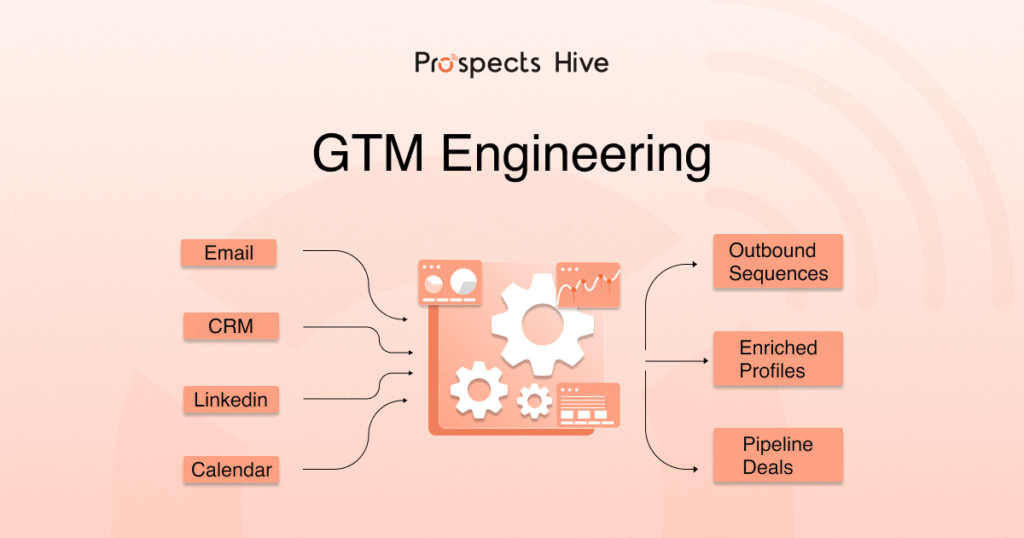
The traditional playbook for sales growth is collapsing. Your company can’t hire its way out of the problem anymore. A sales team that doubled in size used to drive doubled revenue. That math broke somewhere around 2023. Now you’re adding SDRs, paying them 40-50k per year each, and watching cold email reply rates crater to 3-5%. Meanwhile, your RevOps team is drowning in manual work just to keep your 15+ tools talking to each other. Here, GTM engineering brings the solution to the door. Not as a buzzword. As a response to what actually changed. What Changed Between 2024 and 2026 3 things happened simultaneously, and they all point to the same gap. First, buyer behavior shifted. A 2024 Gartner survey of 632 B2B buyers found that 61% prefer an overall rep-free buying experience, and 73% actively avoid suppliers who send irrelevant outreach. Your inbound channels are being squeezed not because your product doesn’t resonate, but because buyers want to self-educate before they ever talk to a human. Second, cold outreach hit saturation. The average decision-maker now receives more than 100 sales emails per week. The overall average reply rate for cold emails is 3.43%, with top performers exceeding 10%, and 58% of all replies coming from the initial email. The math is brutal: for every 100 emails you send, you might get 3-4 replies. Hiring more SDRs to solve this just multiplies the noise. Third, your tech stack became unmanageable. The average mid-market B2B SaaS company runs 15 to 30 marketing tools, with a third of them not talking to each other and another third duplicating what the others already do. B2B sales organizations now average 8.3 tools per SDR at roughly $187 per rep per month, and SDRs spend only 28% of their time actually selling; the rest is spent logging activities, switching between tools, and finding data. Your RevOps team isn’t managing processes anymore. They’re managing chaos. Into this gap stepped GTM Engineering. GTM Engineering Isn’t RevOps, Growth, or Sales Engineering It’s important to be precise here because the market is still confused. RevOps manages existing processes. They ensure forecasting is accurate, pipeline hygiene stays clean, and handoffs between marketing and sales aren’t broken. They optimize the system you have. GTM Engineers build new systems. They take a sales workflow that currently requires 4 manual steps and 3 tool integrations and turn it into an automated pipeline. They don’t optimize the broken system. They replace it. They focus on product-led growth and build in-app funnels, referral loops, and activation workflows. A GTM Engineer’s customer is the revenue team. Sales Engineers sell. They run demos, handle technical objections, and close deals. They’re quota-carrying. A GTM Engineer is a builder for sales, not a seller. The practical difference: if your cold outreach is getting 2% reply rates because you’re sending generic emails to bad lists, RevOps might restructure your process. A GTM Engineer rebuilds the entire pipeline so each email is preceded by 5 minutes of research, anchored to a real signal, and followed by a multi-channel sequence that respects the prospect’s time. What a GTM Engineer Actually Builds Let’s talk about what this looks like in practice. A GTM Engineer typically owns 4 categories of work: 1. Systems Integration This means connecting your CRM, marketing automation platform, enrichment tools, and sales engagement platform so data flows without human intervention.  💡 10+ Best CRM for Outbound Sales in 2026: The Ultimate Decision Framework Modern buyers prefer self-serve digital experiences, yet most revenue teams still operate with disconnected tools and manual handoffs that create friction at every stage. A GTM Engineer builds this: When a prospect visits your pricing page 3 times in a week, the system automatically enriches them with firmographic data, scores them, routes them to the right account executive, and triggers a sequence. No Slack message. No manual CRM update. The data moves. 2. Data and Lead Enrichment Pipelines This isn’t just pulling email addresses from a list. It’s building real-time data pipelines that feed business signals into your sales motion. A real example: A prospect’s company just closed a Series B funding round. That’s a signal.  18 hours later, your system has identified the 5 people at that company who matter most, pulled their LinkedIn profiles, scraped their recent job changes, and created a personalized research doc that sits in your CRM. A GTM Engineer builds the automation that makes this happen without a human running each query manually. 3. Workflow Automation Most teams have workflows. They’re just broken. Tasks get stuck. Emails don’t send. Manual follow-ups slip through the cracks. A GTM Engineer designs logic that actually works.  If someone opens your email twice but doesn’t reply within 48 hours, the system sends them a LinkedIn message. If they reply but don’t schedule a call within 72 hours, a calendar invite gets sent. If they say “not a fit right now,” the system tags them for re-engagement in Q3.  This sounds simple in theory. It’s complicated in practice. 4. AI and Personalization at Scale The GTM engineers commanding the highest salaries are not tool administrators. They’re systems thinkers who understand how data flows from source to CRM to sequence, and can build and debug that pipeline end-to-end. Modern AI enables researching a prospect, generating a personalized first line for their specific situation, and sending it to 500 people in a week.  A GTM Engineer builds the system that does this without sounding generic. They understand the difference between “Hello [First_Name]” and actual personalization. Why This Role Exploded in 2024-2025 The numbers tell the story. GTM engineering job postings grew 205% from 2024 to 2025, and in January 2026, LinkedIn listed over 3,000 open GTM Engineer positions. Glassdoor puts the average US salary at $182,000. (Source) This isn’t temporary hiring. Companies like OpenAI, Clay, Ramp, and Vercel are paying $250K+ for the strongest candidates. Why the premium?  Because GTM Engineers can make a 100-person company operate like a 1,000-person organization. They replace headcount with code

GTM & Growth

AI for Knowledge, Humans for Relationships: GTM Lessons You Can Actually Use

AI is everywhere in marketing right now. More tools. More automation. More content than ever before. And somehow, less trust. Buyers are overwhelmed. Inboxes are noisy. LinkedIn feels automated. Blogs keep getting published, but very few are actually read. The promise of AI-driven scale has arrived, but the outcomes GTM teams care about pipeline quality, speed of deal, and revenue efficiency haven’t improved at the same pace. There’s a simple idea that cuts through the noise: “Use AI for knowledge and leave the relationships to humans.” That sentence should be the throughline for how GTM teams think about AI in marketing in 2026. It’s not anti-AI or anti-automation. It’s a clear-eyed view of where AI creates leverage and where it quietly destroys trust. What follows are GTM lessons you can actually apply, using an allbound marketing lens that connects strategy, execution, RevOps, and reality. TL;DR: The 10 Biggest Takeaways AI accelerates insight, not trust. Marketing still requires both science and art. Fake personalization does more harm than generic messaging. AI is best used before the conversation, not during it. Deleting content often outperforms publishing more. LLMs reward authority, depth, and real experience. Events work when they drive pipeline acceleration, not badge scans. Lead scoring breaks when teams stop talking to customers. Data hygiene for AI matters more than adding another tool. Revenue per employee is one of the most honest GTM metrics. What GTM Teams Get Right (and Where They Still Go Wrong) Most modern GTM discussions get a few important things right. First, AI has raised the bar, not lowered it. When everyone can publish “decent” content, decent stops working. The tolerance for average marketing is shrinking fast, especially in B2B. Second, personalization at scale is not automatically a win. Pretending to care about someone when you don’t is worse than being honest and relevant at a segment or category level. This is why AI personalization vs authenticity has become a defining tension in modern GTM. Where teams still go wrong is assuming tools will fix strategy. They automate before they clarify. They publish before they read. They rely on dashboards instead of conversations. AI didn’t create these problems. It just exposed them faster. The Allbound Lens: Turning Insight Into an Operating System Allbound marketing only works when inbound trust and outbound relevance reinforce each other. Inbound without relevance becomes passive content. Outbound without trust becomes noise. The lesson isn’t “do less marketing.” It’s to do marketing with intent, structure, and care and to use AI where it genuinely creates leverage. Here’s what that looks like as an operating system: Step 1: PASS-F Preflight Before a campaign launches, before content gets written, and even before tools get involved, teams need clarity. The PAS(S)-F framework forces that clarity: Purpose: Why does this campaign exist? What decision should it influence? Audience: Who is this really for? Not job titles, real buyers. Scope: How narrow or broad is the effort? Schedule: When does it launch, iterate, and stop Format: Blog, event, outbound sequence, workshop, asset? Most GTM campaigns fail because one of these is vague. That’s why PASS-F campaign planning matters more than prompt engineering. This is where AI helps. It can analyze markets, break industries into sub-verticals, map buying committees, and surface common pain patterns. What AI cannot do is decide what matters most. That judgment stays human. Step 2: AI for Knowledge, Not for Relationships AI is excellent at getting you close to the conversation. It can accelerate research, clarify ICPs, identify pain points, draft first versions, and compress weeks of analysis into hours. What it cannot do is finish the interaction. Relationships still require judgment, taste, context, empathy, and accountability. That’s why founder-led brand moments like direct conversations, clear POVs, and real presence continue to outperform polished automation. A useful mental model is simple: you can set up the interaction, but you can’t force the relationship. That’s how AI should be used in GTM. Let it do the heavy lifting before the interaction. Let humans handle what happens after. Step 3: The Quality-First Content Sprint One lesson that’s becoming hard to ignore: Deleting content often improves performance. This is no longer an edge case. It’s becoming standard as SEO quality vs quantity becomes the defining trade-off. Search engines and AI systems increasingly reward first-hand experience, clear POV, depth over volume, and evidence of real understanding. A quality-first sprint looks like this: Fewer pieces Stronger POV Bottom-of-funnel focus Subject-matter depth Founders and operators involved in review If you wouldn’t click it yourself, don’t publish it. Step 4: Events as a Pipeline Engine Events are expensive. That hasn’t changed. What’s often missed is why they fail. Events should do two things: generate pipeline and accelerate existing deals. Most only attempt the first, and poorly. Events fail when meetings aren’t booked in advance, follow-up is generic, ownership is unclear, and expectations are unrealistic. For smaller or bootstrapped teams, events work best when they’re targeted, relationship-driven, and designed for conversation, not volume. A dinner with the right ten people beats a booth scanned by five hundred. That’s real pipeline acceleration. Step 5: Attribution and RevOps Guardrails Perfect attribution is a trap. Smart teams focus on attribution that answers one question: did this create or accelerate real opportunities? Instead of obsessing over dashboards, focus on opportunity creation, sales conversations, deal velocity, retention, and expansion. A few hard truths: Lead scoring is overrated when it replaces human judgment. Most teams already have too many tools. Everyone says their data is terrible, and they’re usually right. This is where the real RevOps advantage lives. Clean data, fewer tools, clearer ownership, and better decisions. One metric that cuts through the noise is revenue per employee. It exposes inefficiency fast and highlights where AI can actually help. Where We Go From Here AI will keep getting better. What won’t change is how trust is built. The teams that win in 2026 won’t be the ones automating everything. They’ll be the ones who: Use AI to sharpen thinking

GTM & Growth

SEO x AI Summit 2025: Inside the New Era of Search & Growth

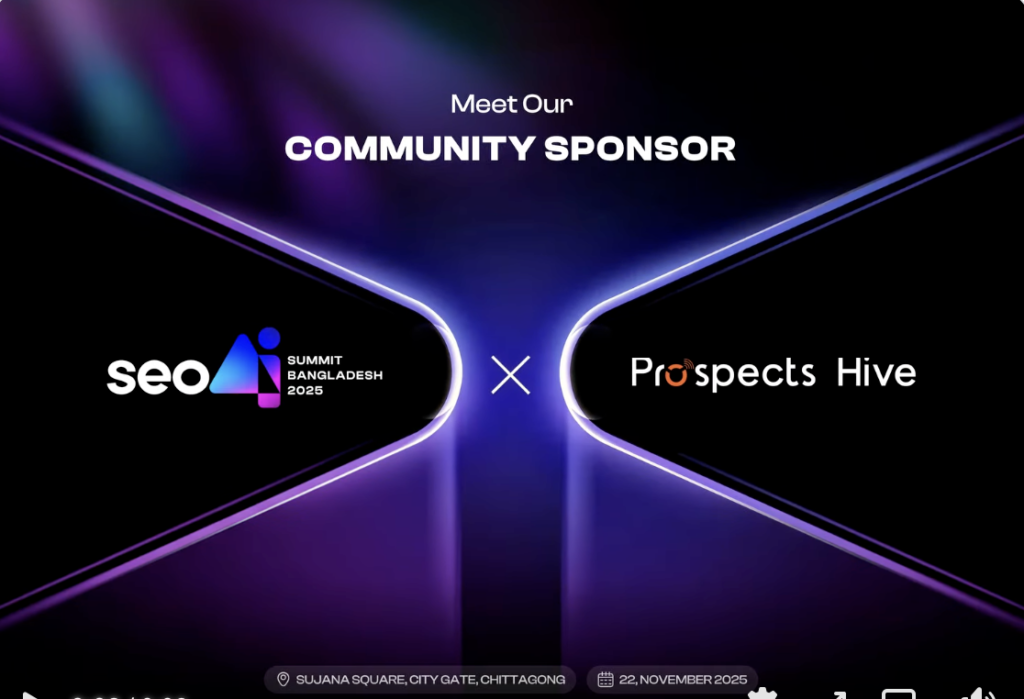
The SEO x AI Summit Bangladesh 2025 brought together industry experts, marketers, engineers, and founders to explore the intersection of search, content, generative AI, and digital growth. Prospects Hive attended the summit with a clear goal: to understand how SEO, AI visibility, and outbound marketing are merging into a single growth system. Across keynote sessions, panel discussions, and technical workshops, one message became consistent: SEO, GEO (Generative Engine Optimization), and Outbound now operate as one unified discipline. The summit offered both strategic and technical clarity on how businesses must now build content, structure websites, and engineer outbound systems if they want to remain discoverable in the age of AI. The Dual-Discovery Era: SEO Meets GEO One of the summit’s opening themes was the shift from a single discovery channel (Google search) to a dual-discovery world: traditional SEO and generative retrieval. The “Dual Discovery Era” shows how SEO optimizes for indexed rankings while GEO optimizes for LLM retrieval, reasoning, and generative responses.  SEO relies on crawl → index → rank; GEO relies on retrieve → reason → respond.  Both now run in parallel, not as competitors but as interconnected systems. Prospects Hive interprets this shift as more than a technical evolution. It changes how outbound works, because buyers now verify information through both search and AI engines before replying to outreach. If a brand is invisible in generative results, outbound becomes harder. SEO Is Not Dead. But It Has Evolved AI search now drives 15% of U.S. queries, up from 7% in 2024. AI-referred traffic converts 4.4x higher than traditional organic traffic.  By 2028, AI will reshape how visitors are valued – rewarding sites optimized for LLMs. This confirms that SEO is not disappearing, it’s only transforming. As SEO evolved, five layers are now at play:  SEO (traditional) AIO (AI readability) GEO (generative engine) AEO (answer engine) SXO (user experience) These categories reflect the expanding surface area of visibility.  Ranking on Google is no longer enough; content now needs to be readable by LLMs, optimized for answer-share, structured for citation, and built for user intent. Keyword Research → Entity Clustering → Predictive SEO One of the summit’s most practical shifts focused on entity-based keyword research. The keyword strategy has now evolved: Old approach: volume, difficulty, manual grouping. New approach: AI-driven entity clustering, predictive queries, semantic mapping Tools like Semrush, Keyword Insights, Surfer SEO, and Answer Socrates now use LLM-powered semantic clustering to forecast emerging search trends. The summit emphasized that brands must shift from chasing keywords to shaping entities, topics, and context. For outbound teams, this matters because entity clarity reduces friction. When prospects Google a brand after receiving outreach, they find structured, consistent information that reinforces the credibility of the message. Search Intent Has Shifted: The New AI Funnel The summit also introduced a redefined funnel built around AI behavior. The “Traditional → AI Funnel” illustrates: Informational → Answer Share Navigational → Brand Trust Transactional → Next-Step Intent Commercial → Multi-Modal Intent This new model mirrors how LLMs surface information. Instead of ranking pages, AI engines look for clarity, extractable answers, and factual signals. This explains why outbound performance often drops when a website lacks structured pages as LLMs can’t retrieve or cite the content, and buyers don’t find what they need. Technical SEO for AI: How Content Becomes Discoverable The key factors influencing AI search visibility: Clear entity usage Google NLP terms Knowledge graph alignment Snippet-ready paragraphs Conversational formatting Structured data schema Frequent content updates   LLMs are now fetching information from: Training data (books, articles, archived content) Live web data (crawled via Bing for ChatGPT, Google for Gemini) This means companies that want to appear in generative answers must maintain structured, extractable content across the web, not just on their sites. The Hard Numbers: AI Overviews Reduce Clicks by 34.5% Ahrefs’ analysis shows Google’s AI Overviews reduce CTR by 34.5% for top-ranking informational pages. This means traditional ranking is no longer enough. Businesses must now compete for visibility inside AI summaries, not just search results. Competitor Analysis Has Become Predictive The summit compared traditional competitor research with AI-driven predictive intelligence: Old approach: keyword lists, backlinks, meta tags. New approach: predictive keyword trends, algorithm shifts, conversational search patterns, UX optimization. For outbound systems, predictive intelligence helps campaigns stay ahead of market shifts.  GEO Audits Reveal a Site’s AI-Readiness One of the most practical takeaways was the GEO audit. The audit evaluates a site across six dimensions: Citation readiness Answer alignment Knowledge graph optimization Content authority Technical AI accessibility Competitive positioning This framework helps teams measure how well their content performs in generative engines and where to improve. Why Outbound Must Evolve With SEO and GEO All three perspectives: traditional SEO, GEO, and outbound, converge on a single truth: Outbound is only as strong as the digital ecosystem behind it. When content is structured for AI, entity-driven, and constantly discoverable: Prospects trust brands faster Search verification becomes smoother Messages land with more credibility Campaigns generate predictable lift Growth becomes compound rather than chaotic This is the direction Prospects Hive expects modern GTM systems to move toward in 2025 and beyond. A Summit That Clarified the Future The SEO x AI Summit Bangladesh 2025 made one thing unmistakably clear: SEO, GEO, and outbound are now one integrated growth engine. Prospects Hive left the event with a stronger conviction that future growth belongs to companies that build: Clear, structured content Strong entity systems Technical AI visibility Predictive SEO insights Outbound messaging rooted in search intelligence The businesses that win the next era of digital growth will be the ones that make their content discoverable, their signals consistent, and their outreach meaningful across both search and AI.

AI GTM in Outbound Marketing
GTM & Growth

AI GTM in Outbound Marketing: The 2026 Playbook for Scalable Growth

Struggling to scale your outbound in 2026? That’s majorly because outbound marketing is undergoing a major transformation. Maybe you’re running campaigns that look good on paper, but the leads aren’t converting. Or you’re hitting the right audience but at the wrong time. In 2026, outbound growth isn’t about sending clever sequences anymore. The real advantage comes from AI-driven GTM systems that identify high-intent leads, personalize outreach at scale, and engage prospects at the right moment. In this blog, you’ll learn how to build an AI-powered outbound GTM strategy and discover the tools that help scale pipeline faster while giving your team clearer data to act on.  Key Notes AI GTM in outbound marketing refers to using AI-driven systems, automation, and data signals to build a more intelligent GTM strategy. AI-driven outbound marketing combines data enrichment, intent signals, and automation for precise prospecting. AI GTM improves lead targeting, pipeline forecasting, and multi-channel outreach. Modern B2B GTM strategy is a combination of AI-powered prospecting, signal-based outreach, and conversational intelligence. Teams implementing AI-powered GTM strategies are scaling outbound marketing without proportionally increasing SDR headcount. What is AI GTM in Outbound Marketing? AI GTM in outbound marketing refers to the use of AI to design, automate, and optimize a company’s GTM strategy for outbound sales and marketing. With AI GTM in outbound marketing, you use AI to analyze large datasets to identify patterns, predict buying behavior of your prospects, and improve targeting.  This empowers B2B teams like yours to build a smarter, precise, and more responsive go-to-market strategy. Typically, a  traditional outbound process includes: Manual list building Generic email sequences SDR-led research Basic CRM tracking In contrast, AI-driven outbound marketing introduces automation and intelligence across your entire GTM tech stack. With AI systems, you can: Identify high-fit prospects using AI lead targeting. Automate prospect research. Personalize outreach at scale. Predict pipeline performance through AI pipeline forecasting. Optimize campaigns across multiple channels. In 2026, a modern AI-powered GTM platform blends data enrichment, intent signals, and automated outreach workflows to identify prospects having the maximum potential to convert into sales. See also: The Future of Outbound Sales: How Automation is Changing the Game As a result, AI has become a core component of B2B marketing and outbound sales strategies, particularly for companies aiming to scale growth efficiently. Why is Traditional Outbound Not Enough Anymore? Traditional outbound marketing once worked well when competition was lower and inboxes were less crowded.  Today, however, generic templates and list-based prospecting can no longer deliver consistent results. Several challenges have made traditional outbound less effective, including: Static lead lists Limited personalization Manual research and workflow bottlenecks Lack of signal-based outreach Because of these changes, modern B2B companies have rapidly shifted to onboarding AI-powered GTM strategies that combine automation, data intelligence, and multi-channel execution. The Core Components of An AI GTM System A successful AI GTM strategy is not just about using a single AI tool. It requires a structured system that integrates data, automation, and sales workflows. Below are the key components of a modern AI-powered GTM tech stack. 1. Data and Enrichment Layer Every AI-driven outbound system begins with high-quality data. AI platforms collect and enrich prospect data from multiple sources such as: company databases social platforms technology usage data hiring trends Data enrichment helps improve AI lead targeting and ensures that outreach campaigns reach the right decision-makers. 2. ICP Modeling and Predictive Targeting AI tools can analyze existing customer data to identify patterns among successful deals. This enables teams to build stronger Ideal Customer Profile (ICP) models based on factors such as: company size industry revenue growth technology stack With predictive targeting, AI systems can prioritize personas most likely to convert. 3. Signal Detection Modern AI systems monitor buying signals that indicate a prospect’s potential buying intent. Examples include: job postings funding announcements leadership changes product launches Signal-based targeting allows teams to run triggered outbound campaigns rather than generic outreach. 4. Automation and Workflow Orchestration Automation tools integrate the entire GTM automation workflow, connecting prospecting, outreach, and CRM systems. This includes: automated lead enrichment multi-channel outreach sequences automated task assignments pipeline updates inside CRM platforms Also read: 10 Best CRMs for B2B Outbound Sales 5. AI Sales Enablement and Insights AI tools also analyze conversations between sales teams and prospects. This includes: call recordings email conversations meeting transcripts Through this conversational intelligence, AI platforms can extract insights about objections, buyer priorities, and deal risks. These insights help improve your sales enablement strategies and messaging. How to Create An AI-Driven Go-To-Market Strategy from the Scratch? Building an AI-driven go-to-market strategy starts with the adoption of a structured approach, keeping your marketing, sales, and data infrastructure aligned.  Below is a simplified framework for implementing AI GTM in outbound marketing. Step 1: Define Your Ideal Customer Profile Start by analyzing your best existing customers. Identify common attributes such as: industry company size revenue range technology adoption AI tools can analyze historical data to identify patterns and refine your B2B GTM strategy. Step 2: Build Your Data Pipeline Next, create a reliable data pipeline that collects and enriches prospect data. A modern GTM tech stack typically includes: data enrichment platforms. AI prospecting tools. CRM systems. outreach automation tools. These systems work together to create a centralized data environment. Step 3: Implement AI Prospect Research AI research tools can gather contextual information about prospects. For example, AI can analyze: company websites news articles LinkedIn updates product announcements This information enables AI sales scripts and outreach messages to reference relevant events or insights. Step 4: Design Multi-Channel Outreach Campaigns Modern outbound marketing relies on multiple communication channels. AI-driven outreach systems combine: email outreach LinkedIn messaging phone calls content engagement This approach is often referred to as AI multi-channel outreach. Step 5: Monitor Performance and Optimize Once your campaigns are live, AI platforms can track performance metrics such as: reply rates meeting bookings pipeline velocity deal conversion Through AI pipeline forecasting, your sales team can identify which strategies generate the most revenue. 5 AI GTM

Scroll to Top