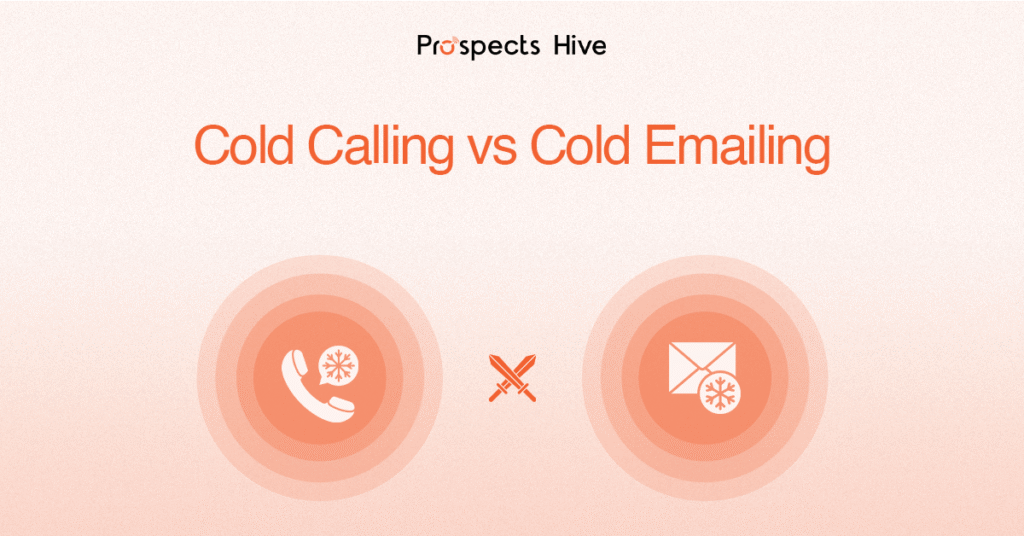
Cold Calling vs Cold Emailing: Building A Smarter Outbound System in 2026
Generic outreach is getting ignored fast. This is no more a surprise. In 2026, your buyers are more informed, more selective, and far more protective of their time and interactions. Inbox filters have become smarter. Phone calls can easily be screened. Yet one question still comes up in almost every B2B sales discussion: Is cold calling or cold emailing better? This blog isn’t here to pick sides in the cold calling vs cold emailing debate. It’s here to cut through the noise. By the end, you’ll know what actually works today, why it works, and how modern teams combine cold calling, cold emailing, and social selling into a smarter outbound system. Key Notes Cold email builds awareness, cold calls move things forward. Cold calling and cold emailing both work, but only when used together as part of a structured outbound system. Email introduces context without pressure, while calls are most effective when they reinforce existing interest or signals. Relevance and timing matter more than your cold calling or emailing volume. Modern outbound succeeds by using triggers and intent signals, not by sending more emails or making more dials. Email-first, call-second works for most B2B teams, making outbound more predictable. When email, calls, and social selling support each other, teams see higher response rates and more consistent results. What is Cold Calling? Cold calling means reaching out to a potential customer by phone without any prior relationship or direct interaction. The goal here is simple: To pitch an offer, get an idea about their needs, and initiate a conversation that could result in a sale. In the B2B sales process, cold calling is often used to: Start a conversation. Qualify interest quickly. Book a meeting or next step. Cold calling demands immediate attention. Unlike email, where the buyer can respond later or not at all, a cold call forces a real-time decision where your prospect decides either to answer, decline, or hang up. What cold calling looks like in the sales process: Prospect research Dial a decision-maker Open the call with context Ask qualifying questions Try to book a meeting Cold calling is direct, fast, and pretty personal. It is also easy to do badly. While it remains a powerful lead generation tactic, it is also risky when done without relevance or context. What does a good cold calling example look like? A strong cold calling example starts with relevance and respect for time. Below is an example showing how cold calling is now done in 2026: Example 1: Context-based cold call “Hi Alex, this is Sam. I’m calling because I saw your team is hiring SDRs right now, and we’re helping sales leaders fix reply rates before they scale. Did I catch you at a bad time?” The best cold calling examples are generally short, specific, and focused on conversation, not persuasion. What is Cold Emailing? Cold emailing means reaching out to someone you have never interacted with before via an email. The goal here is similar to that we’ve seen in cold calling: a clear intent of starting a business conversation. Typically, a cold email is: ⛔ Personal. ⛔ Relevant to the recipient’s role or problem. ⛔ Sent individually, even when automated. ⛔ Designed to get a reply, not clicks. Note: A cold email is not the same as cold email marketing or newsletters. Cold emailing for sales is all about conversations, not campaigns. In 2026, a cold email must contain one clear reason for reaching out. A good cold email should make one promise and ask one thing. It should be personalized beyond the first name. The simplest way to do so is by referring to a role, trigger, or specific problem in your email copy. Some good cold email examples that work in 2026: Good cold emails are short, contextual, and built for how people actually read email now. They contain no hype, no fluff; only a clear next step like the ones given below: Example 1: Trigger-Based (Funding / Growth Signal) Subject: {{Company}} growth question Hi {{FirstName}}, Saw {{Company}} is hiring for {{role/team}} right now. Quick question, when teams grow fast, outbound usually becomes harder to personalize without adding headcount. Curious if that’s something you’re feeling yet. If it’s relevant, happy to share how similar teams are handling this without hiring more reps. Worth a quick chat? – Kamrul Example 2: Pain-First (Operational Friction) Subject: quick outbound question Hi {{FirstName}}, Noticed {{Company}} is targeting {{market/ICP}}. Most teams we speak to at this stage struggle with one thing, messages look “personalized” but still feel generic to buyers. Is improving reply quality something you’re actively working on, or not a priority right now? Either way, appreciate the clarity. – Kamrul Example 3: Social Proof (Subtle, Not Salesy) Subject: outbound question for {{Company}} Hi {{FirstName}}, We recently helped a {{industry}} team clean up their outbound after open rates stayed high but replies dropped. Your setup at {{Company}} looks similar from the outside, so I thought I’d ask. Open to a short conversation to see if there’s overlap? – Kamrul Cold Calling vs Cold Emailing: The Differences That Actually Matter The difference between cold calling and cold emailing is not about which channel is stronger. It is about how each fits into the buyer’s workflow. Understanding these differences listed below helps teams choose the right channel for the right moment: Category Cold Calling Cold Emailing Channel Phone Email Timing Restricted to business hours Can be sent anytime using automation Approach Prospects are called individually Personalized emails sent at scale Interaction Type Synchronous. Requires direct, real-time conversation Asynchronous. Allows prospects to engage on their own schedule. Connection Real-time conversation possible No instant interaction Metrics Calls made, calls duration Opens, clicks, replies, bounces Prospect Mindset Interrupts prospects directly Viewed at reader’s convenience Scalability & Cost It is more labor-intensive and expensive per contact. Highly scalable and cost-effective Personalization & Depth Allows for deeper, “on-the-fly” personalization based on tone and immediate verbal cues. Offers data-driven personalization at scale, using tools to tailor