Your best customer may already be with you.
Most B2B teams treat growth as a numbers game: more pipeline, more demos, more new logos. But while the sales team chases fresh prospects, existing revenue quietly slips away.
Customers who don’t feel valued don’t renew. Those who disengage don’t expand. And the ones who lose interest? They leave without a word.
Acquiring a new customer costs 5 to 7 times as much as keeping one. Yet most B2B budgets stay skewed toward acquisition, and that gap is exactly where revenue gets lost.
Knowing how to increase customer lifetime value is what closes that gap.
Before we dive in here’s what you need to know at a glance:
- Customer Lifetime Value = Average Order Value (AOV) × Purchase Frequency × Customer Lifespan
- A 5% increase in customer retention can boost profits by 25–95%
- B2B CLV is typically higher per customer, but losing one account can equal losing dozens of B2C customers
- The ideal CLV:CAC ratio for sustainable B2B growth is 3:1 or above
- CLV is not just a metric to monitor, it’s a decision-making framework for your entire growth strategy
What is Customer Lifetime Value And Why Does it Matter?
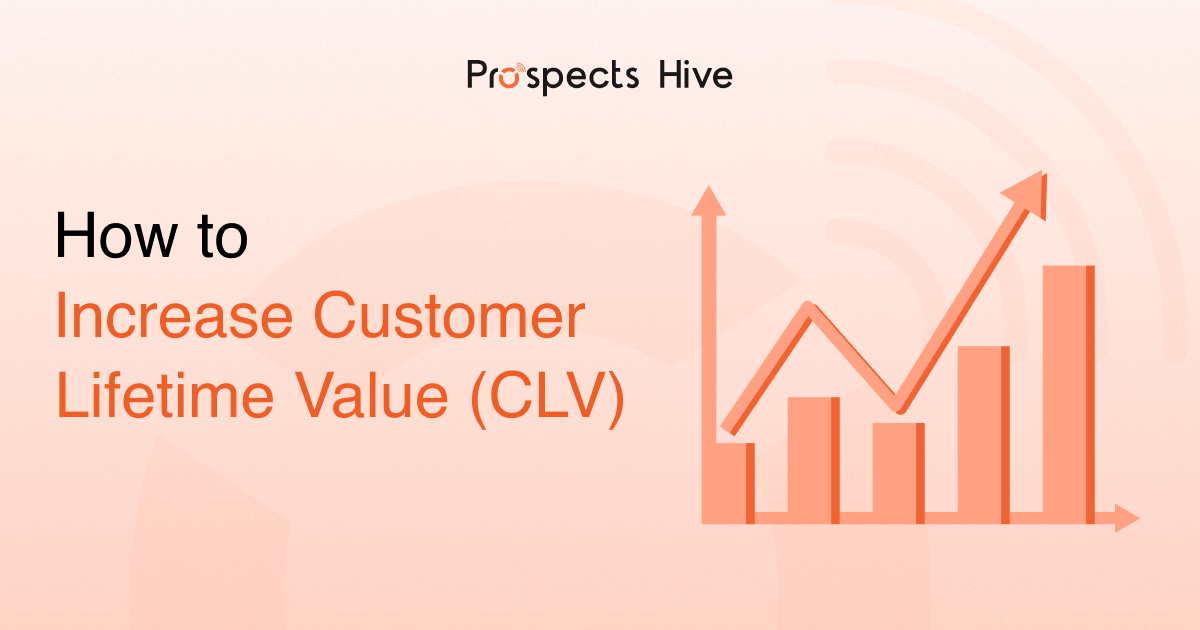
Customer Lifetime Value (CLV) is the total revenue a customer is expected to generate throughout their entire relationship with your business. That’s the simple definition.
But what makes it powerful is what it forces you to consider, not just the deal you just closed, but everything that could come after it.
The formula is simple:
CLV = Average Order Value × Purchase Frequency × Customer Lifespan.
In practice: a B2B client paying $1,500 per month, renewing annually for 3 years, with 2 service upsells along the way. That’s a CLV of $60,000 or more. That single account is worth protecting with the same energy you’d spend acquiring 10 new ones.
So why does it matter more than your lead count?
Because lead count is a vanity metric. If those leads don’t stay. Every business eventually reaches a point where the cost of acquiring new customers starts creeping toward or even surpassing what those customers are actually worth.
When your Customer Acquisition Cost (CAC) approaches your CLV, your growth model has a structural problem that no amount of new pipeline can fix.
The CLV:CAC ratio is your early warning system. A healthy B2B business targets a 3:1 or higher ratio, meaning every dollar you spend acquiring a customer should return at least 3 in lifetime value.
Obsessing over new leads while ignoring CLV is a silent revenue leak. The companies that compound their growth year over year aren’t just better at acquiring customers; they’re significantly better at keeping and expanding them.
So what actually moves the needle? Let’s get into it.
How to Increase Customer Lifetime Value With Just 10 Strategies
Here each one is grounded in how B2B customer relationships actually work and where AI-powered outbound automation changes the game.
1. Start With Clean, Unified Customer Data
You can’t improve what you can’t see clearly. This is the most foundational CLV principle, and the most frequently ignored.
In most B2B companies, customer data is scattered: purchase history lives in the CRM, engagement data sits in the email tool, support tickets are in a separate platform, and billing information is somewhere else entirely.
The result is a fragmented picture that makes it nearly impossible to understand which accounts are thriving, which are quietly disengaging, and which are about to churn.
The fix starts with establishing a single customer view: one place where behavior, spend history, engagement signals, and support interactions are visible together.
⚡10+ Best CRM for Outbound Sales in 2026: The Ultimate Decision Framework
When your team can see that the Account hasn’t opened an email in 60 days, hasn’t logged into your platform in 3 weeks, and has just submitted a frustration-driven support ticket. That’s a churn signal. Without unified data, it’s invisible.
- Audit where your customer data currently lives and identify the gaps
- Prioritize connecting your CRM, email platform, and support tool as a baseline.
- Define “at-risk” and “high-expansion” account criteria based on behavioral signals.
⚡learn, How to Use Intent Signals to Get More B2B Sales
2. Fix Onboarding
Poor onboarding is the number one silent CLV killer in B2B. And it’s almost never dramatic. There’s no angry email, no formal complaint. Customers who don’t reach their “first value moment” quickly just quietly disengage.
They use the product less, engage less with your team, and when renewal comes around, they don’t feel strongly enough to stay.
Good B2B onboarding isn’t a welcome email and a PDF guide. It’s a structured, milestone-driven journey that gets your new client to a clear, tangible win as fast as possible.
Think: what does success look like on Day 7? Day 14? Day 30? If you can’t answer that, your onboarding has a problem.
- Map the first 30-day journey for your average ICP and identify where new clients go quiet.
- Define 2–3 “first value” milestones and build your onboarding sequence around reaching them.
- Personalize onboarding sequences based on company size, use case, or account type
- Follow up personally when a client misses a milestone. Don’t wait for them to ask.
3. Upsell and Cross-Sell
The best upsell feels like a timely, relevant recommendation from someone who actually understands your business. The difference between an upsell that converts and one that damages the relationship is almost entirely about timing and context.
In B2B, natural expansion moments happen when a client hits a success milestone, when usage data shows they’re approaching the limits of their current tier, or when a new pain point emerges that your additional service directly addresses.
Upselling when your quota is due, rather than when your customer is ready, is how you erode trust faster than any competitor can.
- Use account usage data and behavioral signals to identify when expansion is a natural next step.
- Train your account management team to upsell during peak satisfaction moments after a win, a renewal, or a strong NPS score.
- B2B upsell examples: seat expansion, tier upgrades, complementary service add-ons, implementation support packages
- Cross-sell by mapping your service catalog to specific account pain points, not to your own revenue targets
4. Build Loyalty
B2B loyalty is all about making your best clients feel like insiders. People who get access, attention, and recognition that the average account doesn’t. The goal is turning your highest-value clients into advocates who bring in other high-value clients.
The key is treating loyalty as a structured, intentional program, not a series of ad hoc gestures when you think a client might be at risk.
- Early access to new features, product roadmap previews, or beta programs
- Priority support tiers, faster response times, dedicated account managers
- Co-marketing opportunities: case studies, joint webinars, conference speaking slots
- Exclusive community access: private Slack groups, peer networking events, VIP roundtables
- Annual relationship reviews that show genuine investment in the client’s growth, not just yours.
5. Personalize Every Touchpoint
Decision-makers get dozens of generic messages daily, filtering out anything irrelevant. To be heard, personalization is no longer optional. It’s essential.
Personalization in B2B goes beyond using first names. Use industry-specific messages that address vertical challenges.
Adjust communication by account stage. Speak differently to clients in month 2 versus month 18. Use behavior-driven messages that reflect a customer’s actions, not generic sequences.
60% of buyers are more likely to return after a personalized experience.
In B2B, where every account is high value, that means retained contracts and bigger relationships. Segment your client base by industry, company size, product usage, and lifecycle stage.
- Tailor your communication cadence and content to each segment’s specific context.
- Use behavioral triggers. If a client downloads a specific resource, that’s a signal. Respond to it.
- Personalize your QBR (quarterly business review) presentations to each account’s unique goals and metrics.
6. Show Up Consistently Across Every Channel They Use
Single-channel dependency is a CLV risk that most B2B teams don’t take seriously until that channel stops working.
If your entire client relationship runs through email, and email engagement drops. Because of inbox filtering, role changes, or simple fatigue, the relationship cools.
Customers who engage with your brand across multiple channels have a 30% higher CLV than those who interact through a single channel. That figure reflects a simple truth:
The more ways a client connects with you, the more embedded your relationship becomes, and embedded relationships are harder to walk away from at renewal.
B2B omnichannel doesn’t need to be complex. It’s not about being everywhere at once. It’s about staying consistent across the channels that matter to your specific clients with the same message, tone, and level of care.
- Identify client segments and focus on their preferred channels.
- Ensure your messaging is consistent across email, LinkedIn, and in-product communications.
- Don’t let digital replace humans. High-value accounts should have regular voice or video touchpoints.
- Use channel diversity to de-risk the relationship. If one channel goes cold, you have others to fall back on.
7. Shift Customer Support From Reactive to Proactive
Most B2B teams see customer support as a cost center. A reactive function, activated only when something breaks.
The companies with the highest CLV see it completely differently. For them, support is a retention investment, and the goal is to prevent them before customers even know they exist.
The mindset shift is, every support interaction is a relationship moment.
For example, a frustrated customer who receives fast, empathetic, solution-oriented support often becomes more loyal than one who never had a problem. But a customer who encounters a problem, feels ignored, or must struggle to get a resolution is already halfway out the door.
- Use behavioral data to identify friction signals early. Hesitation patterns, repeated failed actions, drops in platform engagement.
- Build automated check-ins at key lifecycle moments. 30 days post-onboarding, 60 days before renewal, post-feature launch.
- Create self-service resources that reduce effort. Searchable knowledge bases, video walkthroughs, and community forums.
- Align product, CS, and support teams around shared customer health data so nothing falls through the cracks.
- Close the loop. When you fix something based on client feedback, let them know. It reinforces that their voice matters.
8. Use Email and Lifecycle Sequences to Re-Engage
Email is one of the most underrated CLV tools in B2B. Social media gets the attention, but email delivers an average ROI of $36 for every $1 spent.
The key distinction between high-CLV and forgettable email programs is simple: behavior-triggered, not calendar-triggered. Sending a generic newsletter on the first of every month is calendar logic.
By contrast, behavior logic means sending a re-engagement sequence as soon as an account’s activity drops below its baseline. One gets ignored. The other gets results.
There are 3 lifecycle sequences every B2B team should have running at all times:
- Re-engagement series: Triggered when an account goes quiet, a 3–4 touch sequence focused on reconnection, value reminder, and a direct offer to talk
- Feature adoption series: Triggered when an account hasn’t explored a key capability after 14–21 days. Positions the feature as a solution to a problem they’ve already expressed.
- Pre-renewal series: Triggered 60–90 days before contract renewal. This sequence reinforces value delivered, surfaces expansion opportunities, and addresses concerns before they become objections.
9. Turn Happy Clients Into a Referral Engine
In B2B, a single referred enterprise account can be worth more than an entire quarter of paid advertising. And yet most B2B companies treat referrals as a nice-to-have, something that happens organically, when it happens at all. That’s a significant missed opportunity.
Referred customers are categorically different from cold-acquired ones. They arrive already trusting you, spend 15–25% more on their first engagement, churn at lower rates.
And the compounding effect is, they are 3 to 5 times more likely to refer to someone else. One referred client doesn’t just add one account to your pipeline. Done right, they start a flywheel.
- Build a structured B2B referral program with clear incentives: revenue share, service credits, and exclusive access.
- Ask for referrals at peak satisfaction moments, such as after a successful project, a positive NPS response, or a contract renewal.
- Use LinkedIn introductions as a B2B-native referral channel. Ask your happiest clients for a warm intro to a specific person at a specific company.
- Develop co-authored case studies. They serve as both a referral tool and a trust signal for future prospects.
- Start now: identify a satisfied client, and ask for a specific, qualified referral today.
10. Make CLV a Team Metric
CLV fails when it lives on just one team’s dashboard. If only marketing focuses on lifetime value, sales on closed deals, and CS on ticket resolution, your organization pulls in 3 directions, and your customers feel it.
The best companies make CLV a shared metric, visible to sales, CS, product, and marketing. When every team sees projected lifetime value with their accounts, their decisions shift.
Sales qualify for fit. Product prioritizes retention-driving features, not just acquisition. CS measures renewals and expansions, not just satisfaction.
The question to anchor every team meeting:
“How does this decision affect customer value 12 months from now?”
That single question changes what gets prioritized.
- Add projected CLV to account dashboards visible across all customer-facing teams.
- Set quarterly targets around CLV metrics: NRR, expansion, referral rate, not just new ARR.
- Hold joint account reviews with sales, CS, and product for top-value clients.
- Celebrate CLV growth alongside new accounts. Champion expansion wins.
The Factors That Quietly Shape Your CLV
Before you can improve CLV, it helps to know exactly what’s pulling it up or dragging it down. Most of these factors operate below the surface, which is why CLV can decline for months before it becomes a visible problem.
1. Purchase Frequency is the most direct lever in B2B. How often clients expand, renew, or add services determines the compounding velocity of their lifetime value. Closely tied to this is Average Order Value (AOV)—the revenue you capture per transaction.
Upselling and cross-selling live here, and even modest AOV increases multiply significantly over the course of a multi-year relationship.
2. Customer Lifespan: how long a client stays is where churn does its damage. Every month of early churn is a month of potential expansion revenue that never materializes. But lifespan isn’t just a retention metric: it’s heavily influenced by Onboarding Quality.
Clients who reach their first value moment quickly stay longer. Those who struggle through a confusing onboarding often don’t make it to month three.
3. Customer Engagement is one of the most predictive leading indicators of CLV. Active customers, those who log in regularly, engage with your content, and participate in QBRs, have a measurably higher lifetime value. Disengaged customers, even if they haven’t churned yet, are statistically pre-churned.
The flip side of engagement is Product or Service Fit. Misaligned expectations between what you sold and what you delivered kill CLV before the first renewal, regardless of how good your retention programs are.
4. Support Experience compounds quietly in the background; each friction point erodes loyalty over time.
Conversely, Personalization Depth strengthens retention and expansion.
5. Referral Behavior is your highest-value CLV signal. Clients who refer others are most satisfied and embedded. They stay longer, spend more, and drive exponential CLV growth. Main idea: Cultivate referrals for compounding value.
These factors don’t operate in isolation. Improving one lifts the others. That’s why CLV compounds with the right strategy, and why neglecting one area undermines progress elsewhere.
How Prospects Hive Helps B2B Teams Increase CLV
Strategy is only as good as execution, and execution at scale requires the right systems. Here’s what CLV optimization actually looks like when Prospects Hive’s AI automation is running in the background.
Scenario 1: Catching Churn Before it Happens
Prospects Hive continuously monitors engagement signals across your active accounts. When a client reduces platform activity, stops opening emails, or misses a scheduled touchpoint, the system flags the event and automatically triggers a re-engagement sequence.
Your team doesn’t need to manually track 50 accounts to catch the one that’s quietly drifting. The system does it for you, at the exact moment intervention is most effective.
Scenario 2: Scaling Upsell Outreach Without Scaling Headcount
When usage data signals that an account is approaching the ceiling of its current service tier, AI-powered outbound sequences deliver a contextual, personalized expansion message at the right moment without a sales rep manually monitoring every account’s usage dashboard.
The message feels timely because it is. Accounts that receive relevant expansion outreach at a natural growth moment convert at significantly higher rates than cold upsell attempts.
Scenario 3: Referral Outreach on Autopilot
The best time to ask for a referral is within 48 hours of a peak satisfaction moment. A contract renewal, a positive review, a successful project completion. Most teams miss this window because they’re busy.
Prospects Hive detects these satisfaction signals and automatically triggers a referral outreach sequence while goodwill is highest.
🍬The result: more referrals, better quality leads, and a CLV flywheel that builds itself.
Scenario 4: Onboarding That Doesn’t Drop the Ball
New client onboarding sequences run automatically from Day 1 to Day 90 with each touchpoint personalized based on account type, ICP profile, and behavioral signals.
If a new client doesn’t complete a key onboarding milestone, the system escalates, triggering a human follow-up before disengagement becomes habitual. Every new client gets the same quality onboarding experience, regardless of how busy your team is.
CLV growth is about doing the right things at the right time, for the right accounts. That’s exactly what AI automation was built for.
Your Best Growth Opportunity is Already in Your Pipeline
Sustainable B2B growth has always been built on relationships, but the companies that scale most efficiently aren’t just good at starting them. They’re exceptional at deepening them.
Small, consistent improvements in retention, expansion, and advocacy multiply to drive CLV growth.
Bottom line: B2B success means keeping customers, not just acquiring them.
Ready to stop leaving revenue on the table?
Prospects Hive builds AI-powered outbound systems that work for the customers you already have.
FAQ
1. What is the difference between CLV and LTV?
CLV (Customer Lifetime Value) and LTV (Lifetime Value) are used interchangeably in most B2B contexts.
The distinction that sometimes gets made: LTV refers to total gross revenue over the customer relationship, while CLV represents net value after deducting acquisition and ongoing servicing costs.
2. How is B2B customer lifetime value different from B2C?
B2B CLV is usually higher because contracts are larger, relationships last longer, and buying decisions involve multiple stakeholders. Risk is also greater: losing one enterprise account can mean losing the revenue of dozens of B2C customers at once.
3. How often should a B2B company recalculate its CLV?
At a minimum, review quarterly. Also, recalculate after major pricing changes, product launches, ICP shifts, or market changes that impact customer engagement.
Fast-growing B2B teams may review CLV by cohort monthly, especially when testing onboarding or retention initiatives, to catch early directional shifts.
4. Can a small B2B team implement CLV strategies without a large tech stack?
Yes. Start with a clean CRM and a behavioral email tool. Even basic segmentation, identifying your top 20% of accounts, lets you begin optimizing onboarding, referral timing, and outreach.
You don’t need enterprise software. Focus on identifying key accounts and nurturing them. Scale tech as needed later.
5. What is the fastest single action a B2B team can take to improve CLV today?
Audit your onboarding. Does every new client reach a clear, tangible ‘first value moment’ within 30 days? If not, that’s your biggest CLV leak.
Fixing onboarding is about process design and a defined early milestone, not a big tech investment. Improvements in retention are evident within one renewal cycle.
6. Does CLV apply to project-based B2B businesses?
Yes, fully. In project-based or agency models, CLV is measured by repeat project frequency, average project value, and referral rate over the duration of the client relationship.
7. What is the relationship between Net Promoter Score (NPS) and CLV?
NPS measures the likelihood that a customer will recommend you, directly predicting 2 key CLV drivers: referral behavior and long-term loyalty.