Still wondering why the pipeline feels flat despite having a great SaaS product and a flawlessly mapped out ideal customer profile?
Your SDRs are chasing outbound while the marketing team is curating and pushing ads. The revenue generating opportunities nonetheless, remain utterly deflated.
Guess what, you’re not alone.
Most SaaS teams show the tendency to treat ABM (Account-Based Marketing), inbound, and outbound as distinct players. Thus, you end up running parallel engines without any unified motion.
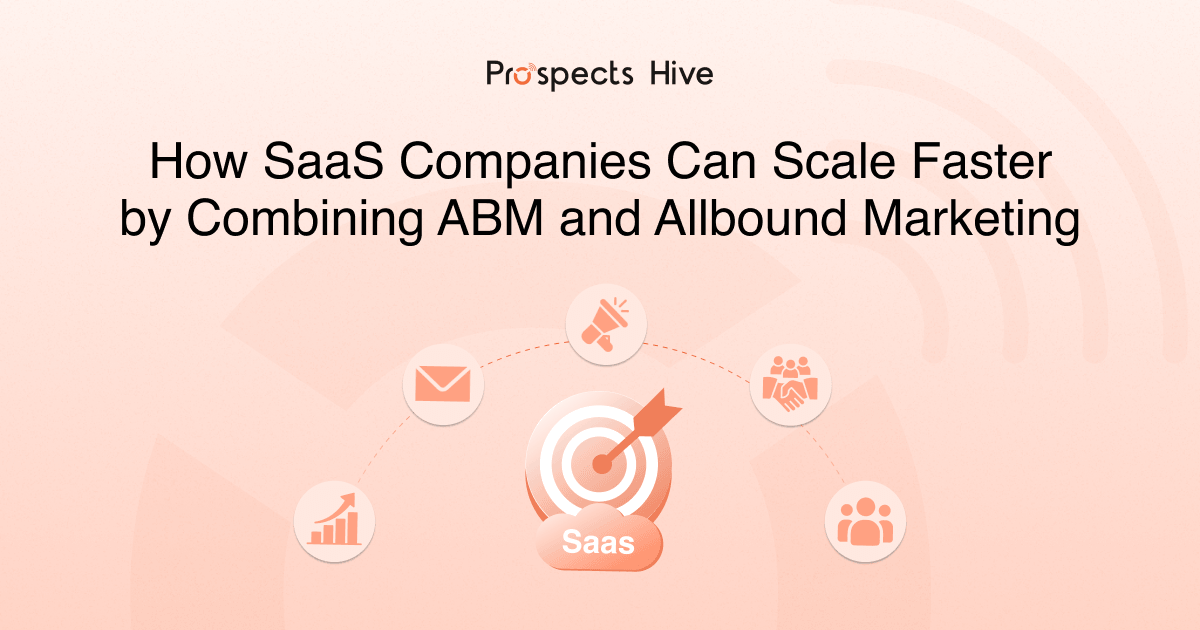
The modern rapidly growing SaaS companies don’t make a choice between ABM and outbound. What they do is merge ABM’s precision targeting with Allbound’s execution power.
In this blog, you’ll get to know how SaaS companies can scale faster by combining ABM and Allbound marketing.
Quick Summary
- Stop treating ABM and outbound as separate systems. Together, they form a full-funnel, signal-driven GTM engine.
- Automate for speed, personalize for conversion. Tools like Clay, Make, and Lemlist let you scale relevance, not spam.
- Align around shared revenue goals. The ABM list is every team’s list, not just marketing’s.
- Measure business outcomes, not clicks. Track meetings, deal velocity, and revenue per account.
- Adopt an Allbound mindset. Every channel, every team, every tool moving in sync around your ICP.
What ABM and Allbound Marketing Mean for SaaS Companies
To understand how SaaS companies scale faster, you need to separate 2 things clearly.
What is Account-Based Marketing (ABM)?
ABM is a B2B marketing strategy for high-value customer accounts.
ABM is about precision.
- Define your ICP
- Identify high-value accounts
- Build targeted ABM campaigns
- Personalize messaging at the account level
It’s a focused account-based growth strategy, not broad lead generation.
What is Allbound Marketing?
Allbound marketing is a coordinated approach that combines inbound, outbound, and automated engagement so every channel works together around the same target accounts.
Allbound is about orchestration.
- Combines inbound marketing and outbound marketing
- Activates engagement across email, LinkedIn, ads, content, and partners
- Connects every touchpoint into one system
It’s not just a marketing tactic. It’s a full-funnel, multichannel engagement strategy.
ABM vs. Allbound: Putting the Strategies Side by Side Without the Confusion
Here is a quick glance at the core difference between ABM and Allbound marketing:
| Approach | ABM | Allbound |
| Goal | Identify and engage high-value accounts | Activate every buying signal across inbound, outbound, and partners |
| Focus | Precision targeting | Multi-channel execution |
| Core Team | Marketing + Sales alignment | Marketing + Sales + Partnerships |
| Weakness Alone | Slow to scale, heavy setup | Fast but noisy and scattered |
When combined, the result is a signal-driven, coordinated, marketing system for B2B SaaS growth.
In a nutshell,
- ABM decides who to target
- Allbound decides how and when to engage
How to Combine ABM and Allbound Marketing in SaaS (Step-by-Step)
Here’s a 6-step framework you can use to combine ABM and Allbound Marketing for SaaS into one scalable revenue engine:
Step 1: Define High-Intent Accounts (Not Just Lists)
Start with precision, but go beyond static lists.
Use tools like Clay or Apollo to build your base using:
- firmographics (industry, size, region)
- technographics (tools they use)
- revenue and growth stage
Then layer in intent-based prospecting signals such as:
- recent funding rounds
- hiring for key roles
- product or expansion announcements
- website or pricing page engagement
Pro Tip: Connect Clay with data sources like Crunchbase so your ICP list updates automatically when new signals appear.
Once enriched, score and prioritize accounts based on fit + intent, not just profile match.
Step 2: Map Buying Groups Within Each Account
ABM fails when it treats accounts as a single contact.
In B2B SaaS, deals involve multiple stakeholders:
- decision-makers
- influencers
- end users
Map these roles and tailor your messaging accordingly.
This is what turns basic outreach into personalized outreach for SaaS that actually converts.
Step 3: Align Sales and Marketing Around the Same Accounts
The real power of combining inbound and outbound marketing comes from alignment.
Sync your ABM account list inside your CRM (Attio, HubSpot, Salesforce, etc.).
Then define shared outcomes across teams:
- meetings booked
- pipeline created
- deals closed
Automation Tip: When a contact shows intent (e.g., downloads content or replies), trigger a nurture or follow-up workflow automatically via HubSpot or Make.com
This ensures:
- no account gets ignored
- follow-ups stay consistent
- engagement compounds over time
Step 4: Build Multi-Channel, “Surround Sound” Engagement
Now activate your Allbound marketing strategy.
Engage the same accounts across:
- email (Lemlist, Instantly)
- LinkedIn (HeyReach, Sales Navigator)
- ads and retargeting (LinkedIn Ads, Meta)
- content (case studies, webinars, landing pages)
The key is consistency.
Every touchpoint should reinforce:
- the same problem
- the same context
- the same value
Here is an example Opener (Signal-Based):
“Saw you’re hiring 5 SDRs, congrats. Most SaaS teams at this stage struggle with scaling outbound without losing personalization. Here’s how teams are turning hiring signals into pipeline.”
Pro Tip: Combine signal (context) + insight (problem) + value (solution) in your messaging.
Also read: Signal Based Selling: How Modern GTM Teams Build Pipeline Without Guesswork
Step 5: Automate Signal-Driven Engagement Across Channels
This is the step where the system becomes scalable.
Use tools like Make.com to orchestrate your workflow:
Example Flow:
New hiring or funding signal in Clay
→ Add account to outreach sequence (Lemlist)
→ Sync to CRM (Attio)
→ Notify SDR in Slack
→ Update stage to “Engaged”
Workflow Stack: Clay → Make → Attio → Lemlist → Slack
Each tool plays a role:
- Clay → detects signals
- Make → triggers automation
- Attio → centralizes data
- Lemlist → executes outreach
- Slack → alerts team
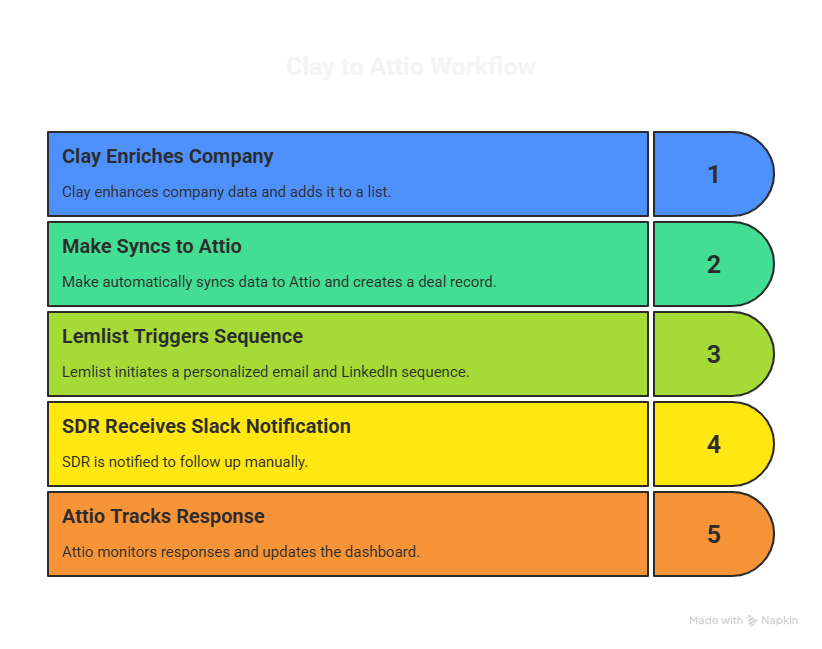
This turns your GTM motion into a signal-driven outbound system, not manual effort.
Step 6: Measure Pipeline Impact, Not Just Activity
Finally, track what actually drives growth.
Focus on:
- engagement per account (email + LinkedIn touches)
- time-to-first-response
- meetings booked per target account
- deal velocity
- revenue from engaged accounts
Pro Tip: Build a “signal scoreboard” in your CRM to track which triggers (funding, hiring, product updates) lead to conversions.
Feed this back into your ABM strategy to continuously refine targeting.
The Outcome
When ABM and Allbound Marketing for SaaS are combined properly:
- outreach becomes timely, not random
- engagement becomes coordinated, not scattered
- pipeline becomes predictable, not reactive
Scaling becomes easier with faster cycles, better conversion, and scalable growth. In fact, 87% B2B marketers believe ABM initiatives bring far better returns on investment.
The Modern SaaS Tech Stack for ABM + Allbound
Here’s what a modern ABM + Allbound stack looks like in practice:
| Stage | Tool(s) | Function |
| Prospecting | Apollo, Crunchbase | Build ICP lists |
| Enrichment & Signals | Clay | Automate intent data and triggers |
| Outreach | Lemlist, GetSales.io, HeyReach | Multichannel engagement |
| Automation | Make.com | Cross-tool workflows |
| CRM | Attio, HubSpot | Centralized account data |
| Nurture & Retargeting | HubSpot Workflows, Meta Ads, LinkedIn Ads | Keep warm accounts engaged |
| Analytics | HubSpot Dashboards, Google Looker Studio | Pipeline reporting and engagement trends |
A typical system looks like this:
- Signals & Enrichment: Clay
- Prospecting: Apollo, Crunchbase
- Outreach: Lemlist, LinkedIn automation tools
- Automation: Make.com
- CRM: Attio, HubSpot
This enables:
- CRM automation for SaaS
- real-time signal tracking
- coordinated execution across tools
How This Looks in Practice with Prospects Hive
Most SaaS teams already have the tools. What they don’t have is a connected system.
Prospects Hive helps B2B SaaS companies:
- build a GTM system for SaaS companies
- connect signals → outreach → CRM
- implement signal-driven outbound workflows
- automate follow-ups and engagement
- create full visibility across the pipeline
Instead of running isolated marketing campaigns, the focus shifts to building a predictable revenue engine.
What ABM + Allbound Teams Actually Measure
Below are the key metrics that ABM + Allbound teams measure to map out their success:
| Metric | What It Means |
| Account-Level Engagement | Tracks how multiple stakeholders within a target account interact across channels |
| Signal-to-Action Speed | Measures how quickly your team responds to signals (hiring, funding, engagement) |
| Meetings Per Target Account | Number of meetings generated specifically from ABM accounts |
| Multi-Touch Conversion Rate | Tracks how different touchpoints contribute to conversion |
| Deal Velocity by Segment | Measures how quickly deals move through the pipeline for different account types |
| Revenue per Engaged Account | Revenue generated from accounts that have shown engagement |
Common Mistakes SaaS Teams Make (And How to Avoid Them)
Even with the right strategy in place, here are the top 5 common mistakes that your SaaS team might be making (with quick fixes!):
| Mistake | Fix |
| Treating ABM as a one-time campaign | Turn it into a living system with continuously updated signals and synced outreach + CRM |
| Running channels in isolation | Align all channels around the same accounts, context, and messaging |
| Personalizing without real context | Use signal-based personalization (hiring, funding, product changes) instead of generic research |
| Slow follow-ups after engagement | Automate response workflows tied to behavior (replies, visits, downloads) |
| Stacking tools without a system | Design the workflow first (Signals → Outreach → CRM → Feedback), then plug tools into it |
Your Next Step Toward a Precision Revenue Engine
ABM and Allbound Marketing for SaaS is not about choosing between inbound and outbound.
It’s about combining them into one coordinated system.
When targeting, timing, and execution work together:
- outreach becomes relevant
- pipeline becomes predictable
- growth becomes scalable
If your pipeline feels active but inconsistent, it’s a system problem.
And fixing the system is what changes everything. Book a strategy call to see how we can help you build your ABM + Allbound motion in weeks, not months.
FAQs
1. What is the 3 3 2 2 2 rule of SaaS?
It’s a growth benchmark that expects a SaaS company to triple revenue for the first 3years, then double it for the next 2 years, and then continue strong growth through the next 2, depending on the version used.
2. What is the 3 3 3 rule in sales?
It’s a follow-up framework that typically means making 3 calls, sending 3 emails, and using 3 social touches over 3 weeks.
3. How to scale a SaaS company?
Focus on repeatable acquisition, strong product-market fit, efficient onboarding, low churn, and a sales process that can be replicated consistently.
4. What is the 95:5 rule in B2B?
It means only about 5% of buyers are in-market at any given time, while the other 95% are not actively buying.
5. Is ABM and Allbound better for enterprise SaaS or SMB SaaS?
It usually works best for enterprise and mid-market SaaS because larger deals justify the personalization, multi-touch coordination, and longer sales cycles.
6. How do you measure the success of ABM and Allbound campaigns?
Track pipeline velocity, account engagement, conversion rates, deal size, and revenue impact.