Think about the last cold email you actually opened, read, and replied to. Chances are that it felt like it was written just for you. Now think about the ten you deleted without a second glance. That gap between the two is basically the whole story of sales outreach.
Every deal starts somewhere. Before the contract, before the demo, before the first reply, someone had to reach out first. Here, that first move is sales outreach. It’s still the backbone of how most B2B companies fill their pipeline.
So, what is sales outreach, really? It’s the practice of contacting a potential customer directly, instead of waiting for them to find you. Everyone has access to the same tools now. Inboxes are more crowded than ever. So, the reps who book meetings aren’t winning because of better tools. They’re winning because they understand the fundamentals underneath those tools.
This guide covers what sales outreach is, how it works, the channels worth your time, and where AI fits in without replacing the human part that makes it work.
What Is Sales Outreach? Why Does It Matter?
Sales Outreach Definition
Sales outreach is when a salesperson contacts a potential customer directly. The goal is simple: start a conversation that leads to a sale. It happens through email, phone calls, LinkedIn, video, or text.
The key word here is direct. Outreach isn’t a billboard. It doesn’t reach thousands of people at once, hoping a few notices. It’s one person reaching one specific person. Usually because that person fits a profile worth pursuing.
Imagine a billboard placed alongside a road versus a handwritten letter placed on someone’s table. Only one feels like it was made for that particular reader. That’s the real difference between marketing and outreach. You’ve felt it yourself, probably more times than you’d like to admit.
Why Sales Outreach Matters
Potential customers won’t find you on their own. Not because your product isn’t good enough. It’s because they’re busy running their own business, the same way you’re busy running yours. They don’t have time to search for solutions to problems they haven’t fully identified yet.
Outreach puts you in front of the right person, at the right time. You don’t have to wait for someone to stumble across your website. It also gives you something inbound marketing rarely offers timing control. You decide when a prospect hears from you.
The conversations that come through sales outreach will also happen more quickly. Once you have someone’s attention, you can ask questions. You can shape your pitch around what they actually need.
Why Businesses Use Sales Outreach
- To create a predictable sales pipeline, rather than relying solely on inbound leads
- To reach decision-makers who never search for solutions online
- To shorten sales cycles by targeting people with a real, current need
- To build relationships with high-value accounts that marketing alone wouldn’t convert
- To test new markets before investing heavily in content or ads
That last point often gets overlooked. Outreach doubles as a research tool. Good conversations, even just a handful of them, can teach you more about a new market than weeks of guessing ever could.
How Sales Outreach Turns Strangers into Customers
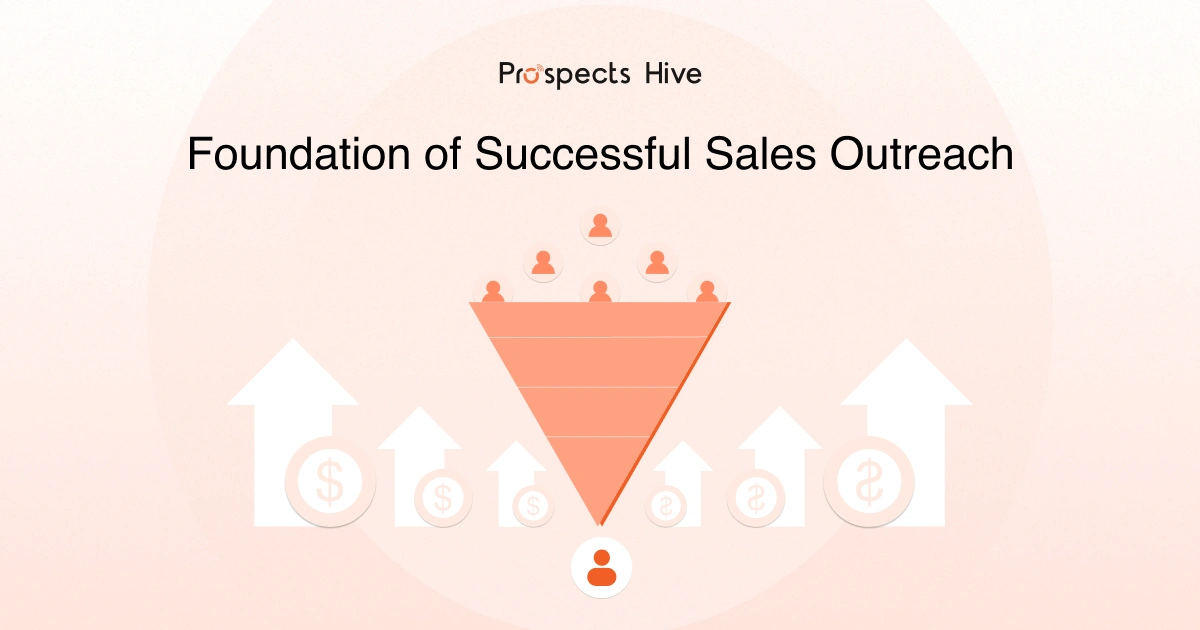
Outreach follows a pattern. It’s not random. Here’s the path a cold prospect typically travels before becoming a customer.
Prospect Identification
Everything starts with finding the right people. This means matching contacts against your ideal customer profile. That’s a description of the type of company and person most likely to buy from you.
Getting this step wrong ruins everything after it. You’ve probably seen it happen. Someone spends an hour crafting a great message, then sends it to a contact who was never going to buy in the first place. Good prospect identification combines two things. Firmographic data, like company size and industry. And softer signals, like recent hiring or funding.
Research and Qualification
Once you have a list, you check who’s actually worth contacting. Does this prospect have a budget? The need? The authority to decide? This step separates a real outreach program from a spray-and-pray one.
Qualification doesn’t need to be complicated. Just use a simple checklist. Does this company fit our ICP? Do they have any influence over the decision maker? Are they doing anything related to the solution we offer?
Personalized Outreach
This is where the first message goes out. Good outreach references something real about the prospect’s situation. Not just their name and job title.
The best messages connect three things. Something specific about the prospect. Something relevant to their role, tied to a real problem. And a clear, low-pressure next step. Miss any one of these, and the message starts to feel like every other cold email sitting in that inbox, the kind you scroll past without a second thought.
Follow-Up and Engagement
Replies rarely come from the first message. They usually come from follow-ups. Sometimes the third or fourth one. Persistence, done well, is simply part of the job.
Here’s the mistake most people make. They repeat themselves. If you’ve ever hesitated to send a third follow-up because you were worried about seeming pushy, you’re not alone. But it’s rarely the follow-up itself that bothers people. It’s a follow-up with nothing new to say. Good follow-ups add something new each time. Try a different angle. Try a relevant piece of content. Try a short case study. Not just “checking in again.”
Meeting Booking and Conversion
Once a prospect shows interest, the goal shifts. Book a call. Then hand that opportunity into your sales pipeline for the next stage.
This handoff matters more than people realize. Confusing booking steps can lose an interested prospect, just as easily as a weak first message. So, keep scheduling simple. Make sure whoever takes the call has full context.
Sales Outreach vs. Prospecting vs. Lead Generation: What’s the Difference?
These terms get mixed up constantly. If you’ve ever nodded along in a meeting while someone used them interchangeably, not entirely sure who was right, you’re in good company. Here’s how they actually relate to each other.
What Is Lead Generation?
Lead generation is the umbrella term. It covers everything a business does to attract potential customers. Inbound, through content and SEO. Outbound, through outreach and cold calling. If you’re building a marketing plan, lead generation sits above every specific tactic underneath it.
What Is Sales Prospecting?
Prospecting happens before outreach begins. It’s the research phase. Identifying who to contact. Confirming they’re worth your time. Larger companies sometimes treat this as a separate role entirely, handled by a dedicated research team.
What Is Sales Outreach?
Sales outreach is the actual contact itself. The emails, the calls, the messages sent to start a conversation. It’s a visible part of the process. The part a prospect actually experiences.
Key Differences Explained
| Term | What it covers | When it happens |
| Lead Generation | The full strategy for attracting customers | Ongoing, umbrella process |
| Prospecting | Finding and qualifying who to contact | Before outreach |
| Sales Outreach | Sending the actual messages and calls | During execution |
Here’s a simple way to remember it. Prospecting decides who you talk to. Outreach decides how you talk to them. Lead generation is the whole system; these pieces sit inside.
Different Types of Sales Outreach Every Team Should Know
Cold Outreach
Cold outreach means contacting someone who has never interacted with your company before. No warm intro. No prior relationship. It’s the hardest type to get right, because there’s zero built-in trust to lean on.
Warm Outreach
Warm outreach means reaching out to someone who already knows your brand in some way. Maybe they downloaded a guide. Maybe they attended a webinar. Reply rates tend to run higher here, since some familiarity already exists.
Inbound Outreach
Inbound outreach means following up on someone who reached out first. Think of a demo request, or a pricing page visit. Speed matters here. Responding within minutes, rather than hours, can change whether that lead converts.
Outbound Outreach
Outbound outreach means initiating contact with someone who hasn’t engaged with your company yet. It covers most of what people picture when they hear the term sales outreach. It’s where the bulk of this guide focuses.
Account-Based Outreach
This is a focused strategy. Target a small number of high-value accounts. Run deeply personalized, multi-touch campaigns. Often involving several people at the same company, instead of one contact hoping to champion the deal alone.
Inbound vs. Outbound Outreach
Inbound converts at a higher rate. Why? Because the prospect already has intent. But inbound volume depends heavily on your content, your SEO, and your ad spend. Outbound gives you more control. You choose who to contact, and when.
Companies generally need both. Inbound handles demand that already exists. Outbound creates demand where it doesn’t yet.
Here’s a simple way to picture it. Inbound is fishing with a net, cast into water where fish are already swimming. Outbound is finding the specific fish you want, and going after it directly, even in water where nobody else is fishing yet.
The Most Effective Sales Outreach Channels Today
If you’ve ever ignored a cold email but replied to a LinkedIn message within minutes, you already understand more about channel strategy than you think.
Email Outreach
Still the most scalable channel. Cold email works best when it’s personalized and sent to a well-researched list. It’s also the easiest channel to track, since open rates and reply rates are measurable in most tools.
Cold Calling
Connect rates run lower here. But once someone picks up, you get a real, live conversation. Cold calling works best as a follow-up to email, not as a first touch.
Social Selling
This means using LinkedIn to build relationships, then messaging prospects directly. Reply rates tend to run higher than email here, especially with senior decision-makers. Commenting on a prospect’s posts first can warm things up naturally.
Video Outreach
Short, personalized videos can stand out in a crowded inbox. They build trust faster than plain text too. Seeing a real face, referencing something specific about their company, creates a connection text alone struggles to match.
SMS and Text Messaging
Fast. Direct. But best used later in a sequence, not as a first touch, since it can feel intrusive too early. It works well for confirming meetings or nudging a prospect who’s gone quiet.
Multi-Channel Outreach
Combining two or three channels consistently beats relying on just one. Someone who ignores three emails might respond to a short LinkedIn message instead. The channels reinforce each other. Someone who sees your name across email and LinkedIn, in the same week, is more likely to respond.
| Channel | Typical Reply Rate | Best Used For |
| 3–10% | Scaling outreach across large lists | |
| 10–25% | Reaching decision-makers directly | |
| Cold calling | 2–5% connect | Following up after email |
| Video | Above average | Standing out, building trust |
| SMS | Varies | Later-stage follow-up |
Related Reading: How to Combine LinkedIn Outreach with Email Campaigns
Key Components That Drive Successful Sales Outreach
- Targeting: contacting the right people, not just a lot of people. Even a great message fails against the wrong audience.
- Personalization: messages that reference something real about the prospect. Not just a name dropped into a template.
- Channels: choosing where your prospect actually spends time. Not just what’s easiest for you to send.
- Cadence: the spacing and number of touches in your sequence. Enough room to notice you, without feeling bombarded.
- Messaging: clear and specific. Focused on the prospect’s problem, not a long list of your product’s features.
- Value proposition: a plain, honest reason for the prospect to care.
These six components work together. Strong targeting with weak messaging still fails. Great messaging sent to the wrong audience still fails too.
Inside the Sales Outreach Process Step by Step
- Step 1: Build a target prospect list matching your ideal customer profile, pulled from verified data sources.
- Step 2: Research prospects for relevant details worth referencing. Recent news, hiring activity, anything that signals timing.
- Step 3: Create outreach messages tailored to each segment.
- Step 4: Launch campaigns across your chosen channels; spacing touches so the sequence feels natural.
- Step 5: Follow up consistently, adding new value or context with each touch.
- Step 6: Qualify leads who show interest, to confirm fit before investing more time.
- Step 7: Book meetings with qualified prospects. Keep scheduling short and simple.
- Step 8: Move opportunities into the pipeline, with full context passed along, so nothing gets repeated.
The Modern Sales Outreach Strategy: Why Precision Beats Volume
Sales communication is no longer about sending out blanket emails to everyone you can think of. It is based on targeted campaigns using multi-touch strategies that revolve around your Ideal Customer Profile, or ICP.
Four things separate a real strategy from noise: research and personalization, an omnichannel sequence, value-driven messaging, and ongoing testing.
Research and Personalization
Generic outreach gets deleted fast. So, sellers tailor messages to something specific: the prospect’s industry, a role-based challenge, or a recent trigger event, like:
- New executive hires
- Funding rounds or acquisitions
- Rapid headcount growth
- Product launches or market expansion
Reaching out near a trigger event, instead of a random Tuesday, signals the prospect may already be reevaluating their tools or vendors.
Omnichannel Sequencing
One email rarely earns a reply alone. So, outreach strings together in a sequence instead: a LinkedIn request, a call, then a tailored email, spaced over several days. Each touch reinforces the last.
Value-Driven Messaging
Features rarely convince anyone to take a call. What earns a reply is naming a real problem the prospect business is likely facing, then tying it to an outcome they want. “Here’s what we do” reads like every pitch. “Here’s the problem your team is probably facing” reads like something worth fifteen minutes.
Continuous Testing
Strategy isn’t set once. Strong teams test subject lines, opening lines, and which trigger events correlate with replies, then adjust.
| Old Approach | Modern Approach |
| Mass, generic blasts | Targeted, ICP-based campaigns |
| Single-channel, email only | Omnichannel sequences |
| Feature-led pitches | Problem-focused messaging |
| Fixed schedule | Timed around buying signals |
| Set once | Tested continuously |
None of these four pieces work alone. Skip the sequence, and even good research gets lost in one inbox. Skip testing, and value-driven messaging stays a guess forever.
How to Build a Sales Outreach Strategy That Gets Responses
Define Goals
Decide what success looks like first. Meetings booked. Pipeline generated. Revenue closed. Without a clear goal, it’s hard to know if a campaign is actually working.
Build Your ICP
Get specific. Company size, industry, role, and the problem they’re likely facing. Vague targeting rarely produces strong results. The more specific the profile, the easier it becomes to write messages that land.
Choose Channels
Pick two or three, based on where your buyers actually spend time. Teams targeting enterprise executives will likely lean on LinkedIn and email. Teams targeting local business owners might do better with calls and text.
Develop Sequences
Plan out 8 to 14 touches, across two to four weeks. Each one should add something new. Map out roughly what each touch will say before you launch, so the sequence feels intentional.
Create Personalized Messaging
Tie your message to a real signal. Maybe a hire, a launch, or a piece of relevant news. Not a generic pitch. Even light personalization performs better than a fully generic template.
Track Performance
Review reply rates and meeting conversion weekly. Adjust what isn’t working. Small changes, like a different subject line or a shorter opening, can shift results meaningfully over a few weeks.
Sales Outreach Best Practices Backed by Real Results
None of these will surprise you once you see them written out. What’s surprising is how often they get skipped, even by people who know better.
- Research before reaching out. Even a few minutes of research changes how relevant your message feels. And relevance is what earns a reply.
- Personalize every interaction. Generic messages get ignored, no matter how good your product is underneath the pitch.
- Focus on buyer problems. Lead with what they’re dealing with, not what your product does.
- Use multiple channels. Email plus LinkedIn plus calls outperforms any single channel alone.
- Follow up consistently. Most replies come after the third touch. Stopping early leaves results on the table.
- Test and improve. Track subject lines, opening lines, and send times, instead of guessing.
- Balance AI and human touch. Automation handles busy work. Judgment still needs a human.
Common Sales Outreach Mistakes That Cost You Opportunities
Take an honest look at this list. You’ll probably recognize at least one habit you’ve fallen into, and that’s alright. Everyone has.
| Mistake | Why it hurts results |
| Generic messaging | Feels like spam, gets deleted instantly |
| Poor targeting | Wastes effort on people who were never a fit |
| Lack of follow-ups | Most replies come after multiple touches |
| Selling too early | Prospects disengage before trust is built |
| Over-automation | Messages feel robotic and impersonal |
| Ignoring buyer intent | Missed opportunities to reach out at the right moment |
| Not measuring results | No way to know what’s working |
These mistakes tend to compound. Poor targeting makes personalization harder. That makes follow-ups feel repetitive, instead of valuable. So fixing targeting first often improves everything downstream.
What an Effective Sales Outreach Cadence Looks Like
Sample 10-Day Outreach Sequence
- Day 1: Personalized email introducing the reason for reaching out
- Day 3: LinkedIn connection request with a short, relevant note
- Day 5: Follow-up email that adds new context
- Day 7: Phone call attempt, with a short voicemail if there’s no answer
- Day 10: Final follow-up email with a clear, low effort asks
This sequence is a starting template, not a fixed rule. Some teams stretch it across three weeks instead of ten days, especially with senior executives.
How Often Should You Follow Up?
Somewhere between 8 and 16 touches, spread across a few weeks. That’s what most successful outreach uses. Stopping after two or three attempts leaves most of your potential replies on the table. The goal isn’t to pester someone. It’s to stay visible long enough that your message lands when they have time to respond.
Sales Outreach Automation & AI: How AI Is Changing Sales Outreach
If part of you is wondering whether AI is coming for your job, take a breath. It’s not. It’s coming for the boring parts of your job, the ones you never enjoyed anyway.
AI for Prospect Research
AI tools can pull together background information on a company in seconds. That’s work that used to take a rep 20 minutes per account. So, reps get to spend more of their day writing and sending messages, instead of digging for background details.
AI-Powered Personalization
Some tools now draft a rough, context-aware first version of a message, which the rep then reviews and refines. This speeds up the process, without removing human judgment at the end.
Outreach Automation
Sequencing, scheduling, and follow-ups can run automatically, once a campaign is set up. That frees reps to focus on replies, instead of repetitive sending.
CRM Automation
Logging calls, updating deal stages, and setting reminders. All of this can happen without manual entry, which keeps your CRM accurate. Clean CRM data also makes reporting far more reliable.
Avoiding Common AI Mistakes
AI should increase relevance per message. Not just increasing volume. Sending more generic messages faster usually damages reply rates and sender reputation, rather than improving them. The teams getting real value from AI use it to personalize more thoroughly, at the same volume. Not to send a bigger volume of the same generic message.
Sales Outreach Metrics That Actually Matter
If you’ve ever stared at a dashboard, wondering why the replies just aren’t coming in, this section is where the answers usually hide.
| Metric | What It Tells You | Rough Benchmark |
| Delivery rate | Whether your emails are landing in inboxes | 95%+ |
| Open rate | Subject line and sender reputation performance | 25–40% |
| Reply rate | Overall message relevance | 3–10% |
| Positive reply rate | Share of replies showing real interest | 60%+ of replies |
| Meetings booked | Volume of qualified conversations scheduled | Varies by industry |
| Opportunity rate | Meetings that turn into real sales opportunities | Varies by industry |
| Conversion rate | Opportunities that turn into closed deals | Varies by industry |
| Revenue generated | The ultimate measure of outreach effectiveness | Tracked against pipeline goals |
Reading these together matters more than tracking each one alone. Take a high open rate paired with a low reply rate. That usually points to weak message content. Now take a high reply rate paired with a low meeting rate. That often points to a scheduling or offer problem instead.
Real Sales Outreach Examples You Can Learn From
SaaS Example
Picture a SaaS company targeting IT managers, right after a leadership change at their company. The message connects that timing to a challenge new leaders commonly face when evaluating their existing tools.
Agency Example
Take a marketing agency that sends a short video, showing a quick audit of a prospect’s website. This creates instant, tangible value before asking for anything. The prospect gets something useful, whether they reply or not.
B2B Service Example
Consider a B2B service provider that comments on a prospect’s LinkedIn posts for two weeks, before sending a direct message. By the time the message arrives, the prospect already recognizes the name. That noticeably raises the odds of a reply.
Local Business Example
Say a local business uses a simple cold call script, referencing a recent local event or community connection. Grounding the call in something specific makes it feel less like a random pitch.
Essential Tools for Modern Sales Outreach
- CRM Platforms: track every interaction and manage your pipeline in one place. HubSpot and Salesforce cover most teams. Pipedrive works well for smaller sales teams that want something simpler.
- Email Outreach Tools: handle sequencing, tracking, and deliverability. Instantly and Smartlead are built for high-volume sending. Lemlist adds strong personalization and LinkedIn steps into the same sequence.
- Sales Engagement Platforms: combine multiple channels into a single workflow. Outreach and Salesloft serve larger sales teams that need structured cadences. Reply.io fits smaller, leaner teams just as well.
- LinkedIn Prospecting Tools: find and organize contacts that match your ICP. LinkedIn Sales Navigator remains the standard here. Apollo pairs a large contact database with outreach in the same platform.
- AI Sales Tools: speed up research, drafting, and follow-up management. Clay handles data enrichment and lists building well. Apollo’s AI features draft first-pass messages based on lead data, which a rep then refines.
- Managed Outbound Partners: build and run the entire system for you. Prospects Hive builds AI systems that combine list building, multichannel outreach, and CRM setup into one managed service, suited for teams that want results without hiring an in-house SDR.
Why Sales Outreach Still Matters in the AI Search Era
How Buyers Research Before Responding
Before replying, most prospects quickly check your website or LinkedIn. What they find shapes whether they take you seriously. Weak online presence can undo the work of an otherwise well-written message.
Brand Authority and Trust
Even faint name recognition changes everything. Prospects who’ve seen your name before are far more likely to respond than someone hearing from you for the first time, with zero context.
Content and Outreach Alignment
Outreach performs better when your content backs up the same message. Say your email claims expertise in a specific industry. Relevant case studies, visible online, reinforce that claim instead of leaving it unsupported.
AI Overviews and Buyer Decisions
Buyers now research vendors through AI-powered search results, often before ever replying to an email. Being clearly explained in that space builds credibility before the conversation even starts.
Visibility Before Outreach
Outreach and visibility work together now. Well-timed messages, backed by a credible online presence, convert at a noticeably higher rate than the same message sent with nothing to back it up.
How Prospects Hive Fits into Your Outreach Strategy
Outreach only works when you have the right people to reach out to, backed by the right data to personalize every message. Prospects Hive handles that groundwork for you.
- Builds targeted, verified prospect lists based on your ICP, instead of leaving you to hunt for contact details across five different tools
- Hands you a clean, organized starting point for cold email, LinkedIn outreach, or a full multichannel sequence
- Keeps your data accurate, so fewer messages bounce and fewer touches get wasted on the wrong contact
- Frees up your team’s time, since list building and research no longer eat into hours better spent writing and sending
Prospect data quality sets the ceiling on your results. Better lists lead to better replies, no matter which channel you run.
7 Common Sales Outreach Mistakes to Avoid
- Giving up after one or two attempts, instead of following a full sequence.
- Treating personalization by inserting a first name into a template.
- Relying on a single channel, instead of combining two or three.
- Leading with product features, instead of the buyer’s actual problem.
- Sending empty “just checking in” follow-ups that add no new value.
- Ignoring timing and relevant triggers before reaching out.
- Prioritizing message volume over relevance and targeting.
Example Outreach Messages
Weak, generic message:
Subject: Quick question
Hi, companies like yours often deal with inefficiency. We help fix that. Want to jump on a call?
Stronger, signal-based message:
Subject: Saw your team’s recent expansion
Hi Sarah, noticed your team just opened a new location last month. Growth like that usually brings new process challenges along with it.
We’ve helped a few companies handle that exact transition smoothly. Worth a short call to see if it’s relevant for you?
The second version works because it’s specific. It shows the prospect that a real person paid attention before hitting send.
Key Takeaways Before You Go
If you take nothing else from this guide, take this. Your next message doesn’t need to be perfect. It just needs to sound like it came from a person who actually paid attention. That’s the part most outreach gets wrong, and it’s the easiest part to fix.
Carry a few things forward with you:
- Outreach still works, but only when it’s targeted and personalized
- Multi-channel sequences consistently outperform single-channel efforts
- Automation and AI should support your reps, not replace the judgment that closes deals
- Metrics matter, and tracking the right ones tells you what to fix
- Visibility and content increasingly shape whether outreach even gets a reply
- Outreach will keep leaning on AI for research, drafting, and follow-up management. But the core of what makes it work isn’t something automation can replace. That core is simple: understanding a real person’s problem, then speaking to it directly. Companies that combine smart systems with genuine, well-timed personalization will keep winning the conversations that matter.
You already have everything you need to start. Pick one prospect. Write one message that actually sounds like you. See what happens.
The Bottom Line
So, what is sales outreach in the end? Strip away the tools and the buzzwords, and it comes down to a few simple moves. Find the right people. Say something relevant. Follow up without giving up too soon. Track what works, then do more of it.
None of this is complicated in theory. The hard part is doing it well, consistently, without losing the human touch that makes someone want to reply.
You don’t need a perfect system on day one. You just need one well-researched message, sent to one person who genuinely fits what you offer. Send it. See what happens. Then send the next one a little sharper.
Frequently Asked Questions
What is sales outreach in simple terms?
Sales outreach is when a salesperson contacts a potential customer directly. They hope to start a conversation that leads to a sale. It happens through email, phone calls, LinkedIn, video, or text. The seller reaches out first, instead of waiting for the buyer to find them.
What are sales outreach examples?
Sending a personalized cold email to a VP of Marketing, right after their company’s product launch, is one solid example. Commenting on a prospect’s LinkedIn post, then following up with a short connection message days later, is another. Short video walkthroughs, like a quick audit of a prospect’s website, count too. So does a phone call placed right after a relevant funding announcement. Each example works because it’s tied to something specific about the prospect, not sent as a generic template.
What is a sales outreach strategy?
It’s basically your game plan. Who you’re going after, which channels you’ll use, how often you’ll follow up before moving on. Strategies that work usually start with a clear picture of your ideal customer, then build a sequence around that. Skip this step and you’re just sending messages and hoping something sticks.
How is sales outreach different from marketing outreach?
Sales outreach talks to one person at a time. Marketing talks to crowds. Getting a message built around your specific situation, that’s outreach. Scrolling past an ad on LinkedIn, that’s marketing.
How many touchpoints does an effective sales outreach require?
It takes more than most people expect, honestly. Somewhere around 8 to 16 touches, spread out over a few weeks. Give up after two or three tries and you’re leaving most of your replies on the table.
Is cold email still effective?
It still works, but only if you’re actually putting thought into it. Blanket templates get maybe a 3% – 5% reply rate these days. Tie the email to something real, like a recent hire or a funding round, and that number climbs fast.
Do I still need sales outreach if I already have inbound leads?
Inbound is great when it’s working, but it leans on your content and SEO staying strong month after month. Outreach gives you a way to go after specific accounts directly, the ones who’d never stumble onto your website on their own.
What’s a good reply rate for sales outreach?
Anywhere from 3% – 10% is considered decent for cold email. LinkedIn usually does better, sometimes 10 to 25 percent. Honestly, the number matters less than how many of those replies are actually positive.