Imagine your outbound campaigns are already working. Cold emails are getting replies, LinkedIn conversations are starting, and sales is booking meetings. At that point, investing in content marketing can feel like adding another cost to a system that is already producing results.
So, why invest in content marketing when outbound already works? Content fills the gaps that direct outreach cannot cover on its own. It helps prospects research your company, build trust before a call, stay engaged between conversations, and find you even when they are not on your outbound list.
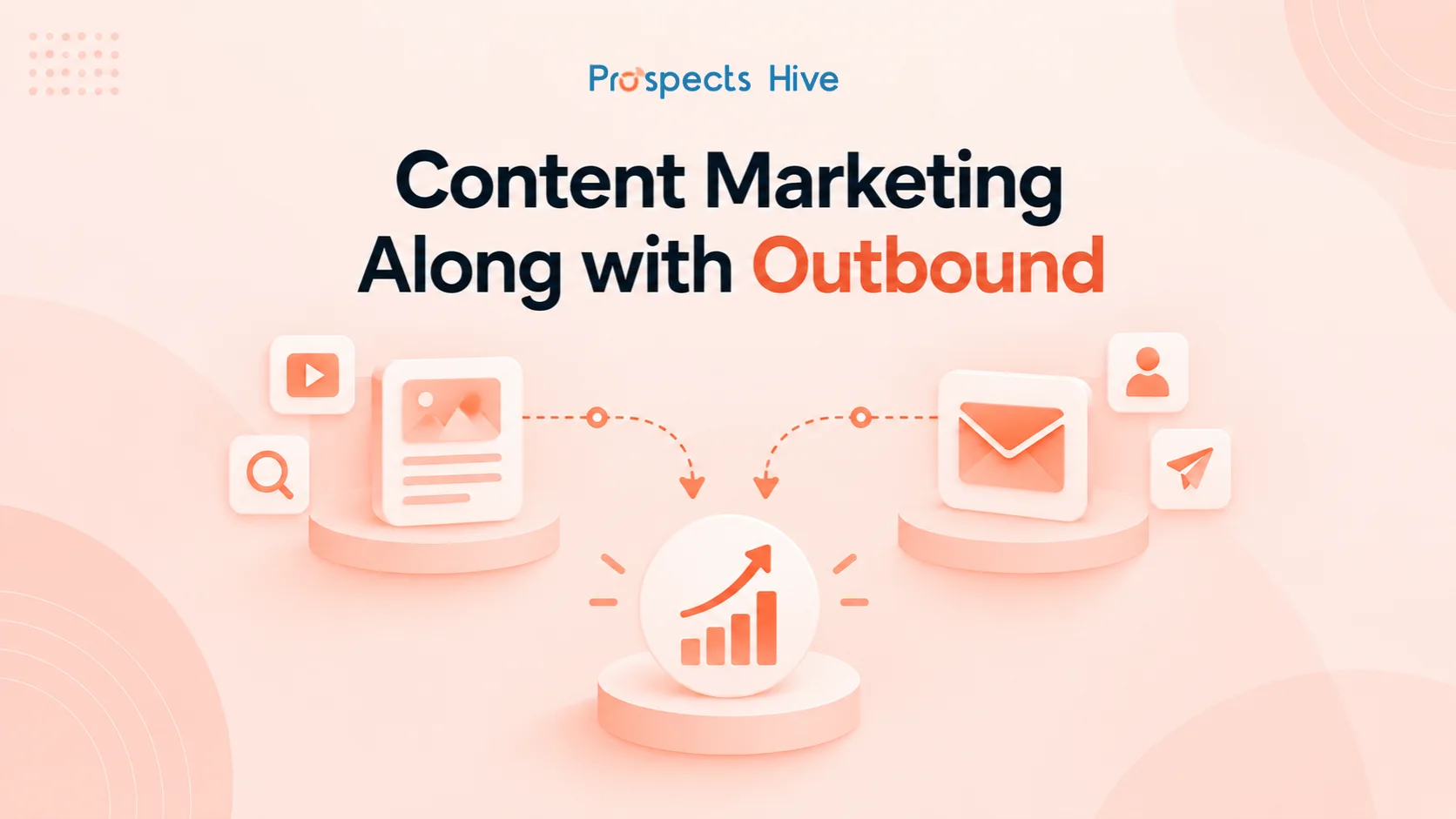
Content does not need to replace outbound marketing. The two can work together, with outbound creating direct conversations and content supporting the research and decisions around those conversations.
This guide explains how content marketing strengthens an existing outbound strategy. You will also see what content to create, when to invest, and how to measure its effect on pipeline.
Why Content Marketing Still Matters When Outbound is Working
Content marketing still matters because outbound can reach the right prospect without answering every question that comes after a cold email or LinkedIn message. Your outreach can earn attention, but prospects may still need proof and more detail before they reply or book a call.
Outbound gives you control over who you contact. You can define your ICP, research target accounts, identify relevant contacts, and start conversations through cold email or LinkedIn.
Content covers what a short outbound message cannot. Articles, case studies, comparison pages, and research can give prospects more detail when they want to understand the problem or evaluate your approach.
That is one reason B2B content marketing works well alongside outbound. It gives relevant prospects useful information while your sales team continues reaching selected accounts directly.
Content can also create demand outside your prospect lists. Search engines and other distribution channels can put your company in front of people already researching problems your service solves.
What Happens After a Prospect Receives Your Outreach?
An interested prospect may research your company before replying to your outbound message. A cold email can create interest without producing an immediate response.
The prospect may visit your website, check your LinkedIn presence, read a case study, or look more closely at the service you mentioned. They may also research the problem itself before deciding whether a sales conversation is worth their time.
B2B buyers often form vendor preferences before speaking with sales. The 2025 6sense B2B Buyer Experience Report found that buyers chose a vendor from their Day One shortlist in 95% of the purchases studied.
That makes the information prospects find about your company important. Content can give them useful proof and answers before the first sales conversation begins.
Prospects Research Your Company Before They Reply
Your content helps prospects check whether the claims in your outbound message hold up. A cold email may get their attention, but they can still look for evidence before replying.
They may want to see:
- Experience with companies like theirs
- Evidence that you understand the problem
- Relevant case studies
- Details about your approach
- Integration or implementation information
- Comparisons with other options
- Proof of results
If that information is easy to find, your outbound message has more evidence behind it. Thin service copy or generic claims mean sales has to build that credibility from scratch on the call.
Your outbound message and the content prospects find afterwards should also tell the same story. Different positioning across email, LinkedIn, service pages, and articles creates unnecessary confusion.
Content Answers Questions Before the First Sales Call
Useful content can answer common prospect questions before sales needs to explain them on a call. That leaves more time to discuss the prospect’s actual system, priorities, and constraints.
For example, a company considering CRM optimization may first want to understand why lead routing keeps failing. Another team may want to know what CRM data cleanup involves before discussing an implementation.
A practical guide can answer those questions before a discovery call or demo. Sales can then focus on how the problem applies to that specific company instead of spending the call explaining basic concepts.
5 Ways Content Marketing Makes Your Outbound Campaigns Stronger
Content marketing makes outbound stronger by giving prospects useful information before, during, and after direct outreach. It can build familiarity before an email arrives, support the claims sales makes, and give reps useful reasons to continue the conversation.
The value comes from using content where outbound alone has limits. The five areas below show where that difference matters most.
1. Content Warms Up Cold Outreach Before You Hit Send
Content can make a prospect familiar with your company before your cold email or LinkedIn message reaches them. They may have already seen one of your LinkedIn posts, found a guide or report through search, or visited your website while researching the problem.
That prior exposure will not happen with every account. But when it does, your company name is no longer completely unfamiliar when sales reaches out.
Targeted content can also create useful context around the problem you plan to discuss. For example, an article about a common CRM issue can introduce the problem before your outbound campaign approaches companies dealing with it.
The goal is not to publish content just so prospects recognize your logo. Create content around the problems, questions, and situations your target accounts already care about.
2. Content Adds Proof Behind Your Outbound Claims
Content gives prospects evidence behind the claims you make in cold email, LinkedIn outreach, and sales conversations. A short message can say you understand a problem, but it has little room to prove that expertise.
Case studies can show how you handled a similar situation. Original research can support a market insight, while a practical guide can show how you approach a problem in detail.
This ability to show rather than simply claim expertise is one reason content marketing is important for B2B companies. Prospects often need more evidence before they are ready to trust a new provider.
The content still needs to match the claim in your outreach. If your email talks about fixing CRM routing problems, a detailed CRM workflow guide is more useful than an unrelated high-traffic blog post.
3. Content Gives Reps a Real Reason to Follow Up
Relevant content gives sales a useful reason to follow up without repeating the same meeting request. The next message can answer a question the prospect already raised.
For example, a prospect may be concerned about implementation. Sending a practical process guide gives the follow-up a clear purpose.
The same approach works with other sales questions:
- Need for proof → case study or testimonial
- Comparison question → comparison page
- ROI concern → business-case content
- Integration question → technical guide
- Industry concern → relevant research or insight
One piece of content can support several conversations when the same issue appears across accounts. The key is to match the resource to the prospect’s actual question.
Sending an unrelated article just to keep the conversation active adds little value. The content should help move the discussion forward.
4. Content Keeps Good-Fit Prospects Engaged Until Timing Improves
Content helps you stay relevant when a good-fit prospect has interest but is not ready to move forward yet. Outbound can reach the right company months before the timing works.
The prospect may still be tied to another provider. Budget may not open until the next quarter, or another project may have taken priority.
Useful content gives you a reason to stay in contact without repeatedly asking for a meeting. A relevant article, research report, webinar, or practical guide can continue helping the prospect while they wait.
This is especially useful in B2B sales cycles where decisions can take time. When the project becomes active again, the prospect already has useful context about your company and approach.
5. Content Captures Demand Outside Your Outbound Lists
Content can attract relevant prospects that your outbound team has never contacted. Even a strong account list cannot include every company researching the problem you solve.
SEO content gives those prospects another way to find you through search engines. Useful LinkedIn content, referrals, and shared resources can create additional discovery paths.
This matters because some potential customers are already looking for answers before your outbound campaign reaches them. Helpful content can put your company in front of that demand at the right time.
The goal is not to generate traffic for its own sake. Content should attract people who match your target audience and have a realistic reason to consider your service.
Outbound still gives you direct control over who you contact. Content adds another path into pipeline rather than replacing that outbound motion.
Content Marketing vs Outbound: Cost, Speed, and ROI
Outbound can create sales activity faster, while content marketing usually builds value over a longer period. That is why comparing the two only by this month’s lead count gives an incomplete picture.
Outbound lets you choose accounts and start conversations quickly. But it needs continued prospect research, data, tools, sending, and follow-up to keep that activity moving.
Content has a different cost pattern. You may invest in research, production, design, distribution, SEO where relevant, and ongoing updates, but a useful asset can support more than one campaign.
| Area | Outbound Marketing | Content Marketing |
|---|---|---|
| Main Purpose | Reach selected prospects directly | Help prospects discover, research, and evaluate |
| Speed | Can start conversations quickly | Usually needs more time to build demand |
| Reach | Based on selected accounts and contacts | Can extend through search, social, referrals, and sharing |
| Ongoing Work | Requires continued prospecting and outreach | Requires creation, distribution, and updates |
| Sales Role | Starts direct conversations | Supports research and active conversations |
| Cost Pattern | Ongoing data, tools, people, and execution | Creation cost with potential reuse across channels |
| Long-term Value | Activity slows when execution stops | Strong assets can keep supporting demand and sales |
Content is not automatically more cost-effective than outbound. A weak content asset that attracts the wrong audience may produce little commercial value.
The difference is reuse. One case study can support cold email, LinkedIn outreach, follow-ups, proposals, and active sales conversations.
The same applies to SEO content. A strong page can continue attracting relevant search demand after publication, although rankings and traffic still need monitoring and updates.
Time to results also depends on the content type. Sales-support content can help as soon as reps start using it, while SEO-led content usually needs longer to gain meaningful organic visibility.
For that reason, measure ROI across the wider acquisition process. Look at pipeline created, opportunities influenced, sales usage, and customer acquisition cost instead of assuming either channel wins on cost alone.
What Content Works Best with Outbound Sales?
The best content for outbound answers a question, objection, or concern that already appears in prospect conversations. Start with what sales needs to explain, then choose the content type.
You do not need to create every possible format. A focused case study can be more useful than several webinars, e-books, or social media posts that do not support a real sales need.
| Outbound or Sales Situation | Content to Create | What It Helps With |
|---|---|---|
| Prospect does not fully understand the problem | Educational guide | Explain the issue |
| Prospect wants evidence | Case study or testimonial | Provide proof |
| Prospect is comparing approaches | Comparison page | Clarify the differences |
| Prospect questions ROI | Business-case content | Support internal justification |
| Prospect worries about execution | Implementation guide | Explain the process |
| Prospect has technical concerns | Integration or workflow content | Provide practical detail |
| Outreach needs a useful conversation starter | Original research or industry data | Add a relevant insight |
| Opportunity has gone quiet | Relevant educational resource | Give the follow-up a reason |
Your outbound activity can tell you which of these assets to create first. Review cold email replies, LinkedIn conversations, discovery calls, CRM notes, and lost opportunities for questions that keep appearing.
If several prospects ask how your service works with their CRM, that may justify an integration guide. If the same comparison keeps coming up on calls, a comparison page may remove that information gap.
SEO data can still help validate demand. But a lower-volume topic that matters to your ICP can be more commercially useful than a broad keyword that attracts people who will never become clients.
How Content Fits Across an Outbound Campaign
Content works best in outbound when it answers a real need at the right stage of the conversation. Adding a content link to every cold email will not automatically increase replies or conversions.
The right role changes as the conversation develops.
Before Outreach: Build Proof Around Your Message
Create the proof behind your outbound message before you launch the campaign. If the email makes a strong claim, prospects should be able to find information that supports it.
That may be a case study, detailed service page, research report, or practical guide. Good supporting content makes the campaign feel connected to a credible business rather than an isolated email sequence.
This is especially useful when you target a defined industry or problem. Your website should reflect the same understanding shown in your outbound message.
During Outreach: Share Content Only When It Adds Context
Share content during outreach when the resource strengthens the reason you contacted that prospect. Do not force a resource into a cold email just because you have one.
An industry report may support a message about a new problem in the market. A relevant case study may provide proof when your prospect resembles the company in the example.
Keep the message simple. The content should support the conversation, not become another task the prospect has to complete.
After Engagement: Match Content to the Next Question
Use follow-up content to answer the next question the prospect needs solved. Once a conversation starts, generic nurture content becomes less useful.
Someone concerned about implementation needs process information. A stakeholder preparing an internal business case may need ROI evidence or a case study instead.
CRM notes and sales feedback help you choose the right resource. This makes content part of relationship-building rather than a separate marketing campaign.
How to Measure Content’s Impact on Your Outbound Pipeline
Measure content by how it helps create or progress qualified opportunities, not by traffic alone. A page can attract thousands of visitors without contributing to pipeline.
Content attribution is difficult because one B2B opportunity can involve several touchpoints. Content Marketing Institute’s 2025 B2B research found that 56% of marketers struggled to attribute ROI to content, while the same percentage struggled to track customer journeys.
For an outbound-led business, useful measures include:
- Content-sourced opportunities: Prospects who first entered your pipeline through content
- Content-influenced opportunities: Outbound prospects who engaged with content during the sales process
- Content-assisted meetings: Meetings where a case study, guide, report, or other resource helped move the conversation forward
- Target-account engagement: Relevant accounts viewing important content before or during outreach
- Sales usage: Content that reps regularly use in follow-ups and active deals
- Qualified organic enquiries: Search-driven leads that match your ICP
- Pipeline and revenue: Opportunities and revenue connected to content
- Blended customer acquisition cost: What it costs to create pipeline across content and outbound together
Do not treat every pageview as proof that content influenced a deal. Use CRM history, campaign data, content engagement, and sales feedback together.
Content Marketing Institute also found that 74% of surveyed B2B marketers said content helped generate demand or leads. Only 49% said it helped generate sales or revenue. That gap shows why content needs a clear role in the wider GTM system.
When Content Marketing Should Wait and When It’s Time to Invest
Invest in content when your outbound motion has produced enough market insight to guide what you create. Content should not become a distraction from an unclear ICP, weak offer, or poor targeting.
You are in a stronger position to invest when:
- Your ICP is clearly defined.
- Your offer gets meaningful interest.
- The same prospect questions keep appearing.
- Sales sees repeat objections.
- You have useful proof or case studies.
- Prospects research you after outreach.
- Reps need better resources for follow-ups.
- You want another source of qualified demand.
These signals give your content creation process real inputs. You know who the content is for and what it needs to solve.
Content should wait when those fundamentals are still unclear. If you do not know who responds to your offer or why they care, creating more content will not solve the underlying GTM problem.
Fix targeting, positioning, and messaging first. Then use what outbound teaches you to make content that supports the same market.
Common Mistakes Outbound Teams Make When Adding Content
The biggest mistake is creating content without giving it a clear role in your outbound and sales process. That leads to pages that generate activity but do little for pipeline.
Common mistakes include:
- Adding content links to every cold email: A link is useful only when it supports the message.
- Choosing topics only by search volume: Traffic from the wrong audience has little commercial value.
- Creating generic content: Quality content should answer a real question or add useful insight.
- Ignoring sales feedback: Repeated objections often reveal valuable content opportunities.
- Measuring success through traffic alone: Pipeline impact matters more than vanity metrics.
- Expecting instant SEO results: Organic search often takes time to build.
- Publishing without distribution: Even useful content needs a clear way to reach the target audience.
- Creating too many formats: A strong guide or case study is better than several weak assets.
- Treating content and outbound as separate teams: Both should learn from the same prospect conversations.
More content does not automatically mean more marketing success. Create fewer pieces when needed, but make sure each one has a clear audience and purpose.
How Prospects Hive Builds Content Around Your Outbound Motion
Prospects Hive builds content to support the same ICP, sales process, and outbound motion. Its content strategy uses audience pain, search intent, buying triggers, and sales feedback to decide what should be created.
That content can include case studies, comparison pages, lead magnets, LinkedIn posts, nurture emails, and sales enablement resources and more. Prospects Hive also creates content that can support cold email, follow-ups, objection handling, and active sales conversations.
On the outbound side, Prospects Hive runs personalized cold email and LinkedIn campaigns. CRM automation can log interactions, replies, and outcomes, while campaign reporting tracks performance by campaign, persona, response type, and touchpoint.
The goal is to make content useful inside the same outbound motion, not treat it as a separate publishing activity. Content gives prospects more context and proof, while outbound creates direct conversations with the accounts you want to reach.
Bottom Line
Invest in content marketing alongside outbound when it gives your existing GTM system leverage that more outreach alone cannot provide. Outbound reaches selected prospects directly, while content supports research, trust, follow-up, organic discovery, and long-term demand.
You do not need to replace a working outbound engine. Use the questions and objections from those campaigns to create content that makes the wider sales process stronger.
Then measure what happens. The right content strategy should help create or progress real opportunities, not simply add more pages to your website.
Frequently Asked Questions
Is content marketing worth it if outbound already works?
Yes, content marketing can still add value when outbound already works. It gives prospects more information, proof, and reasons to trust your company. It can also support follow-ups and attract relevant prospects outside your outbound lists.
Does content marketing replace outbound sales?
No, content marketing does not replace outbound sales. Outbound helps you reach selected prospects directly, while content supports their research and evaluation. Both can work together as part of the same B2B growth strategy.
How does content marketing help cold email?
Content can make cold email more useful by adding relevant proof or context. A case study, research report, or practical guide can support the message you are sending. The resource should relate directly to the prospect’s problem or question.
What content works best with outbound sales?
The best content answers questions that prospects already raise during sales conversations. Case studies can provide proof, comparison pages can support evaluation, and guides can explain implementation. Research and ROI content can also help when the situation calls for them.
How Long Does Content Marketing Take to Work?
The timeline depends on the type of content and its purpose. A case study or sales resource can support reps as soon as it is published. SEO-focused content usually takes longer because organic visibility develops over time.
How Much Should a B2B Company Spend on Content Marketing?
There is no fixed content marketing budget that suits every B2B company. Your spend should depend on your pipeline goals, outbound performance, sales needs, and available resources. Start with the content gaps that have the clearest connection to your prospects and sales process.
How Do You Measure Content’s Impact on Outbound?
Measure whether content helps create or progress qualified opportunities. Useful metrics include content-assisted meetings, influenced pipeline, qualified organic leads, sales usage, and revenue. CRM data and sales feedback can help show where content played a role.
Should a B2B Company Start with Content or Outbound?
It depends on how well you understand your target market. Outbound can give you faster feedback on your ICP, offer, and messaging. Content becomes easier to target when those conversations reveal repeat questions, objections, and information gaps.