A prospect has a problem your company can solve, but they are not ready to speak with sales yet. They start by searching for answers.
They may read a few articles, compare different approaches, check case studies, or see what companies are sharing on LinkedIn. Useful content helps them make sense of that research before a sales conversation starts.
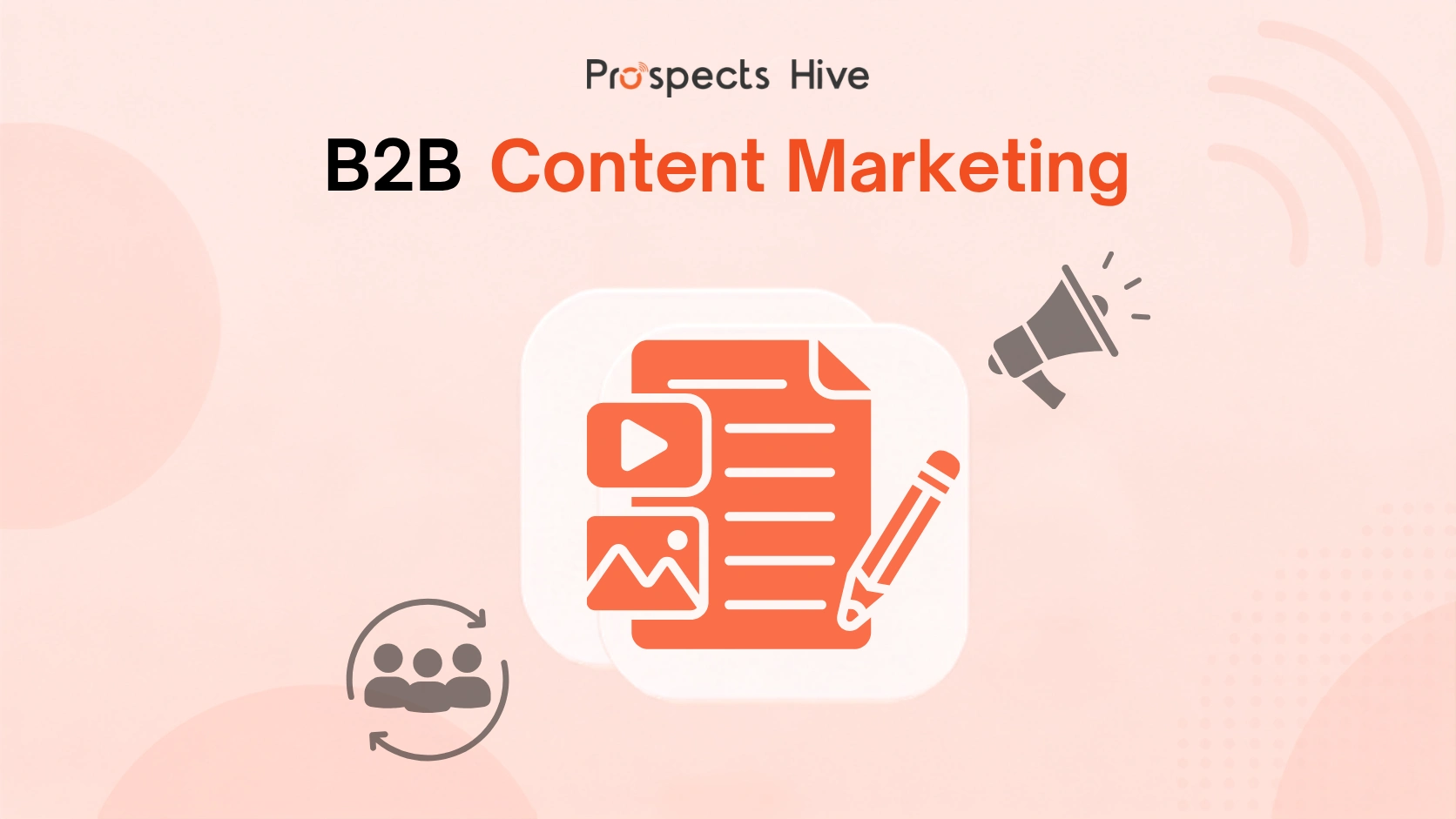
So, what is B2B content marketing? B2B content marketing is the process of creating and sharing useful content for businesses, decision-makers, and professionals who are researching problems or evaluating solutions.
It is not just about publishing blogs. B2B content can educate an audience, answer real questions, explain possible solutions, provide proof, and give sales teams useful material when a conversation moves forward.
This guide explains how B2B content marketing works, who it is for, the main content types, how content fits different stages of a decision, and how to build and measure a practical content strategy.
What is B2B Content Marketing?
B2B stands for business-to-business. B2B content marketing is the practice of creating and distributing useful, relevant content for other businesses and the people involved in their decisions. The content can explain a problem, answer a question, compare possible approaches, or show how a product or service can help.
For example, a CRM company might publish a guide on reducing duplicate records. A cybersecurity firm might release research on emerging risks, while an accounting platform could publish a case study about shortening the month-end close.
Each piece helps the audience understand something useful while staying relevant to the problems the company solves, and to the specific person reading it.
B2B content can also support lead generation when people discover useful resources while researching a problem or possible solution.
And it goes far beyond blog posts. B2B content can include research, case studies, whitepapers, newsletters, webinars, videos, LinkedIn content, landing pages, tools, and sales resources.
The format is not the starting point. The starting point is what the target audience needs to understand.
How Does B2B Content Marketing Work?
B2B content marketing works by matching useful content with the questions prospects ask while researching a problem or solution.
A company first understands its target audience, the people involved in the decision, and what they need to know. It then creates content around those questions and distributes it through channels such as search, LinkedIn, email, and outbound.
A simple flow looks like this:
Understand the audience → identify their questions → create useful content → distribute it → measure what happens
Different content can support different stages. An article may explain a problem, while a case study or comparison page can help later when a prospect starts evaluating solutions.
Search behavior, content engagement, and sales conversations can then show what prospects need next.
B2B Content Marketing vs B2C Content Marketing
B2B content marketing usually supports a business decision that involves more research, detail, and stakeholders. B2C (business-to-consumer) content marketing usually speaks to individuals making personal purchasing decisions.
Both can educate and persuade. The main differences come from the audience, decision context, and information people need.
| Area | B2B Content Marketing | B2C Content Marketing |
| Audience | Businesses and professional decision-makers | Individual consumers |
| Main focus | Business problems, risks, processes, and outcomes | Personal needs, preferences, and interests |
| Decision process | Often involves more research | Often involves fewer steps |
| Stakeholders | Several people may influence the decision | Often one person or household |
| Content depth | Often detailed and educational | Often quicker to consume |
| Common proof | Case studies, research, data, ROI | Reviews, recommendations, demonstrations |
| Common channels | Organic search, LinkedIn, email, webinars, industry media | Organic search, social media, email, creators, ads |
Think about a company choosing a new CRM. Sales may care about usability, operations may focus on automation, and finance may want clear cost information.
One general message will not answer all three. B2B content often needs to cover the same decision from different angles.
What Types of Content Do B2B Companies Use?
B2B companies use different content formats because each format serves a different information need. The right choice depends on the topic, audience, and stage of the decision process.
| Content type | What It is Useful For |
| Blog posts and guides | Answering search questions and explaining business problems |
| Case studies | Showing real situations, processes, and results |
| Whitepapers and ebooks | Explaining technical subjects or detailed frameworks |
| Industry reports | Sharing original data, trends, and market insight |
| LinkedIn content | Reaching professional audiences with useful insights |
| Email newsletters | Keeping an interested audience informed over time |
| Thought leadership | Sharing informed ideas and a clear point of view |
| Webinars | Teaching detailed topics and answering questions |
| Videos | Explaining concepts, products, or workflows visually |
| Comparison content | Helping prospects evaluate approaches or options |
| Landing pages | Explaining a specific product, service, or offer |
| Sales content | Supporting follow-ups, objections, and active opportunities |
A simple question may only need a short article. A technical subject may need a detailed guide, webinar, or research report.
Thought leadership works differently again. It is strongest when a company can add original research, first-hand experience, or a useful view on an industry issue.
How Content Supports Different Stages of a B2B Decision
B2B content should change as a prospect moves from understanding a problem to evaluating and validating a solution. The questions usually become more specific as the decision develops.
The process is rarely perfectly linear. Someone may read an article, return weeks later through a newsletter, compare solutions, and only then contact a company.
Mapping content to different stages still helps teams see what information is missing.
Awareness and Problem Research
Awareness content helps people understand a problem, trend, or opportunity. They may know something needs attention without knowing which type of solution they need.
Useful formats include educational articles, introductory guides, industry reports, research, podcasts, LinkedIn posts, and infographics.
For example, an operations manager may search why CRM data keeps becoming inaccurate. A useful article can explain the common causes before discussing any specific provider.
The focus here is the problem. The reader needs a clear answer before they need a sales message.
Solution Research and Evaluation
Evaluation content helps people understand different approaches and decide what could fit their situation. They already understand the problem and now need more detail.
Detailed guides, whitepapers, webinars, checklists, frameworks, and comparison pages can work well. These formats can explain trade-offs, processes, costs, and practical differences.
A company comparing two software options, for example, may need information about integrations, implementation, reporting, and pricing structure. A basic introductory article will no longer be enough.
Validation and Decision
Decision-stage content provides the proof and practical detail people need before moving forward. General educational content is usually not enough at this point.
Case studies, testimonials, ROI tools, FAQs, implementation guides, tutorials, and detailed product or service pages can help. They answer questions about results, fit, process, and risk.
Different stakeholders may still need different information. Finance may focus on commercial impact, while a technical team may care more about implementation and integrations.
How B2B Content Supports Sales Outreach
B2B content can support direct sales conversations as well as inbound marketing. Useful content gives sales teams relevant material when a prospect needs more information or proof.
Suppose someone raises a concern during a discovery call. A case study involving a similar situation can answer that concern more clearly than another general follow-up.
Sales teams can use content to:
- Answer recurring questions
- Share proof after a call
- Support comparison and evaluation
- Explain a process
- Address common objections
- Nurture a contact over time
- Re-engage an older opportunity
This type of material is often called sales enablement content. Its purpose is to help sales teams explain, educate, and provide evidence during active conversations.
The relationship also works in reverse. Questions heard repeatedly during sales conversations can show the content team what needs better coverage.
How B2B Content Reaches the Right Audience
B2B content needs distribution because useful content has little value if the right prospects never see it. The best channel depends on where the audience searches, reads, and communicates.
For many B2B companies, organic search, LinkedIn, email, and outbound work together. Each channel puts content in front of prospects in a different way.
Organic Search
Organic search helps B2B content appear when people actively search for a question, problem, or solution. SEO is the practice that makes this possible. It covers how a page is structured, what it targets, and whether it actually answers what the searcher needs.
Search intent should shape a page before the writing starts. A keyword tells you what someone searched. Search intent tells you what they expect the result to give them, and those two things are not always the same.
Search discovery is also changing as people use traditional results alongside AI search experiences. Google says the same foundational SEO practices continue to apply to AI Overviews and AI Mode.
LinkedIn helps B2B companies share useful ideas directly with professional audiences. It works well for short insights, practical lessons, research findings, opinions, and examples.
The platform can also support outreach. Someone who has already seen useful posts from a company has more context when a connection request or message arrives.
Content does not need to become a daily sales pitch. Useful LinkedIn content should give people a reason to read even if they are not ready to speak with sales.
Email and Newsletters
Email gives B2B companies a way to keep useful content in front of prospects over time. It works especially well when the sales process does not happen in one conversation.
Newsletters can share broader insights and new resources. Nurture emails can send more focused content based on what a prospect has already shown interest in.
Sales follow-ups need even more context. A case study or guide should relate to something discussed, not appear as a random link.
Outbound and Account-Based Distribution
Outbound lets a company put relevant content directly in front of selected accounts and contacts. It removes the need to rely only on organic discovery.
For example, a team targeting finance companies could share a guide written around a common problem in that industry. The same content could support email, LinkedIn, and follow-up conversations.
This also fits account-based marketing. Content can be selected or created around the needs of a smaller group of high-value accounts rather than a broad audience.
How to Build a B2B Content Marketing Strategy That Supports Sales
A B2B content marketing strategy decides who the content is for, what it needs to cover, where it will appear, and how results will be measured. It gives direction to the ongoing content marketing work.
B2B content marketing and content strategy are related, but they are not the same. Content marketing is the activity, while the strategy is the plan behind that activity.
Define Your ICP and Stakeholders
Start with a clear ideal customer profile before choosing topics. “B2B companies” is far too broad to guide useful content.
Define details such as industry, company size, market, business model, and common problems. Then identify the roles that influence the decision.
A sales leader and a founder may care about the same service for different reasons. Your content needs enough context to speak to both when relevant.
Research Real Questions, Problems, and Search Intent (H3)
Strong B2B topics come from questions prospects already ask. You do not need to guess every topic from a blank content calendar.
Useful research can come from:
- Search queries
- Sales calls
- CRM notes
- Prospect objections
- Client conversations
- Support questions
- LinkedIn discussions
- Industry communities
- Competitor content gaps
- Demo and discovery calls
Search data shows what people look for online. Sales conversations show the questions that appear once a real business conversation begins.
Use both. That gives the content more depth than relying on keyword volume alone.
Map Content to the Decision Process
Map each important question to the stage where a prospect is most likely to ask it. This helps you see whether your content covers the full decision process.
A company may already have 50 introductory blog posts but no case studies for active opportunities. That is a content gap, even if the blog gets traffic.
The same map can show stakeholder gaps. You may have content for marketing leaders but nothing that helps finance or operations review the same solution.
Choose Topics and Formats Based on Purpose
Choose the topic first, then use the format that explains it best. Do not publish a webinar, ebook, or report only because other companies are doing it.
A simple question may need a short article. A complex process may work better as a webinar, detailed guide, or visual walkthrough.
The topic also needs a clear connection to your ICP. Traffic from people who will never need your service does little for the wider GTM (go-to-market) process.
Plan Distribution Before Publishing
Decide how people will find the content before you create it. Distribution should be part of the plan from the beginning.
Ask where the content belongs. It may target Google search, support LinkedIn posts, enter an email newsletter, or become a resource for outbound follow-ups.
Some content can serve several channels. But each channel needs its own presentation rather than the same copy pasted everywhere.
Repurpose Strong Content Across Channels
One useful idea can create several pieces of content when each version fits its channel. This helps teams get more value from strong research and subject knowledge.
For example:
Industry research → detailed guide → LinkedIn posts → newsletter → sales resource → outbound follow-up
The core insight stays the same. The length, angle, and context change.
That is different from simply reposting the same paragraph. Good repurposing makes the idea useful in a new setting.
Review Performance and Improve
A content strategy should change when real data shows what prospects use and respond to. Review both marketing performance and sales feedback.
An article that attracts the right search traffic may deserve an update or supporting content. A case study that sales keeps using may signal a need for more proof around the same problem.
Some content will also miss the mark. Update it, change the angle, or stop investing in it instead of keeping it alive because it once appeared on the calendar.
How to Measure B2B Content Marketing Performance
B2B content marketing should be measured beyond traffic because different content does different jobs. A search article and a sales case study should not have the same success metric.
A simple measurement model can include four areas:
| Area | Metrics to review |
| Visibility | Search impressions, rankings, organic traffic, LinkedIn reach |
| Engagement | Newsletter sign-ups, downloads, webinar registrations, content interactions |
| Lead activity | Qualified enquiries, demo requests, meetings, content-assisted conversions |
| Pipeline impact | Opportunities influenced, sales progression, conversions, revenue influenced |
Traffic still matters when visibility is the goal. But high visitor numbers do not automatically mean the content is reaching the right companies.
B2B decisions also involve several touchpoints. Someone may find an article through search, see a LinkedIn post later, and receive a case study from sales before booking a call.
That makes attribution less tidy. CRM records, campaign tracking, conversion data, and sales feedback can give a clearer picture than one final-touch metric.
Common B2B Content Marketing Mistakes (H2)
Most B2B content mistakes come from creating content without a clear audience, question, or distribution plan. The writing can look polished and still do very little.
Common problems include:
- Writing for everyone: Broad targeting usually creates generic content.
- Following search volume alone: A high-volume keyword may have little connection to your ICP.
- Publishing surface-level content: Prospects need useful detail when the problem is complex.
- Ignoring sales questions: Repeated objections and questions often reveal strong content ideas.
- Publishing without distribution: Content cannot support the pipeline if nobody relevant sees it.
- Using one message for every stakeholder: Different roles often need different information.
- Measuring traffic alone: Visibility does not show whether content supports useful conversations.
- Producing content only for volume: More pages do not help when the information is repetitive or inaccurate.
A better approach starts with the prospect’s real question. Then it connects that question to the right format, channel, and business context.
How Prospects Hive Supports B2B Content Marketing
Prospects Hive connects B2B content with the wider GTM and outbound process. The content is planned around the audience, sales process, and channels where prospects already interact.
That can include LinkedIn content, newsletters, landing page copy, case studies, sales resources, and search-focused content. Each piece has a clear role rather than sitting in a separate content calendar with no link to sales.
Content can also support cold email, LinkedIn outreach, nurture sequences, and follow-ups. This gives sales teams useful material when a prospect needs more context or proof.
The process works both ways. Questions from outreach and sales conversations can feed future content topics, so the content reflects what prospects are actually asking.
Bottom Line
B2B content marketing is about creating useful information for businesses and the people involved in their decisions. It helps prospects understand problems, research solutions, compare options, and continue sales conversations with more context.
The strongest approach connects content with ICP research, search intent, LinkedIn, email, outbound, sales, and measurement. That makes content part of the GTM process rather than a collection of disconnected posts.
Read Related Resource: Why Content Marketing is Important for B2B
Frequently Asked Questions
What is a B2B content marketing strategy?
A B2B content marketing strategy is the plan behind the content. It defines the audience, goals, topics, formats, distribution channels, publishing process, and performance measures.
What is a buyer persona in B2B content marketing?
A buyer persona is a profile of the person involved in a B2B buying decision. It shows their role, priorities, responsibilities, questions, and involvement in a business decision.
What is the difference between B2B and B2C content marketing?
B2B content focuses on business problems and often supports decisions involving several stakeholders. B2C content usually speaks to individual consumers and often follows a different research and decision process.
What are the main types of B2B content?
Common types include blog posts, case studies, whitepapers, research reports, LinkedIn posts, newsletters, webinars, videos, comparison pages, and sales resources. The right format depends on the topic and purpose.
Which channels are used for B2B content marketing?
Common channels include organic search, websites, LinkedIn, email, newsletters, webinars, industry communities, publications, events, and outbound campaigns. The best mix depends on where the target audience already looks for information.
How does B2B content support sales?
B2B content gives sales teams useful material for follow-ups, questions, evaluation, and active opportunities. A relevant guide, comparison, or case study can provide context without repeating the same sales message.