GDPR does not ban cold email. It regulates how you collect, store, and use the personal data behind it.
Understanding the GDPR rules for cold emailing comes down to one distinction: if your outreach targets other businesses, you have a workable path forward under legitimate interest. If you are emailing individual consumers, you almost always need consent first.
That distinction is the single most important thing to understand before you send another cold email to anyone in the EU or EEA.
Key GDPR Rules for Cold Emailing at a Glance
- Cold emailing B2B contacts is legal under GDPR’s legitimate interest basis.
- B2C cold email generally needs prior consent.
- You need a documented Legitimate Interest Assessment (LIA), not just an opt-out link.
- Country rules differ. Germany is stricter than France or the UK.
- Non-compliance fines can reach €20 million or 4% of global annual revenue, whichever is higher.
Does GDPR Actually Ban Cold Emailing?
No, it does not. This is the most common myth around GDPR and outbound sales, and it stops a lot of teams from running perfectly legal campaigns.
What GDPR actually does is set rules for processing personal data. A cold email involves personal data the moment it goes to a named individual. So GDPR applies, but applying it does not mean forbidding.
Most B2B teams rely on legitimate interest as their legal basis. That means you can email a business contact without asking for consent first, as long as your outreach is relevant to their role and you follow a specific set of conditions. We will cover those conditions below.
💡 Also Read: Is Cold Email Illegal? The Complete Legal Guide for 2026
When Does GDPR Even Apply to Your Cold Emails?
GDPR applies to your outreach if any of the following are true:
- Your prospect is based in the EU or EEA, regardless of where your company is located.
- You are processing personal data, meaning information that can identify a specific person.
- You use tools or platforms that track or profile individuals in the EU.
Here is where it gets practical. Not every email address counts as personal data.
- info@company.com is a generic address. It is not tied to one identifiable person, so GDPR’s personal data rules generally do not apply to it.
- jane.doe@company.com identifies a specific individual. This counts as personal data, and GDPR applies.
If your list is full of named work emails, assume GDPR applies and plan your outreach accordingly.
The Legal Basis You Need Before You Hit Send
Consent vs. Legitimate Interest, and Why Most B2B Teams Pick the Latter
GDPR gives you 6 possible legal bases for processing personal data. 2 matters for cold email.
Consent means the person actively agreed to be contacted. It has to be freely given, specific, and clearly documented. It is the safest basis, but it does not scale for cold outreach, since you cannot get consent from someone before you have contacted them.
Legitimate interest lets you contact someone without prior consent, provided your reason for reaching out is genuine, relevant to their role, and does not override their right to privacy. This is the basis most B2B outbound teams rely on, and it is the reason cold email remains viable at scale.
💡 Also Read: AI GTM in Outbound Marketing: The 2026 Playbook for Scalable Growth
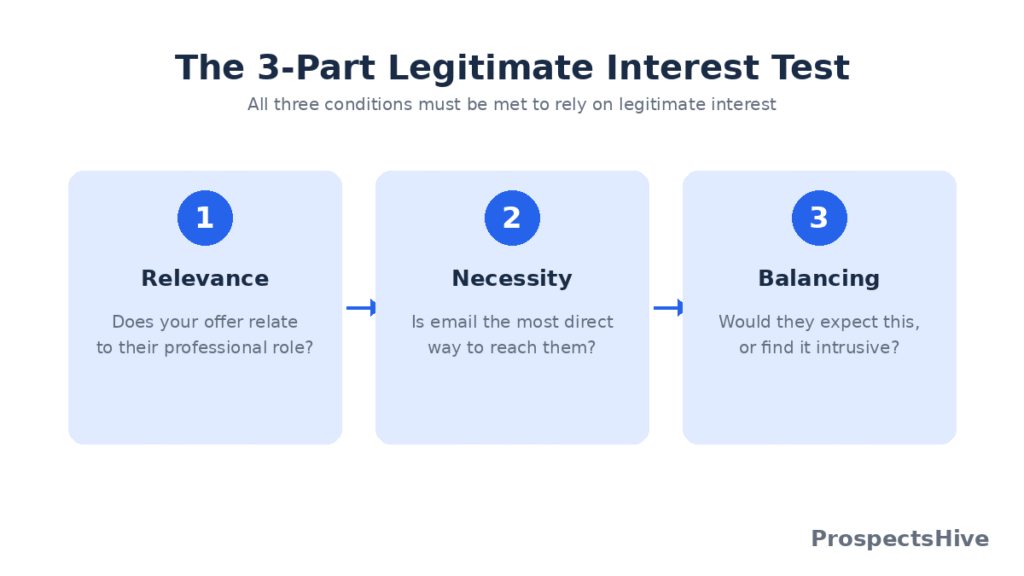
The 3-Part Test for Legitimate Interest
Before you can rely on legitimate interest, your outreach needs to pass 3 checks:
- Relevance. Does your offer directly relate to the recipient’s professional role?
- Necessity. Is email the most direct way to reach them for this purpose?
- Balancing. Would a reasonable person in that role expect this kind of email, or would they find it intrusive?
A quick way to apply this test:
| Scenario | Pass the test? |
| Pitching sales automation software to a Head of Sales | Yes |
| Pitching HR software to an HR Director | Yes |
| Pitching office cleaning services to a Software Engineer | No |
| Pitching generic SEO services to an unrelated department head | No |
If the connection between your offer and the recipient’s job is a stretch, it will not hold up under this test.
What a Legitimate Interest Assessment (LIA) Actually Looks Like
An LIA is the documentation that proves you thought this through before sending, not after a complaint lands.
A basic LIA should record:
- Your purpose for the outreach, stated specifically (for example, “offering a sales engagement tool to sales leaders at mid-size SaaS companies”)
- Why this is necessary and proportionate for that purpose
- Why the recipient’s privacy rights do not override your interest in reaching out
One detail matters here. Document this per campaign, not once as a company-wide checkbox. A campaign targeting CFOs about financial software needs its own reasoning, separate from a campaign targeting IT Directors about security tools.
A one-time blanket LIA does not hold up if a regulator asks you to justify a specific send.
The Non-Negotiables Every Compliant Cold Email Needs
Every cold email you send under legitimate interest should include these 4 elements.
Say Who You Are: State your name, your company name, and include a physical business address in your signature. Do not hide behind a generic sender name or a no-reply address.
Say How You Found Them: Tell the recipient how you got their information. A line like “I came across your profile on LinkedIn” or “I found your details on your company’s team page” builds trust and shows transparency, which GDPR requires.
Link to Your Privacy Policy: Include a link showing how your company collects, stores, and processes personal data. This does not need to be in the email body itself, but it should be one click away.
Give Them an Easy Way Out: Every email needs an obvious opt-out. This can be as simple as “reply STOP to be removed” or a dedicated unsubscribe link. Whatever method you choose, it has to work the first time.
💡 Also Read: Cold Email Templates Guide for B2B Teams
What Happens the Moment Someone Opts Out
GDPR gives recipients the right to object to marketing and the right to have their data deleted. When someone opts out:
- Stop all outreach immediately, including any scheduled follow-up emails already queued.
- Add them to a suppression list so they are not re-added by future imports.
- If they specifically request deletion, remove their data from your CRM, your email tool, and any enrichment platform you used to find them.
Do not treat an opt-out as a soft signal. Continuing to email someone after they have asked to stop is one of the fastest ways to turn a compliance question into a complaint.
Building Your Prospect List Without Breaking GDPR
Where your data comes from matters as much as what you do with it once you have it. Legitimate sources include:
- Company websites and team pages
- LinkedIn, used within its own terms of service
- Public business directories
- Professional databases with verified sourcing
💡 Also Read: How to Find Emails for Cold Emailing (Without Killing Your Deliverability)
Avoid purchased email lists and scraped data from questionable sources. These rarely come with any documented legal basis, and you inherit the compliance risk the moment you use them.
Stick to data minimization. Collect only what you need to run the outreach: name, job title, company, and work email. Skip anything beyond that.
💡 Also Read: How Do I Develop an Email List from LinkedIn Contacts?
GDPR Compliance Checklist Before Launching a Campaign
Run through this before any new campaign goes live.
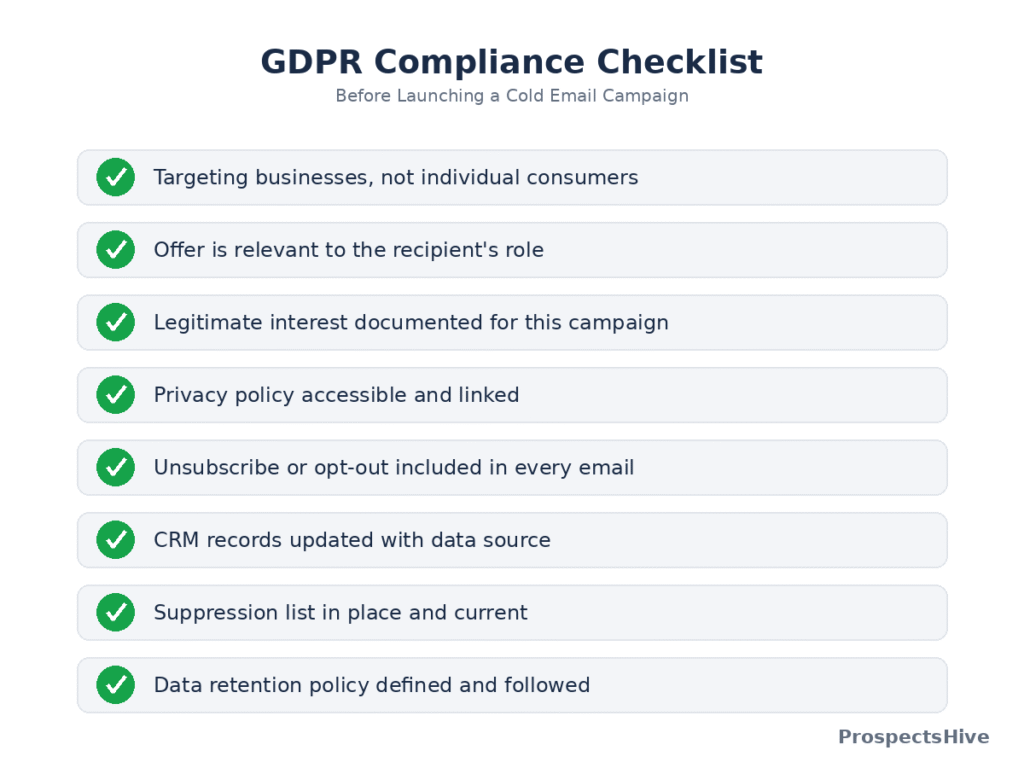
- Targeting businesses, not individual consumers
- Offer is relevant to the recipient’s role.
- Legitimate interest documented for this specific campaign.
- Privacy policy accessible and linked
- Unsubscribe or opt-out included in every email
- CRM records updated with data source
- Suppression list in place and current
- Data retention policy defined and followed.
Understanding the 2 Laws That Affect Cold Emailing
GDPR is not the only regulation in play. A second law sits alongside it, and missing this distinction is where many outbound teams go wrong.
What GDPR regulates:
- Personal data itself
- The lawful basis for processing it
- Individual rights, like access, correction, and deletion
What the ePrivacy Directive covers:
- Rules specifically for unsolicited electronic marketing, including cold email
- Implementation is left to each EU member state, so the exact rules vary by country.
- In the UK, this is implemented as PECR (Privacy and Electronic Communications Regulations)
GDPR tells you how you are allowed to handle someone’s data. The ePrivacy Directive, and its national versions, often decide whether you can market to them in the first place. Both apply at the same time, and the stricter of the two usually wins in practice.
Why the Same Email isn’t Equally Legal in Every Country
This is where most cold email guides stop short, and it is exactly where B2B teams run into trouble. GDPR sets the baseline, but each EU country layers its own marketing rules on top through its national ePrivacy implementation.
Germany’s Stricter Standard
Germany treats unsolicited B2B email with more caution than most of the EU. In practice, German courts and regulators have leaned toward expecting a closer, more direct connection to consent-like conditions, even in B2B contexts.
Teams targeting German contacts should build in extra scrutiny before relying on legitimate interest alone.
France’s More Permissive Stance
France generally allows B2B cold email under legitimate interest when the outreach is clearly tied to the recipient’s professional role. This makes it more workable for outbound teams compared to Germany, though the same relevance and transparency rules still apply.
The UK’s PECR Rules
The UK sits outside the EU but runs its own closely related framework. PECR includes a “corporate subscriber” exemption that treats email addresses tied to companies (rather than individuals) more flexibly, giving UK-targeted B2B outreach a bit more room than some EU countries.
The practical takeaway: if you are running outbound across multiple countries, do not assume one compliance approach covers all of them. What passes in Paris will not automatically pass the same test in Berlin.
Cold Email Mistakes That Get Companies Fined
Most GDPR enforcement actions against cold email programs come down to a handful of repeated mistakes:
- Spray and pray. Blasting thousands of unsegmented contacts with the same message ignores the relevance requirement entirely.
- Buying lists with no consent trail. Purchased lists almost never come with a documented legal basis you can point to later.
- Storing data longer than needed. Holding onto contact records for leads who never responded, with no retention policy, is a data minimization violation.
- Treating an unsubscribe link as the whole strategy. An opt-out link does not replace the need for a documented legal basis, relevant targeting, and transparency.
GDPR and Cold Emailing Myths Debunked
“You always need consent.” Not for B2B outreach. Legitimate interest is a valid legal basis when your outreach is relevant and documented.
“LinkedIn emails are automatically legal.” Using LinkedIn as a data source is fine within its terms of service, but it does not exempt you from GDPR. You still need a legal basis and a valid reason for the outreach.
💡 Also Read: 20+ Best LinkedIn Automation Tools (2026): Ranked by Safety, Features & ROI
“You can email anyone with a work address.” A work email is still personal data if it identifies an individual. Relevance to their role still matters.
“My CRM makes me GDPR compliant.” A CRM can help you manage suppression lists and data retention, but it does not create a legal basis for you. Compliance comes from how you use the tool, not the tool itself.
💡 Also Read: Cold Emailing Tools: Best Software for Scalable B2B Outbound
Conclusion
Cold email and GDPR are not opposites. GDPR does not ask you to stop reaching out to prospects. It asks you to be specific about why you are reaching out, document your reasoning, and give people an easy way to say no.
Role-based, relevant outreach was always the better approach anyway. GDPR just makes it a compliant one too.
That is the same approach we take with every outbound campaign at Prospects Hive. If you would rather have a team that already builds relevant, role-based outreach into every send, see how Prospects Hive runs compliant B2B outbound campaigns.
FAQs
1. What’s the Fine for GDPR Cold Email Violations?
Fines can reach up to €20 million or 4% of a company’s total global annual revenue, whichever amount is higher. The exact penalty depends on the severity and nature of the violation.
2. Is LinkedIn Data Allowed for Cold Emailing Under GDPR?
Yes, as long as you use it within LinkedIn’s terms of service. This does not remove your GDPR obligations. You still need a valid legal basis, like legitimate interest, and the outreach still needs to be relevant to the person’s role.
3. How Long can I Keep Prospect Data Under GDPR?
GDPR does not set one fixed number of days for every case. It requires you to keep data only as long as it serves your stated purpose, under your own documented retention policy.
Once a lead goes cold with no response and no ongoing business reason to keep their data, it should be reviewed for deletion.