Email Conversion Rate

what is a good email conversion rate
Email Conversion Rate

What is a Good Email Conversion Rate?

Ever paused at your dashboard, wondering what is a good email conversion rate? You’re not alone. It’s one of the most searched and misunderstood email metrics. Benchmarks float around without context: one Reddit reply says 2% is great; another says you should aim higher. No one explains why. This guide is here to cut through that noise. We’ll break down what conversion rate actually means, what “good” looks like in real business scenarios, and why chasing surface-level numbers often leads teams in the wrong direction. Most importantly, we’ll focus on improving outcomes without obsessing over vanity metrics. Key Notes  There’s no single “good” email conversion rate. Context matters more than averages. Conversion rates vary by email type: cold, warm, and lifecycle emails behave very differently. Cold emails usually convert in low single digits. Warm email campaigns often reach mid single digits. Lifecycle emails can convert at higher rates, depending on timing and relevance. Audience intent and business model shape what’s realistic. Conversion rate is not the same as open rate or reply rate. Benchmarks without context are misleading and often misused. What is Email Conversion Rate? In email marketing, conversion rate measures how many recipients take the intended action after receiving an email. A conversion is not the email itself. It’s what happens after the email does its job. In simple terms: Conversion = the desired action after an email is received. That action depends on the email’s goal. Common examples include: Booking a demo Submitting a form Completing a purchase Signing up for a trial or newsletter Many teams optimize opens or clicks and assume progress. But reporting on the wrong metric leads to the wrong decisions. Conversion rate keeps performance tied to outcomes rather than activity. 💡The Ultimate Guide to Email Conversion Rate What is a Good Email Conversion Rate? A good email conversion rate depends on who you’re emailing, why you’re emailing, and what you’re asking them to do. There isn’t a single number that works across every business or campaign. Context matters more than averages. A good email conversion rate depends on, The intent of the audience The goal of the campaign The stage of the funnel General benchmark ranges (high level) Used carefully, benchmarks can help set expectations. Most email conversion rates fall into these broad ranges: Email marketing campaigns: often land in the low single digits, depending on offer and audience Cold email campaigns: usually lower, since recipients have no prior relationship Automated lifecycle emails: tend to convert higher due to timing and relevance These are reference points, not performance targets. You might ask, why there is no single “perfect” number Conversion rates vary widely based on: Business model and pricing Deal size and sales cycle length Traffic and list quality List age and engagement history Ultimately, a conversion rate is only meaningful when measured against your unique context. What’s strong for one business could be weak for another. Email Marketing Conversion rate Formula and Calculation Email conversion rate tells you how often your emails lead to a meaningful action. To avoid confusion, it’s important to calculate it correctly. The email conversion rate calculation formula is simple: Email Conversion Rate = (Number of Conversions ÷ Number of Delivered Emails) × 100 Numerator (conversions): the number of people who completed the intended action Denominator (delivered emails): emails that actually reached inboxes Delivered emails matter because bounced messages were never seen. Including them inflates results and hides real performance. Some teams use different approaches, which is where confusion starts. Delivered vs sent emails: Always use delivered emails for accuracy. Click-based vs action-based conversions: Clicks show interest; conversions reflect outcomes. Both can be tracked, but they should not be labeled the same. Email marketing Conversion Rate Benchmarks by Industry There is no single “correct” benchmark. Conversion rates vary widely by industry, email type, and audience awareness. Below are realistic email conversion rate benchmarks by industry based on current B2B and B2C performance patterns: Industry Email conversion rate Ecommerce (Overall) 1.8% – 3.34% B2B Tech / Services 1.5% – 4.6% Food & Beverage 4.9% – 7.06% Beauty & Personal Care 3.46% – 6.8% Arts & Crafts 3.89% – 5.11% Finance & Insurance 2.5% – 5.2% SaaS (Software as a Service) 2% – 7% Pet Care & Veterinary Services 2.32% – 4.17% Consumer Electronics 1.68% – 3.6% Automotive 1.33% – 4.0% Apparel & Accessories 1.35% – 3.01% Home & Furniture / Decor 1.24% – 1.9% Toys, Games & Collectibles 1.88% – 1.91% Luxury & Jewelry 0.98% – 1.46% Source: Optimonk How to Improve Email Conversion Rate Increasing your email conversion rate requires a combination of strategic steps that align with your recipients’ behavior, interests, and needs.  Here’s how you can get started: 1. Improve Relevance First Relevance is the largest lever you can pull to increase your email conversion rate. The more tailored the content, the better the chances of conversion.  Segmentation allows you to divide your audience into smaller groups based on factors such as lifecycle, interests, behavior, location, or even device usage. By doing so, you can deliver highly personalized content that resonates with each group’s needs. For example, if you’re a B2B business, sending relevant offers based on the prospect’s industry or job title can dramatically increase engagement.  Emails that include personalized recommendations have a 29% higher open rate and a 41% higher click-through rate. 2. Clear Call-to-Action (CTA)  To drive conversions, ensure your email’s CTA is clear, direct, and easy to act on. It’s crucial to focus your email on a single main CTA to avoid overwhelming the reader. Phrases like “Get the demo,” or “Download the checklist” are action-oriented and guide the recipient toward the next step. Mailchimp reports that emails with a single CTA see a 371% higher click-through rate than those with multiple competing actions. Ensure the CTA is prominently placed, especially on mobile devices where real estate is limited. 3. Reducing Post-Click Friction Often, the conversion rate breaks after the click, so it’s essential to align the email promise with
Email Conversion Rate Benchmarks
Email Conversion Rate

Email Conversion Rate Benchmarks (2026): What Actually Drives Results

Email marketing still works. But most teams are still measuring the wrong metrics. Your open rates are inflated. Clicks could be looking nice in reports. Yet neither tells you if your email is actually driving revenue or not. That’s why knowing email conversion rate benchmarks matter. They shift the focus from activity to a specified outcome: not how many people opened your email, but how many took a meaningful action. In this blog, we’ll break down what email conversion rates really mean in 2026, what the average email conversion rate looks like across industries, and what metrics to look after in terms of email without letting them limit your growth. Read This in 60 Seconds Email conversion rate measures actions, not attention. A “good” email conversion rate depends on intent, audience, and offer. Industry benchmarks are useful, but context matters more. Cold email conversion rate benchmarks are very different from lifecycle or inbound emails. Improving conversion rate for email marketing is mostly about relevance and timing, not volume. Benchmarks guide direction. Systems drive revenue. What Is Email Conversion Rate? Email conversion rate is the percentage of recipients who complete a desired action after receiving your email. That action could be: Booking a meeting Signing up for a demo Downloading a resource Making a purchase Replying to a cold email 💡 The Ultimate Guide to Cold Emailing for Beginners In simple terms, it answers this question: How many people chose to perform a specific action (a “conversion”) after reading or clicking a link in your email? Across channels including email marketing, conversion rate measures how efficiently attention turns into outcomes.  How to Calculate Email Conversion Rate? The email conversion rate formula is simple: Email Conversion Rate = (Number of Conversions ÷ Number of Delivered Emails) × 100 Example: If 1,000 emails are delivered and 25 people convert (by performing a specific action after opening your email), your email marketing conversion rate is 2.5%. Some teams calculate conversion rate based on clicks or opens. That’s not wrong, but it changes the narrative. For revenue-focused teams, delivered emails to final action is the cleanest view. If you prefer automation, an email conversion rate calculator inside your CRM or analytics stack can track this automatically using events and goals. Email Conversion Rate Benchmarks by Industry in 2026 There is no single “correct” benchmark. Conversion rates vary widely by industry, email type, and audience awareness. Below are realistic email conversion rate benchmarks by industry based on current B2B and B2C performance patterns: Industry Email conversion rate Ecommerce (Overall) 1.8% – 3.34% B2B Tech / Services 1.5% – 4.6% Food & Beverage 4.9% – 7.06% Beauty & Personal Care 3.46% – 6.8% Arts & Crafts 3.89% – 5.11% Finance & Insurance 2.5% – 5.2% SaaS (Software as a Service) 2% – 7% Pet Care & Veterinary Services 2.32% – 4.17% Consumer Electronics 1.68% – 3.6% Automotive 1.33% – 4.0% Apparel & Accessories 1.35% – 3.01% Home & Furniture / Decor 1.24% – 1.9% Toys, Games & Collectibles 1.88% – 1.91% Luxury & Jewelry 0.98% – 1.46% Source: Optimonk What Is a Good Email Conversion Rate for Your Business? A good email conversion rate varies by industry, business type, and campaign goals, but typically ranges from 1% to 5% across most sectors. Besides the percentages, a good email conversion rate generally depends on 4 factors: Audience temperature: Cold lists convert differently than warm subscribers. Intent alignment: Educational emails convert less than bottom-of-funnel offers. Offer friction: A demo request is harder than a content download. Traffic quality: List growth strategy directly impacts conversion rate marketing performance. As a rule of thumb: For cold outbound: 1% is healthy, 2% is strong For B2B newsletters: 2%–4% For promotional B2C emails: 3%–6% How to Improve Email Conversion Rate  Increasing your email conversion rate needs a combination of strategic steps, aligned with your recipients’ behavior, interests, and needs.  Below are 5 steps to help you get started: 1. Improve Relevance First Relevance is the smartest tactic you can apply in order to increase your email conversion rate. The more tailored your content is, the better the chances of conversion.  Segmentation gives you the avenue to divide your audience into smaller groups based on factors such as lifecycle, interests, behavior, location, or even device usage. By doing so, you can deliver highly personalized content that resonates with each group’s needs. For instance, if you are a B2B company, you can boost engagement by tailoring offers to a prospect’s industry or role instead of sending the same message to everyone. Emails that include personalized recommendations have a 29% higher open rate and a 41% higher click-through rate. 2. Clear Call-to-Action (CTA)  To drive conversions, you need to make sure that your email’s CTA is clear, direct, and easy to act on. It’s important to frame your email around a single main CTA to avoid overwhelming or confusing the reader. Phrases like “Get the demo,” or “Download the checklist” are action-oriented and can potentially guide the recipient towards the next step. According to Porch Group Media, emails with a single CTA see a 371% higher click-through rate than those with multiple competing actions. 3. Reducing Post-Click Friction More than often it appears that the conversion rate breaks after the click, so it’s essential to align the email promise with the landing page.  To make it easier for the recipient to perform the desired action, your landing page should reflect the same offer and message from the email. This in turn, also minimizes distractions and maintains consistency. For example, if your email promotes a downloadable guide, the landing page should make that download option obvious and immediate, without extra steps or distractions. 4. Testing and Optimizing for Better Results To optimize email conversion rate, you must continuously improvise your emails through A/B testing. Test elements like subject lines, CTAs, and offers. Start by testing one variable at a time, so that you can understand what truly drives conversion. For instance, BigSea discovered that small subject

Email Conversion Rate

The Ultimate Guide to Email Conversion Rate

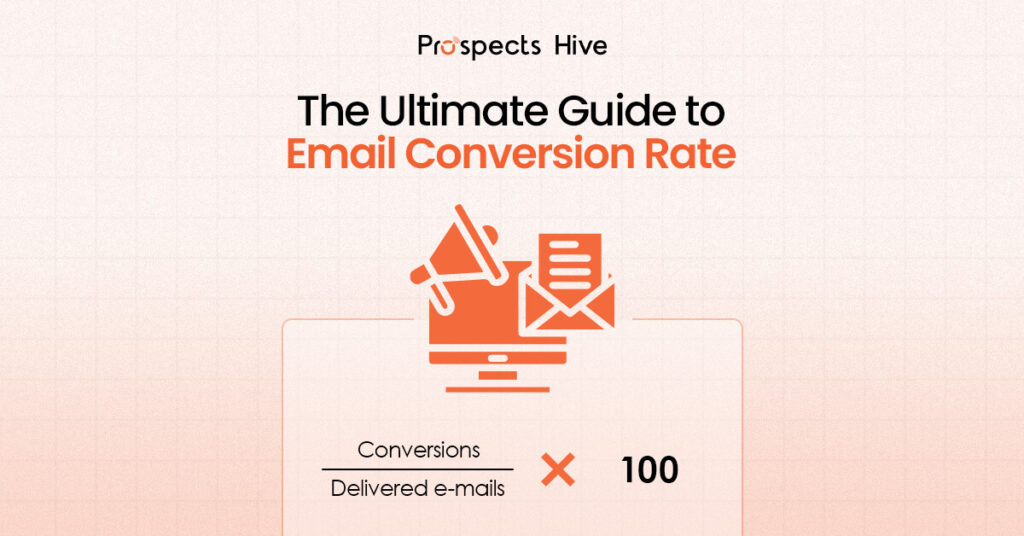
If you’re sending emails and only watching open rates and click-through rates, you’re missing the metric that actually pays the bills: email conversion rate.  This is the number that tells you whether your emails are turning attention into real actions like purchases, demo bookings, sign-ups, or downloads.  The tricky part is that “conversion” can mean different things depending on your goal, and the way you calculate it can change the story.  In this blog, we’ll define it clearly, show you the exact formula, explain what “good” looks like, and share the highest-impact ways to improve it without guessing. Key Notes: Conversion rate means measuring outcomes. Track conversions per delivered, opened, or clicked emails, depending on what you’re optimizing. “Good” varies, but most teams aim for a steady baseline and improve from there. Segmentation, a single CTA, and low post-click friction usually move the needle fastest. Deliverability and list hygiene can quietly cap your conversion rate. What is Email Conversion Rate? To start, it’s important to know the email conversion rate. It is a metric that measures the percentage of recipients who take a desired action (such as making a purchase, signing up, or downloading a resource) after opening an email. It directly correlates with how well your emails drive sales or engagement. One quick point to make it clear: Email response rate is about replies (common in cold email). Email marketing conversion rate is about the outcome you care about (meeting booked, sign-up, purchase, and so on). Formula for Email Conversion Rate: Email conversion rate = ( Conversions / Total Delivered Emails ) * 100 A higher conversion rate means your email campaigns are effectively engaging your audience and persuading them to take action. Well-segmented, personalized emails can see up to 760% higher revenue per email. The Importance of Tracking Email Conversion Rate Conversion rate is the “final step” metric. It tells you whether your email is producing real outcomes, not just activity. Campaign Monitor puts it plainly: low opens suggest timing or subject-line issues, but low conversions may mean you need to reassess the campaign more broadly. It also keeps teams honest across the funnel: If clicks are fine but conversions are low, you likely have post-click friction. If conversions drop suddenly, you may have a deliverability or list quality problem, not a copy problem. What is a Good Email Conversion Rate? A useful rule of thumb: a “good” conversion rate depends on your goal, your offer, and how you define conversion. Unbounce cites Mailchimp, saying a good email conversion rate typically falls between 2% and 5% across industries. 2 things matter more than chasing a universal benchmark: Your email type: Automated flows usually convert better than one-off campaigns because they’re triggered and more targeted. Klaviyo notes that flow conversion rates are typically higher than campaign conversion rates for this reason. Your segment quality: the more relevant the audience, the higher the conversion ceiling. If you want true “by industry” context, benchmark reports can help set expectations, but your best target is usually: beat your own baseline month over month. How to Increase Email Marketing Conversion Rate Increasing your email conversion rate requires a combination of strategic steps that align with your recipients’ behavior, interests, and needs.  Here’s how you can get started: 1. Improve Relevance First Relevance is the largest lever you can pull to increase your email conversion rate. The more tailored the content, the better the chances of conversion.  Segmentation allows you to divide your audience into smaller groups based on factors such as lifecycle, interests, behavior, location, or even device usage. By doing so, you can deliver highly personalized content that resonates with each group’s needs. For example, if you’re a B2B business, sending relevant offers based on the prospect’s industry or job title can dramatically increase engagement.  Emails that include personalized recommendations have a 29% higher open rate and a 41% higher click-through rate. 2. Clear Call-to-Action (CTA)  To drive conversions, ensure your email’s CTA is clear, direct, and easy to act on. It’s crucial to focus your email on a single main CTA to avoid overwhelming the reader. Phrases like “Get the demo,” or “Download the checklist” are action-oriented and guide the recipient toward the next step. Mailchimp reports that emails with a single CTA see a 371% higher click-through rate than those with multiple competing actions. Ensure the CTA is prominently placed, especially on mobile devices where real estate is limited. 3. Reducing Post-Click Friction Often, the conversion rate breaks after the click, so it’s essential to align the email promise with the landing page. Your landing page should reflect the same offer and message from the email, minimizing distractions and maintaining consistency. For example, if your email offers a downloadable guide, the landing page should immediately provide a clear option to download it, without unnecessary steps or confusing elements.  4. Testing and Optimizing for Better Results Continuous improvement through A/B testing is essential for email conversion optimization. Test elements like subject lines, CTAs, and offers. Start by testing one variable at a time, so you can understand what truly drives conversion. For example, BigSea found that testing subject lines in B2B cold emails can lead to a 56% higher response rate, just by tweaking how the message is framed. Testing helps you understand what works best for each segment of your audience. 5. Protecting Deliverability and List Quality To maintain a high email conversion rate, it’s essential to manage your email list and protect your deliverability. A clean list reduces the risk of bounces and complaints, improving your sender reputation.  Managing your list effectively can increase your engagement rate by up to 35%. Avoid spammy subject lines and regularly clean your list by removing inactive subscribers. This ensures that your emails reach an engaged audience, and your conversion rate remains high. Conclusion Improving your email conversion rate requires a holistic approach. Focus on segmentation, crafting a clear CTA, reducing post-click friction, and continuously testing your strategies.  Clean your email list,
Average Email Marketing Conversion Rate
Email Conversion Rate

Average Email Marketing Conversion Rate Explained (With Industry Data)

You sent the emails. You got opened. Maybe even a few clicks. But did it convert? That’s the question most email reports don’t answer. In email marketing, a conversion isn’t just a sale. It could be a booked call, a demo request, a lead form submission, or a signup. The action depends on what you asked the reader to do. That’s why average email marketing conversion rates can be misleading. A “good” number only makes sense when the conversion goal and funnel stage match. Benchmarks help, but context decides what actually matters. Key Notes  The average email marketing conversion rate usually falls between 1% and 5%. A conversion is not always a sale. It can be a sign-up, a booked call, a demo, or a form fill. “Good” conversion rates only make sense when the conversion goal and funnel stage match. Cold emails and high-ticket offers convert lower than warm, high-intent campaigns. Industry benchmarks give context, not targets. Sales cycle length and deal size strongly affect conversion rates. Many averages look inflated because clicks are counted as conversions. Improving conversion rate is often more effective than sending more emails. Small gains in relevance, CTA clarity, or follow-up can drive big ROI. What is the Average Email Conversion Rate? The short answer is: it depends. Across most industries, the average email conversion rate typically falls between 1% and 5%. That range shows up again and again in benchmark reports, case studies, and real-world campaigns. But the spread is wide for a reason. Some campaigns struggle to reach 1%, while others consistently exceed 5%. The difference usually comes down to  who you’re emailing,  what you’re asking them to do, and  where they are in the funnel. Cold outreach, high-ticket offers, and long sales cycles naturally result in lower conversion rates. Warm lists, strong intent, and low-friction actions convert higher. Many averages look inflated because clicks are counted as conversions. Others are misleading because cold and warm emails are mixed together, or landing page performance is mistaken for email performance. Why Does Email Conversion Rate Matter?  Open rates and clicks tell you if people noticed your email. The conversion rate tells you whether the email actually worked. That’s the difference between engagement and impact. Conversion rate connects email directly to revenue, leads, and ROI. It shows whether your message, offer, and follow-up experience moved someone to take a real action, not just skim a subject line. Improving conversion is often more effective than sending more emails. A small lift in conversion usually outperforms higher volume, without hurting deliverability or trust. And sometimes, a lower conversion rate is still a win. High-value offers, longer sales cycles, or top-of-funnel emails are expected to convert less, but they can create far more downstream value. Average Email Conversion Rate by Industry Email conversion rates vary widely by industry. That’s expected. Different businesses sell different things to different buyers, with very different buying journeys. Industry benchmarks exist to give context, not targets. They help you understand what’s typical for businesses with similar deal sizes, risk levels, and sales cycles. A shorter sales cycle and lower price point usually mean higher conversion rates. Longer cycles and high-ticket offers convert less often, but each conversion carries more value. That’s why a 2% conversion rate in one industry can outperform a 6% rate in another. At a high level, most industries fall into predictable ranges. But your real benchmark should still be your own historical performance, improved over time. You Might Ask Why Industry Averages Shift The answer lies in different points, such as, Sales cycle length: The longer it takes to buy, the lower the immediate conversion rate. Complex decisions need more touches. Buying risk (high-ticket vs low-ticket): Low-cost offers convert faster. High-ticket purchases require trust, proof, and time. Lead quality and list intent: Warm, high-intent lists consistently outperform cold or loosely targeted audiences. Industry Snapshots Industry Email conversion rate Ecommerce (Overall) 1.8% – 3.34% B2B Tech / Services 1.5% – 4.6% Food & Beverage 4.9% – 7.06% Beauty & Personal Care 3.46% – 6.8% Arts & Crafts 3.89% – 5.11% Finance & Insurance 2.5% – 5.2% SaaS (Software as a Service) 2% – 7% Pet Care & Veterinary Services 2.32% – 4.17% Consumer Electronics 1.68% – 3.6% Automotive 1.33% – 4.0% Apparel & Accessories 1.35% – 3.01% Home & Furniture / Decor 1.24% – 1.9% Toys, Games & Collectibles 1.88% – 1.91% Luxury & Jewelry 0.98% – 1.46% Source: Optimonk How to Improve Your Email Conversion Rate?  Increasing your email conversion rate needs a combination of strategic steps, aligned with your recipients’ behavior, interests, and needs.  Below are 5 steps to help you get started: 1. Improve Relevance First Relevance is the smartest tactic you can apply in order to increase your email conversion rate. The more tailored your content is, the better the chances of conversion.  Segmentation gives you the avenue to divide your audience into smaller groups based on factors such as lifecycle, interests, behavior, location, or even device usage. By doing so, you can deliver highly personalized content that resonates with each group’s needs. For instance, if you are a B2B company, you can boost engagement by tailoring offers to a prospect’s industry or role instead of sending the same message to everyone. Emails that include personalized recommendations have a 29% higher open rate and a 41% higher click-through rate. 2. Clear Call-to-Action (CTA)  To drive conversions, you need to make sure that your email’s CTA is clear, direct, and easy to act on. It’s important to frame your email around a single main CTA to avoid overwhelming or confusing the reader. Phrases like “Get the demo,” or “Download the checklist” are action-oriented and can potentially guide the recipient towards the next step. According to Porch Group Media, emails with a single CTA see a 371% higher click-through rate than those with multiple competing actions. 3. Reducing Post-Click Friction More than often it appears that the conversion rate breaks after the click, so it’s essential

Scroll to Top