Outbound used to be simple. Build a list. Send emails. Then hope for replies. But today, that approach breaks more than it works.
Buyers are more aware. Inboxes are more crowded. And generic outreach gets ignored instantly. This is where outbound sales automation changes the game, not as a shortcut but as a system.
A system that connects: prospecting → personalization → timing → follow-up → CRM → pipeline growth.
In 2026, if you aren’t automating your outbound sales, your sales team is still losing hours to admin work in the name of outreach instead of closing deals.
In this guide, we’ll break down how modern outbound actually works, and how to use automation to scale the pipeline without losing relevance.
Outbound Sales Automation in 60 Seconds
- Outbound sales automation = structured workflows, not just tools.
- Automation covers prospect sourcing, enrichment, outreach, personalization, follow-ups, and CRM sync.
- Automation reduces manual effort, not thinking. The goal is execution efficiency without losing relevance.
- Timing + message + targeting must align. Right prospect, right message, right time is the core principle.
- When done right, it builds a predictable pipeline. Consistent inputs → consistent outputs → scalable growth.
- When done wrong, it turns into spam. Poor data, weak targeting, and generic messaging break outbound fast.
What is Outbound Sales Automation?
Outbound sales automation refers to the use of automation tools and workflow systems to execute outbound sales processes at scale.
It supports 5 key parts of the outbound sales approach, including:
- Outbound sales prospecting.
- Lead generation.
- Outreach sequencing.
- Follow-up management.
- CRM tracking.
In a traditional outbound sales process, SDRs used to manually research prospects, then write emails from scratch, and follow-up individually.
In contrast, an automated outbound sales process systemizes all these repetitive and manual tasks without eliminating the human element from messaging and conversations.
Automating your outbound sales process does not replace your outbound strategy all together. It simply enables the strategy to be executed more efficiently and consistently. Thus, improving your sales team’s overall productivity.
Also read: Inbound vs Outbound Sales: Which Strategy Builds a More Predictable Pipeline?
Why Outbound Sales Automation Matters
Outbound sales remains one of the most reliable ways to generate pipeline. But how it works has fundamentally changed.
Here are the key shifts have made automation essential:
Sending thousands of emails is no longer a strategy. Buyers are overwhelmed, and anything that lacks relevance is filtered out without a second thought. They are now used to personalized experiences across every channel, and that expectation carries into outbound.
Also read: How to Write a Cold Email That Gets Replies (2026 Guide + Examples)
Outbound is no longer just cold email. High-performing campaigns combine multiple touchpoints, including email, LinkedIn messages, connection requests, and follow-ups across channels.
The biggest shift is the role of intent signals. Automation enables teams to capture, process, and act on these signals in real time.
The Bottom Line: Outbound automation is no longer about sending more messages.
It’s about sending the right message, through the right channel, at the right time,
based on the right signals. And doing it consistently, at scale.
Also read: LinkedIn Outreach vs Cold Email: Which Works Best for B2B Sales?
Build the Foundation Before You Touch a Single Tool
Outbound sales automation fails when teams jump straight into tools without a clear system behind them.
Before setting up sequences or workflows, you need a strong foundation that pinpoints 5 core areas of your automation strategy:
- Define your ICP (Ideal Customer Profile): Who you’re targeting and why they’re a fit.
- Clarize your value proposition: What problem you solve and how it matters to them.
- Map your buyer journey: Key touchpoints from first contact to conversion.
- Set qualification criteria: What makes a lead worth pursuing.
- Align messaging with pain points: Ensure relevance before scale.
Without this groundwork, automation only adds to chaos, not results. Build the strategy first, then let the tools execute it at scale.
Core Components of Outbound Sales Automation
A successful outbound automation system is built on several interconnected components, which are as follows:
1. Lead Sourcing and Enrichment
Your outbound begins with the identification of the right prospects.
When outbound is automated, sales teams can use tools like LinkedIn Sales Navigator, Apollo, and Clay to define their ideal customer profile and develop targeted lists.
Using enrichment tools, teams can then add important data such as verified emails, job roles, company details, and intent signals.
2. Automated Sequencing & Multi-Channel Orchestration
Outbound campaigns are typically structured as sequences rather than single messages.
When outbound is automated, these sequences are created using a combination of emails, LinkedIn messages, and follow-ups which are sent over multiple days.
Automation tools make sure that each step in your campaign is scheduled and executed at the right time.
3. AI-Powered Personalization at Scale
AI allows teams to personalize outreach without writing every message manually.
This includes generating opening lines, referencing company-specific data, and adapting messaging based on signals.
4. Behavioral Triggers and Response Detection
Modern outbound systems can now track how prospects interact with your messages.
For example, if a prospect opens an email, clicks a link, or visits a profile, an automated outbound system can trigger a follow-up or adjust the sequence accordingly.
5. CRM Sync and Activity Logging
Automating your outbound sales process syncs all your outreach activity with the CRM. This ensures that the sales team can retain full visibility across prospect interactions and pipeline status.
Also read: 10 Best CRMs for B2B Outbound Sales
6. Email Deliverability and Account Protection
Deliverability plays a critical role in outbound success.
This includes proper domain setup, email warm-up, inbox rotation, and monitoring to ensure that emails reach the inbox instead of spam folders.
7. Analytics and Performance Tracking
Outbound sales automation equips your team with valuable tracking metrics such as response rates, booking rates, and conversions. Hence, allowing teams to optimize campaigns and improve performance over time.
How AI Has Changed Outbound Sales Automation
Here are 5 ways in which AI has changed outbound sales automation:
1. Higher response and meeting rates
AI‑powered outbound sequences typically lift response rates by 30% versus traditional automation, and sales teams using AI‑driven outreach report 20–25% more conversion rates.
2. Improved lead qualification accuracy
AI‑based lead prioritization experiences 14.5% more conversion rates, improving predictive analytics and lead scoring.
3. Faster and more efficient outreach
AI‑assisted drafting and sequencing cut the time sales reps spend on writing and follow‑ups, enabling teams to send 2–3× more personalized touches without increasing headcount.
4. Higher revenue per outbound campaign
Companies using AI in outbound sales automation often see 10–20% boosts in sales ROI driven by better targeting, timing, and personalization.
5. Reduced manual work and error rates
Across AI‑augmented outbound workflows, sales productivity increases up to 30% with sales cycles seeing 20% reduction rates.
Also read: The Future of Outbound Sales: How Automation is Changing the Game
The 7-Step Automation Workflow to Automate Your Outbound Sales
Building an effective outbound automation system isn’t about tools. It’s about having a structured workflow where each step plays a clear role:
1. AI-Powered Prospecting & List Building
The process begins with identifying the right prospects.
What this includes:
- Defining your Ideal Customer Profile (ICP) based on:
- industry
- company size
- job roles
- buying signals
- Using tools like LinkedIn Sales Navigator and Apollo to build targeted lists
- Identifying high-intent accounts using AI signals such as:
- hiring trends
- funding activity
- content engagement
Key principle: Don’t aim for the biggest list. Aim for the most relevant one.
2. Lead Enrichment & Validation
Once you have your list, data quality becomes the priority. The next step is to enrich and validate the data.
Enrichment involves:
- Finding verified email addresses
- Confirming job roles
- Adding company-level insights
Validation ensures:
- Low bounce rates
- Strong deliverability
- Long-term system health
Tools to use: Clay, enrichment APIs, verification tools
Key principle: Bad data breaks outbound before it even starts.
3. Multi-Channel Sequencing
After preparing your list, you need to design your outbound sequences.
A strong sequence typically includes:
- Email outreach
- LinkedIn connection requests
- LinkedIn messages
- Follow-ups across channels
Each step should have a purpose:
- Step 1: Introduce context
- Step 2: Build relevance
- Step 3: Add value or insight
- Step 4+: Prompt response
Execution tools to use: Smartlead, Lemlist
Key principle: Consistency across channels beats isolated outreach.
3. AI-Driven Personalization
Personalization is where most campaigns succeed or fail, making it one of the important factors in outbound success.
AI can help you:
- Generate personalized opening lines
- Reference recent company activity
- Tailor messaging based on role or industry
But avoid:
- Forced personalization
- Irrelevant data points
- Overcomplicating the message
Key principle: Personalization should create context, not noise.
4. Behavioral Branching & Triggered Follow-Ups
This is where automation becomes intelligent. Outbound automation becomes significantly more powerful when it reacts to prospect behavior.
Examples of behavioral triggers:
- Email opened → send follow-up
- Link clicked → adjust messaging
- Website visit → increase intent score
What this enables:
- Timely follow-ups
- Context-aware messaging
- Less repetition
Key principle: Respond to behavior, don’t just follow a fixed sequence.
5. Smart Meeting Scheduling
Once a prospect shows interest, reducing friction in the booking process is critical.
Best practices:
- Add scheduling links directly in outreach
- Reduce back-and-forth communication
- Offer clear time slots
Why it matters:
- Faster booking = higher conversion
- Less drop-off between interest and action
Key principle: Speed to conversation directly impacts revenue. Because the faster a prospect can move from interest to conversation, the higher the likelihood of conversion.
6. AI-Led CRM Updates
Your system is only as good as your data. The final step in the workflow is maintaining accurate CRM data.
Automation should handle:
- Logging every interaction
- Updating deal stages
- Categorizing leads
- Triggering internal workflows
What this ensures:
- Clean CRM
- Accurate reporting
- Better decision-making
Key principle: If your CRM is messy, your pipeline visibility is broken.
Bottomline:
This workflow isn’t about adding more steps. It’s about making each step intentional.
When done right, it allows you to:
- scale outreach
- maintain relevance
- respond to real signals
- and convert consistently
That’s what modern outbound actually looks like.
Top 5 Outbound Sales Automation Tools 2026
Here are the top 5 outbound sales automation tools, with a comprehensive glance at each tool’s key strengths, pricing and pros and cons:
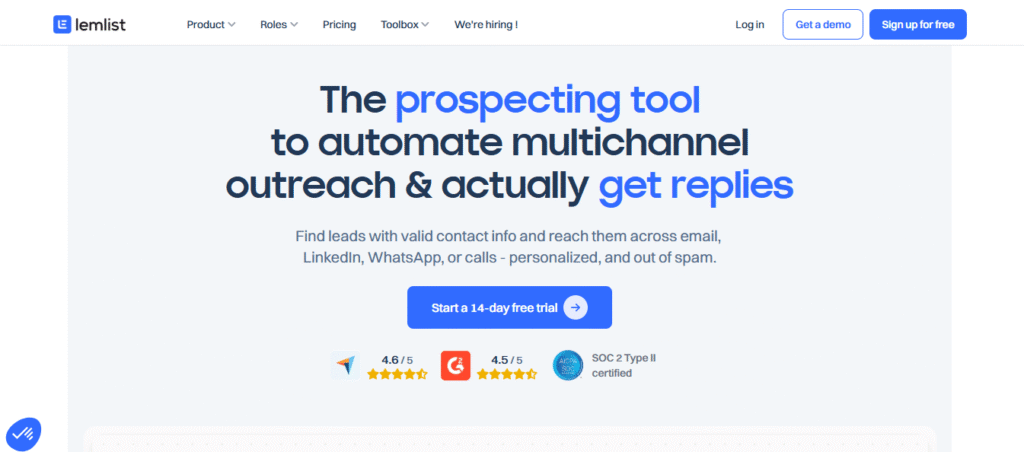
1. Lemlist (Hyper-Personalized Outreach)
Overview
Lemlist focuses on making outbound feel more human and personalized, rather than automated and generic.
The tool enables teams to create email sequences that include LinkedIn steps while using dynamic variables and custom messaging and images.
It proves most effective for high-value outreach because the system needs to establish relevant contacts who will respond to the outreach.
Best for: Teams prioritizing personalization and multichannel outreach
Key strengths
- Advanced personalization (text, images, variables)
- Native email + LinkedIn sequencing
- Built for contextual, signal-based outreach
- Easy-to-use campaign builder
Pricing: Yearly, monthly, and quarterly plans available with basic ones starting from $63 per user/month.
Pros & Cons
| Pros | Cons |
| High-quality outreach experience | Limited scaling vs dedicated email tools |
| Great for targeted campaigns | No built-in data source |
| Strong multichannel capabilities | Pricing increases with usage |
2. Instantly (High-Volume Cold Email Outreach)
Overview
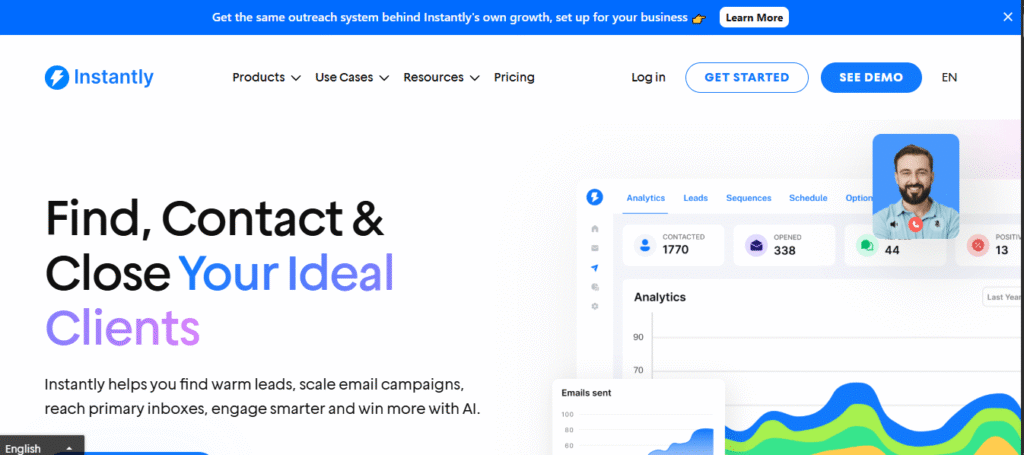
Instantly is built for teams that want to launch and scale cold email campaigns quickly without heavy technical setup.
It focuses on simplicity while still supporting multi-inbox sending, campaign tracking, and lead management. Compared to more complex tools, it reduces the friction of getting campaigns live and managing multiple sending accounts.
It is widely used by agencies and operators who want a balance between ease of use and scaling capability, especially when speed matters.
Best for: Teams looking to scale cold email campaigns fast with minimal setup
Key strengths
- Simple and fast campaign setup
- Multi-inbox sending for scaling outreach
- Built-in lead management and tracking
- Clean UI with minimal learning curve
Pricing: Starts ~$37/month (varies by plan and usage).
Pros & Cons
| Pros | Cons |
| Easy to get started | Limited advanced personalization |
| Suitable for agencies and small teams | Basic automation compared to enterprise tools |
| Good balance of scale and simplicity | No native data enrichment layer |
3. Smartlead.ai (Email Scaling & Deliverability)
Overview
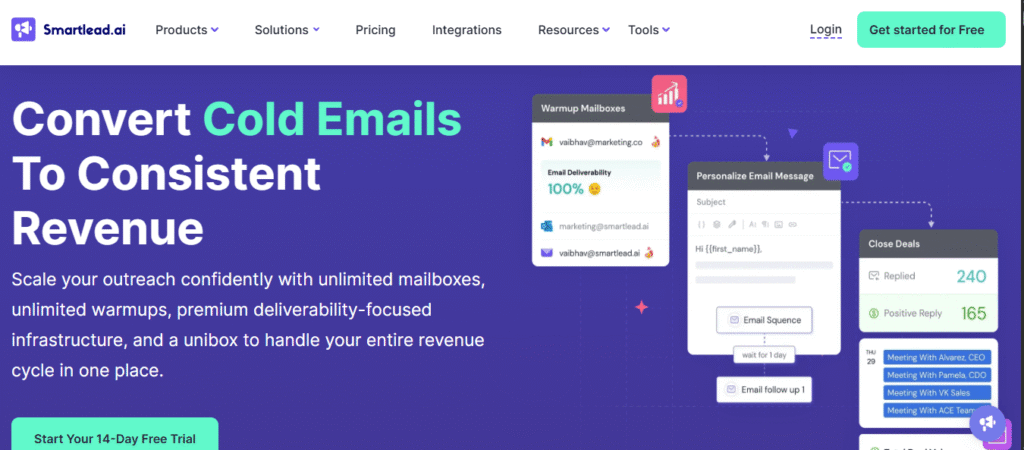
Smartlead provides businesses with a dedicated solution that enables them to expand their cold email operations while maintaining their email delivery success rate.
The tool handles all technical requirements of outbound email operations by managing inbox rotation and sending restrictions and domain control.
The tool operates as an effective solution for agencies that require their teams to send more than 1000 emails daily.
Best for: Agencies and teams running high-volume outbound campaigns
Key strengths
- Unlimited inbox rotation for scaling campaigns
- Strong deliverability controls and warm-up features
- Centralized management of multiple sending accounts
- Simple interface optimized for speed
Pricing: Paid plans starting from $32/month, free trial available.
Pros & Cons
| Pros | Cons |
| Excellent for scaling outreach | No native prospecting data |
| Cost-effective for volume | Limited personalization features |
| Reliable deliverability setup | Requires external tools for full workflow |
4. Apollo.io (All-in-One Prospecting & Outreach)
Overview
Apollo stands out as the leading outbound platform because it provides users with combined prospecting enrichment and outreach capabilities through its unified system.
Teams can perform lead searching and contact data verification and campaign initiation through a single interface instead of needing multiple tools.
The tool proves beneficial to teams who require rapid progress without developing an extensive technology framework.
Best for: Startups and SMB teams that want a single platform to run outbound end-to-end
Key strengths
- Large B2B contact database with built-in filters
- Native email sequencing and campaign management
- Fast setup with minimal technical complexity
- Affordable entry point for early-stage teams
Pricing: Free plan available with paid plans starting from ~$49/user/month.
Pros & Cons
| Pros | Cons |
| All-in-one workflow | Data accuracy can vary |
| Easy to get started | Limited advanced personalization |
| Good for high-volume outreach | Not built for signal-based outbound |
5. Clay (AI Data Enrichment & Prospecting)
Overview
Clay operates as the intelligence framework which supports current outbound systems.
The tool provides data access but enables users to create workflows that enhance lead development and enable signal detection and automated generation of customized insights.
It enables users to extract data from various sources and execute AI prompts while creating structured tasks for execution.
Best for: Teams building signal-based, AI-driven outbound systems
Key strengths
- Combines enrichment, automation, and AI in one workflow
- Supports deep, research-level personalization
- Integrates with multiple data sources and APIs
- Highly flexible for custom outbound systems
Pricing: Starting from a free tier up to Pro ($720-$800/month) and Enterprise plans.
Pros & Cons
| Pros | Cons |
| Extremely powerful and customizable | Credit usage can scale quickly |
| Enables signal-based targeting | Requires integration with outreach tools |
| Best-in-class enrichment workflows | Requires time to set up properly |
The Mistakes That Quietly Kill Your Outbound Automation
Here are 5 mistakes that can quietly kill your outbound automation without your team even realizing:
| Mistake | How it quietly kills your outbound automation |
| Automating low‑quality or outdated data | Outdated or inaccurate contact lists silently tank deliverability and response rates over time. |
| Blind, over‑personalized templates | Reusing the same “personalized” copy across segments makes outreach feel robotic and lowers reply rates. |
| Volume without strategy or segmentation | Sending high volumes to unsegmented audiences scales noise instead of pipeline. |
| Ignoring performance metrics and A/B tests | Skipping tracking and experimentation lets underperforming sequences waste capacity unnoticed. |
| Treating automation as “set‑and‑forget” | Outdated workflows slowly decay in deliverability and engagement without anyone realizing. |
Key Metrics to Measure Outbound Pipeline Scaling Success
Below are 5 essential metrics that you must monitor to effectively measure the success of your outbound sales automation:
1. Outbound-generated pipeline value
Total revenue potential created directly from outbound activities, reflecting its contribution to pipeline growth.
2. Conversion rate (lead → opportunity)
Percentage of outbound leads that convert into qualified opportunities, indicating lead quality and targeting effectiveness.
3. Meeting / discovery booking rate
Share of prospects who agree to meetings after outreach, showing the strength of your messaging and CTA.
4. Response / engagement rate
Rate at which prospects reply or interact with outreach, signaling relevance and messaging resonance.
5. Pipeline velocity / cycle length (outbound)
Speed at which outbound deals progress from first touch to close, indicating efficiency of the sales process.
How Prospects Hive Helps Automate Your Outbound Sales
At Prospects Hive, outbound isn’t a set of scattered tools. It’s designed as a scalable system, where you get:
- Signal-based prospecting → Identify high-intent leads based on real-time triggers, not static lists.
💡 Also Read: B2B Intent Data Providers (2026 Guide): How to Choose the Right One for Your GTM Motion
- AI-powered personalization → Deliver tailored messaging at scale without manual effort.
- Multi-channel orchestration → Seamlessly coordinate email, LinkedIn, and calling workflows.
- CRM sync & automation → Keep your pipeline clean, updated, and action-ready.
- End-to-end workflow design → Connect every step from prospect discovery to deal creation.
The result: A unified outbound engine that scales efficiently while staying highly relevant and conversion-focused.
Conclusion
The process of outbound sales automation focuses on enhancing sales results instead of boosting sales productivity.
Teams that generate pipeline through outbound sales are now depending more on tools using which they can develop operational systems integrating strategic planning, data analysis, and automated processes.
The combination of these elements makes outbound operations become both predictable and scalable for businesses.
Modern outbound success depends on the relevance of your messages to recipients instead of the number of messages you send.
If your outbound still relies on volume over precision, it’s time to rethink the system.
Build a smarter, signal-driven engine with Prospects Hive that turns outreach into a predictable pipeline.
FAQs
1. What pain points does outbound sales automation solve for SDRs?
Outbound sales automation relieves SDRs from manual and repetitive tasks ranging from prospecting, data entry, and follow-ups, enabling them to focus on high‑value conversations instead of repetitive tasks.
2. How to define ICP for outbound sales campaigns?
Define your ICP by analyzing your best existing customers and codifying their shared firmographics, technographics, roles, and trigger events into a clear targeting profile.
3. What are the common mistakes in implementing sales automation and how to avoid them?
Common mistakes include over‑automating, using bad data, ignoring workflow updates, and skipping training. These can be avoided by segmenting efforts, cleaning data, iterating workflows, and upskilling teams regularly.
4. What is the future of outbound sales automation?
The future lies in AI‑driven, multimodal automation that intelligently orchestrates voice, email, and social touchpoints while predicting best‑time‑to‑reach and self‑optimizing sequences
5. How can I measure the ROI of my outbound sales automation?
Measure ROI by tracking cost per meeting, meeting‑to‑opportunity conversion, resulting pipeline, and revenue versus fully‑loaded SDR/tool costs across your automated campaigns.