In 2026, B2B growth is no longer about volume. It’s about timing.
Your buyers are researching long before they even speak to sales. The companies winning in 2026 aren’t guessing who might buy. They’re tracking who is already looking. That’s why B2B intent data providers have become central to modern GTM strategy.
Unlike traditional B2B data companies that sell static B2B contact data, today’s intent data platforms and buyer intent data tools reveal real-time buying signals.
The right buyer intent data provider doesn’t just give you names, it gives you momentum.
In this blog, we’ll break down what B2B intent data really means, how it works behind the scenes, and how to evaluate the best B2B intent data providers for your GTM motion.
Key Notes
- In 2026, B2B growth is driven by timing, not volume. Intent data shows who’s actively researching your category.
- Intent data identifies accounts that are in-market and signaling buying intent.
- The right intent provider depends on your GTM motion, whether ABM, SDR outbound, PLG, or RevOps.
- Signal quality beats quantity. Evaluate source depth and behavior accuracy before investing.
- Intent data drives pipeline only when integrated with CRM, automation, and outbound workflows.
- Intent data is fuel. Without structured execution and prioritization, it won’t generate revenue.
What Are B2B Intent Data Providers and Why They Matter?
B2B intent data providers collect and analyze behavioral signals to identify companies actively researching specific topics, products, or solutions.
They matter because they help your GTM motion prioritize B2B intent data so that your outreach is focused on buyers who are more likely to convert.
Now, what exactly is B2B intent data and why does it matter?
B2B intent data is behavioral data that signals when a company is actively researching products or services within a specific category.
Instead of just identifying who fits your ideal customer profile, intent data B2B reveals who is currently in-market.
Traditional B2B data vendors provide firmographic and demographic information:
- Company size
- Industry
- Revenue
- Job titles
- Email addresses
This type of B2B contact data is essential for targeting. But it’s static. It tells you who your ideal customer is but not whether they’re ready to buy.
Intent data B2B, on the other hand, captures behavioral signals that indicate purchase research.
It shows:
- Which accounts are reading content related to your category
- What topics they’re researching
- How frequently they’re engaging
- Whether their activity is increasing
Reaching out when a buyer is actively researching increases response rates and shortens sales cycles. Without intent signals, even the most accurate B2B contact data becomes guesswork.
In 2026, competitive advantage doesn’t come from having more data. It comes from having the right signals at the right time. And that’s exactly what modern buyer intent data providers deliver.
This shift is why modern GTM teams are investing in:
- Intent data tools
- Advanced intent software
- AI-driven buyer intent software
- Integrated intent data platforms
Because timing changes everything.
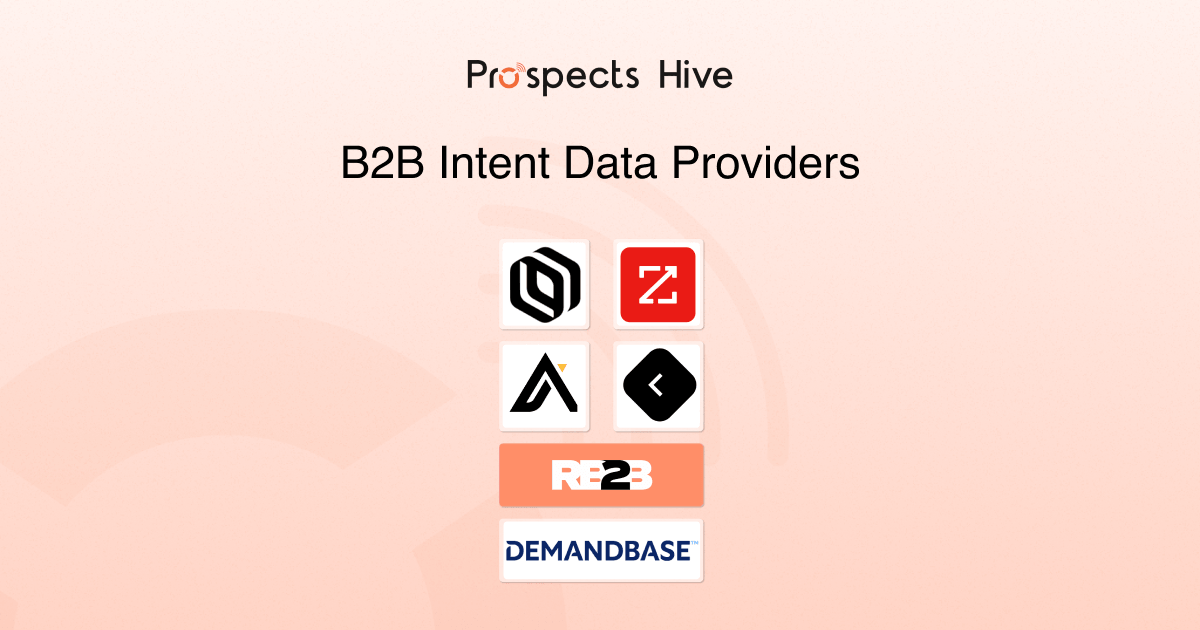
Best 15+ B2B Intent Data Providers in 2026 (Quick Overview)
Before we jump into the detailed review of the best B2B intent data providers, here is a quick overview to skim through:
| Intent Data Provider | Free Trial | Starting Price | Best for | Rating |
| DemandBase One | ❌ | $18,000-$65,000+
per year |
Enterprise ABM teams running multi-channel intent programs. | 4.4 |
| ZoomInfo | ✅ | $14,995 to $15,000 per year | Sales teams needing data plus light intent signals. | 4.1 |
| RB2B | ✅ | $79 /month | Companies identifying anonymous website visitors in real time | 4.5 |
| Common Room | ❌ | $1k/month | Product-led growth teams tracking community engagement signals. | 4.5 |
| Apollo.io | ✅ | $49 Per user per month, billed annually | Startups combining prospecting, outreach, and basic intent. | 4.5 |
| Unify | ✅ | $1740 per month, billed annually | Modern GTM teams automating signal-based outbound workflows. | 5.0 |
| 6sense | ✅ | $25000/year | Enterprise revenue teams using predictive, account-based selling. | 4.4 |
| LeadIQ | ✅ | $200/month | SDR teams sourcing contacts directly from LinkedIn. | 4.4 |
| LeadFeeder | ✅ | $99/month | Marketing teams revealing companies visiting their website. | 4.3 |
| Cognism | ❌ | $1,000 to $1,500 per month | European-focused sales teams needing compliant contact data. | 4.7 |
| G2 | ✅ | $2,999/year | SaaS vendors targeting high-intent comparison stage buyers. | 4.7 |
| Lead Forensics | ✅ | customized pricing | B2B firms identifying anonymous website traffic at scale. | 4.5 |
| Maximise.ai | ✅ | $59/month | AI-driven outbound teams prioritizing behavioral buying signals. | 3.6 |
| Bombara | ❌ | approximately $2,500 per month | Teams targeting accounts researching specific industry topics. | 4.4 |
| Foundry | ❌ | customized pricing | Tech vendors leveraging publisher-level content consumption intent. | 4.3 |
| Seamless | ✅ | $147/month | High-volume outbound teams needing fast contact data. | 4.4 |
| Lusha | ✅ | $37.45 USD / month | SMB sales teams who need to enrich contacts quickly. | 4.0 |
| SalesIntel | ✅ | $18,000/year for teams | Best for teams wanting human-verified B2B contact data. | 4.3 |
| Lead Onion | ✅ | $100 per month | Best for smaller teams tracking company-level website visitor activity. | 4.2 |
| TrustRadius | ✅ | $30k/product per year | Best for vendors targeting bottom-funnel buyers reading in-depth reviews. | 4.4 |
6 Best B2B Intent Data Providers (Deep Comparison)
After a quick eye-check of tools, let’s discuss each of these in more detail to find out the best one for your GTM motion:
1. Demandbase
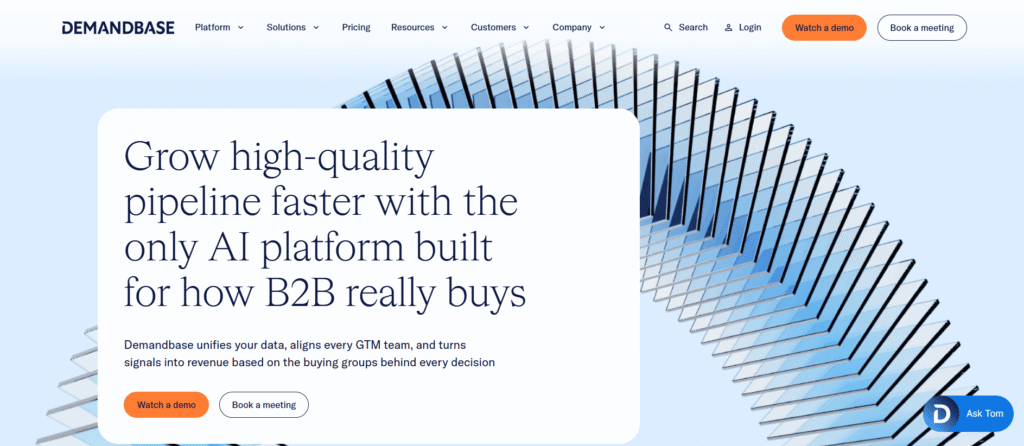
Pricing: Although no fair trial is available, it offers custom enterprise pricing with starting price from $18,000-$65,000+ per year.
Best For: Enterprise ABM teams running multi-channel, account-based programs.
Overview
Demandbase is a full-scale account-based go-to-market platform designed for enterprise revenue teams. It combines account intelligence, advertising, sales insights, and intent data into a unified system. Instead of just giving you contact data, it focuses on identifying which accounts are actively researching your category and helps orchestrate coordinated engagement across marketing and sales.
Key Intent Signals
- Third-party account-level topic intent
- First-party website engagement
- Buying group activity signals
- Predictive scoring based on account behavior
Pros and Cons of DemandBase
| Pros | Cons |
| Strong ABM orchestration | Expensive for SMBs |
| Enterprise-grade integrations | Complex onboarding |
| Deep account visibility | Requires mature GTM team |
2. ZoomInfo
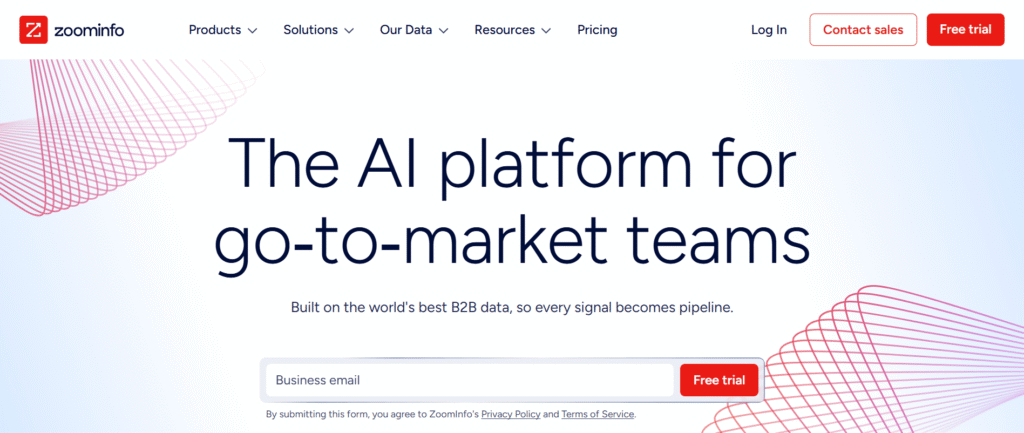
Pricing: Offers quote-based pricing, with annual contracts typically starting around $14,995–$15,000 for the Professional tier, $24,995+ for Advanced, and $35,995–$45,000+ for Elite.
Best For: Sales teams needing both contact data and intent signals in one platform.
Overview
ZoomInfo is primarily a large B2B data intelligence platform that layers intent data on top of its massive contact database. It allows teams to identify companies researching specific topics, enrich those accounts with decision-maker contacts, and push them into outreach workflows.
It’s powerful for teams that want a single system covering prospecting, enrichment, and intent prioritization without stitching multiple tools together.
Key Intent Signals
- Topic-level buyer intent trends
- Website engagement tracking
- Technographic changes
- Organizational growth signals
Pros and Cons of Zoominfo
| Pros | Cons |
| Massive global database | High cost |
| Combines data + intent | Pricing transparency low |
| Strong CRM integrations | Data accuracy can vary |
3. Apollo.io
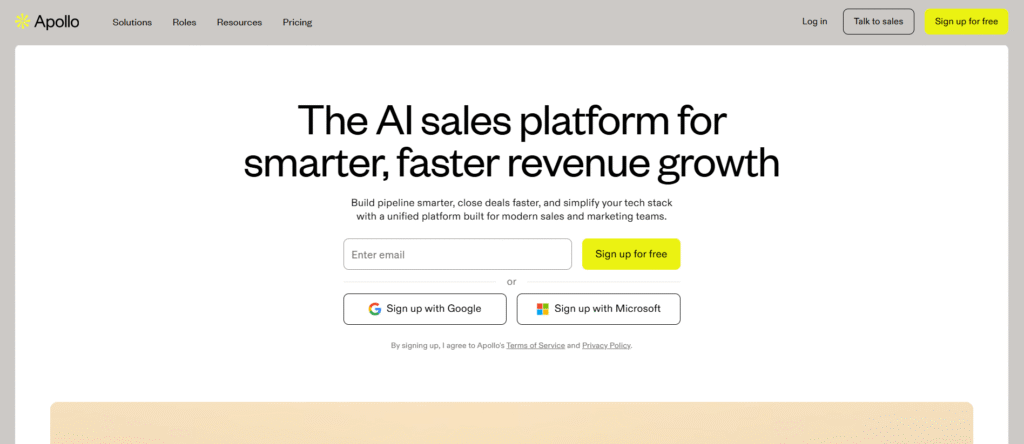
Pricing: Free plan available with paid plans starting from ~$49/user/month.
Best For: Startups and SMB teams combining prospecting and outreach affordably.
Overview
Apollo.io is an all-in-one sales engagement and intelligence platform that includes a large B2B contact database, enrichment capabilities, and built-in email sequencing. Its intent layer is lighter compared to enterprise ABM platforms, but it offers useful behavioral and firmographic signals for prioritization.
💡 How SaaS Companies Can Scale Faster by Combining ABM and Allbound Marketing
It’s ideal for teams that want a cost-effective way to run outbound campaigns without buying separate intent and engagement tools.
Key Intent Signals
- Website visit tracking (limited)
- Job changes and hiring signals
- Technographic filters
- Engagement tracking within sequences
Pros and Cons of Apollo
| Pros | Cons |
| Affordable and scalable | Intent depth limited |
| Built-in sequencing | Data quality varies by region |
| Easy to use | Not enterprise-grade ABM |
4. RB2B
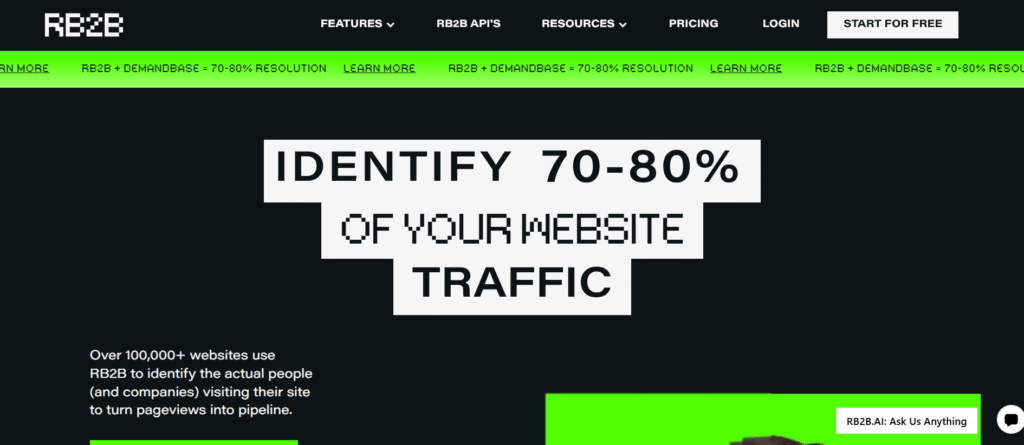
Pricing: Offers 7 day free trial with starter plans starting from around ~$149/month (varies).
Best For: Teams wanting to identify anonymous website visitors.
Overview
RB2B focuses on revealing companies and sometimes individuals visiting your website. It helps turn anonymous traffic into identifiable accounts so your sales team can follow up quickly.
Unlike broad market intent platforms, RB2B works purely on first-party signals. It’s best used to capture and act on high-intent website visitors rather than predict demand across the wider market.
Key Intent Signals
- Anonymous visitor identification
- Company-level traffic detection
- Contact matching and enrichment
- Real-time alerts
Pros and Cons of RB2B
| Pros | Cons |
| Great for capturing inbound intent | Not market-wide intent |
| Simple setup | Limited predictive scoring |
| Useful for SDR follow-ups | Narrow scope |
5. Common Room
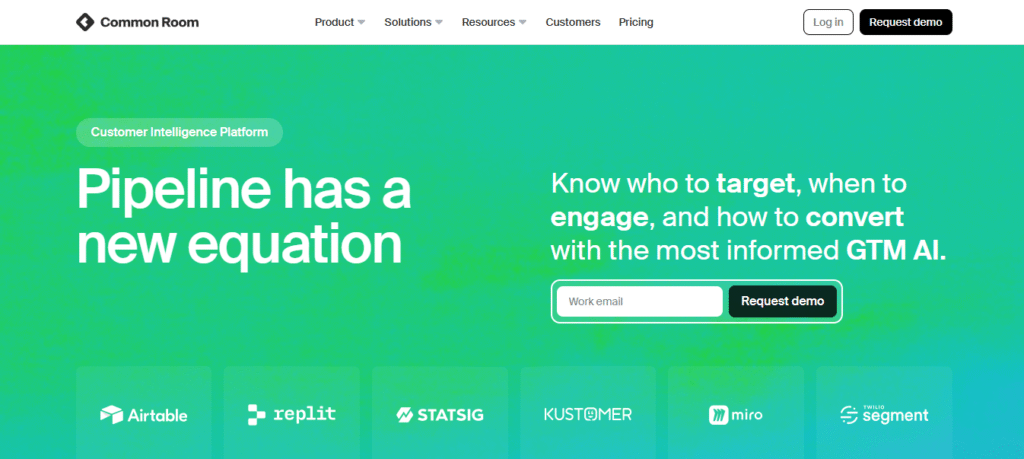
Pricing: Generally starts at $1,000 per month (often billed annually as ~$12,000/year) for the Starter plan,
Best For: Product-led growth and community-driven GTM teams.
Overview
Common Room is a customer intelligence platform that aggregates engagement signals across community platforms, product usage, website activity, CRM data, and social channels. It helps identify active champions and buying signals inside developer communities, Slack groups, GitHub activity, and more.
It’s particularly powerful for PLG companies that rely on bottom-up adoption and need visibility into engagement before formal sales conversations begin.
Key Intent Signals
- Community engagement tracking
- Product usage signals
- Job changes and growth triggers
- Multi-source behavioral scoring
Pros and Cons of Common Room
| Pros | Cons |
| Strong people-level visibility | Expensive for early-stage teams |
| Ideal for PLG motions | Not classic third-party intent |
| Rich integrations | Requires signal strategy |
6. Unify
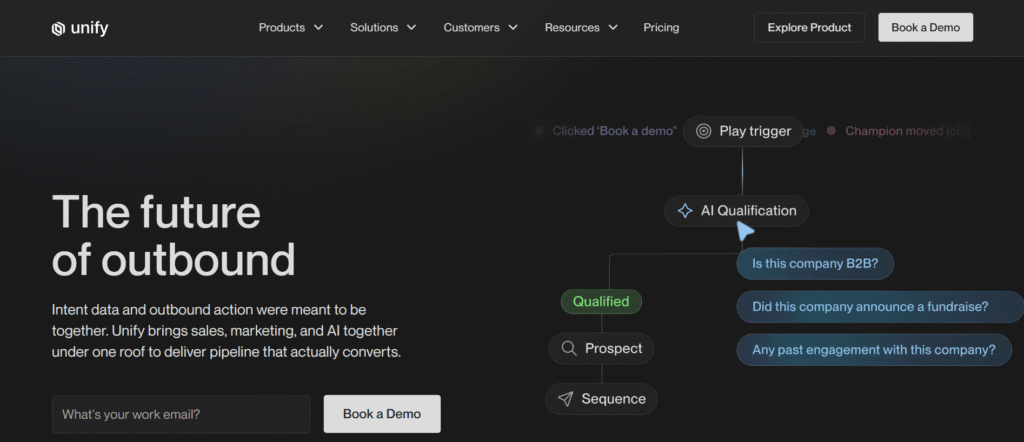
Pricing: Uses a credit-based, annual subscription model typically starting around $1,460/month (billed annually) for their “Growth” plan.
Best For: Modern GTM teams running signal-based outbound.
💡 AI GTM in Outbound Marketing: Strategies, Benefits & Tools
Overview
Unify is a signal-driven GTM platform that combines multiple data sources with automation and AI workflows. It captures signals like hiring trends, web activity, funding events, and other buying triggers, then routes them into outbound sequences automatically.
It’s designed for teams that want to operationalize intent, not just view dashboards. Rather than focusing only on reporting, it emphasizes activation and automation.
Key Intent Signals
- Website activity signals
- Hiring and funding triggers
- Technographic shifts
- Multi-source enrichment signals
Pros and Cons of Unify
| Pros | Cons |
| Strong signal automation | Less brand recognition |
| Built-in outbound activation | Pricing not public |
| AI workflow integrations | Smaller ecosystem than enterprise tools |
Best Emerging B2B Intent Data Provider of 2026 (Bonus)
7. Maximise.ai
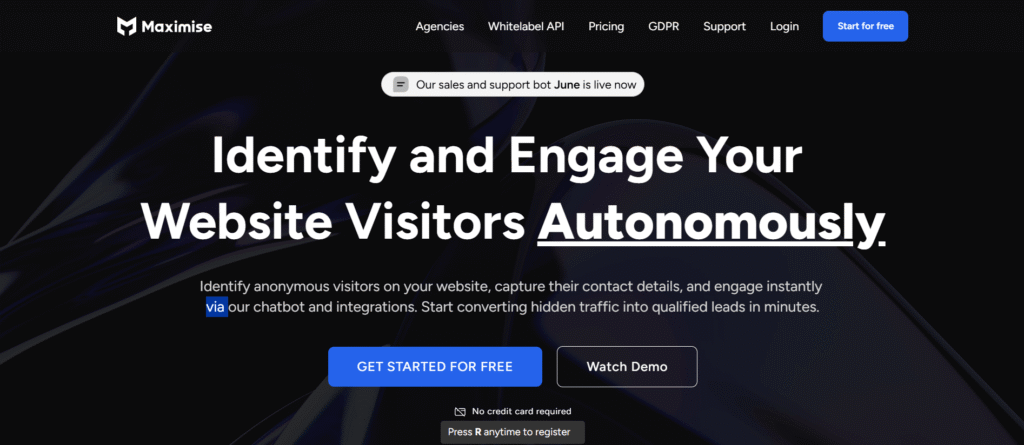
Pricing: Offers 30 days no restriction free trial with starter plans beginning from $59/month.
Best For: AI-driven outbound teams prioritizing predictive signals.
Overview
Maximise.ai focuses on AI-driven sales intelligence and automated outbound workflows. It aggregates behavioral signals and uses predictive models to surface accounts most likely to convert.
It’s built for teams that want to combine machine learning insights with automated prospecting rather than manually reviewing intent dashboards.
Key Intent Signals
- Predictive scoring models
- Behavioral buying triggers
- Engagement-based prioritization
- Automated sequencing integration
Pros and Cons of Maximise.ai
| Pros | Cons |
| AI-focused prioritization | Limited public benchmarks |
| Workflow automation emphasis | Not widely reviewed |
| Good for scaling outbound | Best suited for data-mature teams |
How to Choose the Right Intent Data Provider
There’s no universal “best” among B2B intent data providers. There’s only the best, i.e. the right one for your GTM motion.
Most teams compare logos like 6sense or Bombora and assume bigger means better. But buyer intent software only works when it aligns with your actual use case.
Here’s how to evaluate it properly:
1. Define Your Use Case
Before comparing intent data platforms, ask yourself this: What problem are you solving?
Are you trying to improve outbound targeting? Perhaps, you are supporting account-based marketing or triggering SDR follow-ups based on buying intent.
Or, maybe you’re aiming to prioritize inbound demo requests and enhance CRM scoring?
Some B2B data companies specialize in topic-level surge signals. Others combine B2B contact data with predictive scoring.
Some act as full buyer intent data tools integrated into a broader data platform.
If your goal is:
- Enterprise ABM → You may need advanced account-level intent.
- SDR outbound → You need fast, actionable buyer intent signals.
- RevOps optimization → You need CRM integration + scoring logic.
- Lead generation scale → You may need intent + enrichment combined.
Without clarity, even the best B2B intent data providers won’t move your pipeline.
2. Evaluate Data Quality
Not all intent data is equal. You need to establish whether the data you’re receiving is first-party, third-party, or network-level intent data.
Ask your intent data provider:
How is buying intent tracked?
What does “surge” actually mean?
Is it account-level or contact-level?
How fresh is the data?
Many intent software platforms track content consumption across publisher networks. That’s useful. But it doesn’t always mean a buying committee is active.
Strong buyer intent data provider signals should include:
- Topic engagement spikes.
- Website behavior.
- Comparison page visits.
- Review activity on platforms like G2.
- Technographic and firmographic overlays.
High-quality buyer intent signals reduce noise and increase relevance for B2B sales teams. At the end of the day, volume without accuracy will only create false urgency.
3. Integration Capabilities
Intent data B2B only works when it connects to execution. Check whether the platform integrates with:
- Your CRM.
- Sales engagement tools.
- Marketing automation.
- Ad platforms.
- Data enrichment workflows.
If your data platform cannot sync cleanly with your CRM, the signal dies in a dashboard.
💡 10 Best CRMs for B2B Outbound Sales
The best intent data tools allow:
- Real-time CRM triggers
- Account scoring updates
- SDR task automation
- Segment creation for B2B marketing campaigns.
Without integration, you can be buying insights, but not pipeline.
4. Scalability & Pricing
Some top intent data providers are enterprise-heavy. Others are built for mid-market.
Many B2B data vendors package buyer intent software with large data subscriptions. That may be overkill if your motion is focused outbound.
It’s always better to ask beforehand:
- Whether pricing based on accounts, topics, users, or data volume?
- Whether cost scales aggressively as usage increases?
- Whether you are paying for bundled B2B contact data you don’t need?
Match the tool to your growth stage. Not your aspiration stage.
5. Compliance & Privacy Standards
Intent data lives in a sensitive space. Ensure your B2B intent data provider complies with GDPR, CCPA, global privacy standards, and transparent data sourcing.
Ask your provider how they collect buying intent signals. Reputable B2B data list providers and intent data platforms should clearly explain:
- Data sources
- Opt-in frameworks
- Tracking methodology
Compliance is not optional. It protects both your brand and your buyers.
6. Ease of Setup & Use
Intent data platforms should reduce friction, not create it. Many buyer intent software platforms look powerful in demos but require months of configuration.
If your B2B sales team can’t act on the signals quickly, adoption drops. And unused intent data becomes expensive to report.
Intent Data Tools Don’t Execute Themselves
This is where most teams fail. They buy intent software. They celebrate access to buying intent. Then nothing changes.
Here’s the reality: Intent data platforms identify opportunity. They do not create pipelines.
Your signals must be: Interpreted, prioritized, enriched, routed, and activated across channels.
Without workflow integration, best B2B intent data providers become expensive dashboards.
The real ROI comes from activation speed.
Buyer intent signals should trigger:
- Personalized outbound messaging
- Contextual LinkedIn engagement
- Dynamic ad audiences
- CRM follow-up tasks
- ICP scoring adjustments
Bear in mind, intent data is fuel, but execution is the engine!
How Prospects Hive Runs Intent-Driven GTM for B2B Teams
Prospects Hive doesn’t treat intent data as a list. It treats intent data as a signal layer.
Here’s how Prospects Hive activates intent data B2B:
- Signal Capture: It connects leading B2B intent data providers to capture topic-level and behavioral buying intent.
💡 Also Read: Signal Based Selling: How Modern GTM Teams Build Pipeline Without Guesswork
- Enrichment Layer: It overlays firmographic, technographic, and ICP filters to validate the B2B buyer profile.
- CRM Sync: Next, signals update account scoring inside the CRM automatically.
- Multichannel Activation: High-intent accounts move into outbound, LinkedIn engagement, and personalized email sequences.
- Feedback Loop: Lastly, it measures conversion rates by signal type, not just by campaign.
This turns buyer intent signals into structured lead generation motion. Intent becomes operational. Not theoretical.
Conclusion
The market for B2B intent data providers is crowded in 2026.
From enterprise-heavy platforms to lightweight buyer intent data tools, options are everywhere. But the real question isn’t: Which is the best intent data provider?
It’s: Which one fits your GTM motion?
Teams that combine the right intent data platforms with disciplined activation workflows will outperform those chasing dashboards.
If you’re evaluating B2B data companies or buyer intent software this year, focus less on feature lists. Focus more on fit, signal quality, and onboard execution readiness using Prospects Hive’s tailored solutions.
Because that’s where the real pipeline begins.
FAQs
1. How does intent data work?
Intent data tracks online behavior to identify companies actively researching specific solutions.
2. What is an intent data provider?
A company that collects and sells buying-intent signals from business audiences.
3. What is a B2B data provider?
A provider that supplies company and professional contact data for sales and marketing.
4. Who uses intent data?
B2B sales and marketing teams use it to prioritize high-intent prospects.
5. What is the difference between intent data and traditional lead data?
Intent data shows buying behavior; traditional lead data shows just contact details.
6. Is third-party intent data still reliable in 2026?
Yes, if sourced from compliant and high-quality providers.
7. Can intent data improve outbound conversion rates?
Yes, by targeting prospects already in-market.
8. What is the best B2B contact database?
One that offers accurate, compliant, and regularly updated contact data.