Agentic AI is everywhere right now. In product launches, boardroom decks, and “next big thing” threads.
But most explanations blur the lines between generative AI, AI agents, and automation. That creates more noise than clarity. Especially for B2B teams trying to decide what actually matters and what can wait.
Agentic AI matters in 2025–2026 because it marks a real shift. From AI that responds to prompts, to AI that can plan, decide, and take action across systems.
In this guide, you’ll learn what Agentic AI really is, how it works at a practical level, and where it fits in modern automation for sales, marketing, and operations.
Key Notes in 60 Seconds
- Agentic AI = AI that can pursue a goal and take multi-step actions with limited supervision
- It often uses LLMs + tools/APIs + memory + guardrails
- It’s not “just ChatGPT” and not “just automation”
- Best for workflows that are messy, multi-step, and change over time
- Biggest risk: autonomy without governance
What is Agentic AI?
Agentic AI refers to AI systems designed to act independently, make decisions, and adapt to changing environments. These agents are not limited to predefined scripts; they can interpret context, learn from interactions, and adjust their behavior to achieve desired outcomes.
To put simply, Agentic AI:
- Is goal-driven, not task-tied.
- Can break big goals into smart, bite-sized moves.
- Is a self-starter, doesn’t wait for a human greenlight to act.
- Can remembers past wins (and failures) to get sharper next time.
Agentic AI vs Generative AI vs AI Agents vs Traditional AI
The confusion around agentic AI usually starts here. Many teams hear the term and assume it is just a smarter chatbot or a new name for automation. But the truth is, it is not.
The difference becomes clear when you compare how each type of AI behaves, what it is designed to do, and how much autonomy it actually has.
Let’s break it down in simple terms.
Agentic AI vs Generative AI
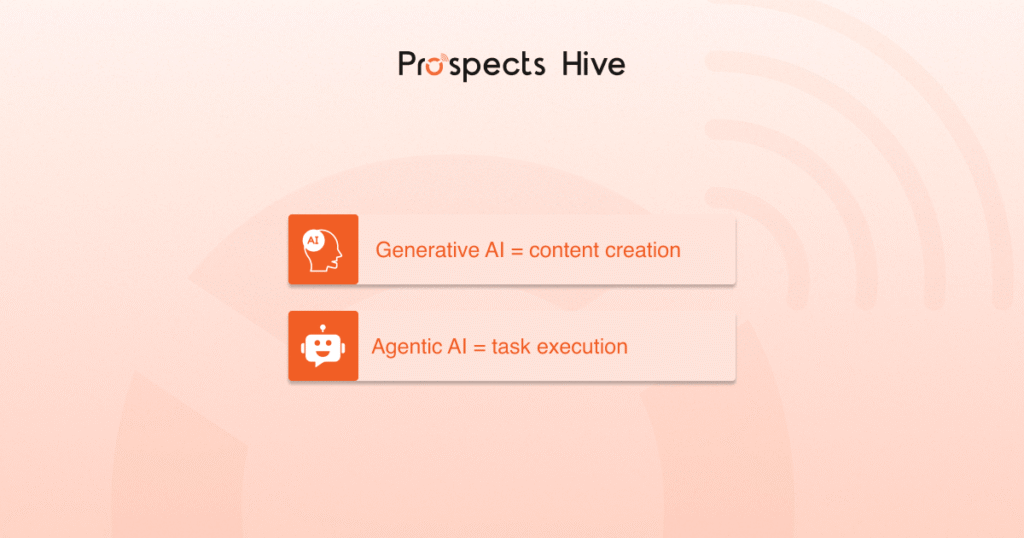
The core difference is output vs outcome.
Generative AI is built to create content. You give it a prompt, and it produces text, images, code, or summaries. It reacts to instructions. Once it generates the output, its job is done.
Agentic AI is built to achieve outcomes. It does not stop at generating content. It plans, executes, checks results, and adjusts. It can use tools, call APIs, update systems, and continue working toward a goal.
For example, generative AI can write a marketing email. Agentic AI can draft the email, send it to a segmented list, monitor responses, update the CRM, and automatically adjust follow-ups.
Generative AI is often the brain. Agentic AI is the system that puts that brain to work.
Agentic AI vs AI Agents
This is where many people get the terminology wrong.
AI agents are individual software entities that perform tasks. They might follow rules, respond to conditions, or handle a specific workflow.
Agentic AI is the broader system that coordinates these agents toward a larger objective.
Think of AI agents as tools in a toolbox. Agentic AI is the architect using those tools to build something bigger.
There are 2 common structures:
- Single-agent systems: One intelligent agent handles a defined workflow.
- Multi-agent systems: Multiple specialized agents collaborate. One may plan, another may execute, and another may monitor results.
All agentic AI systems use AI agents. But not all AI agents qualify as agentic AI. The differences lie in autonomy, coordination, and goal management.
Agentic AI vs Traditional AI
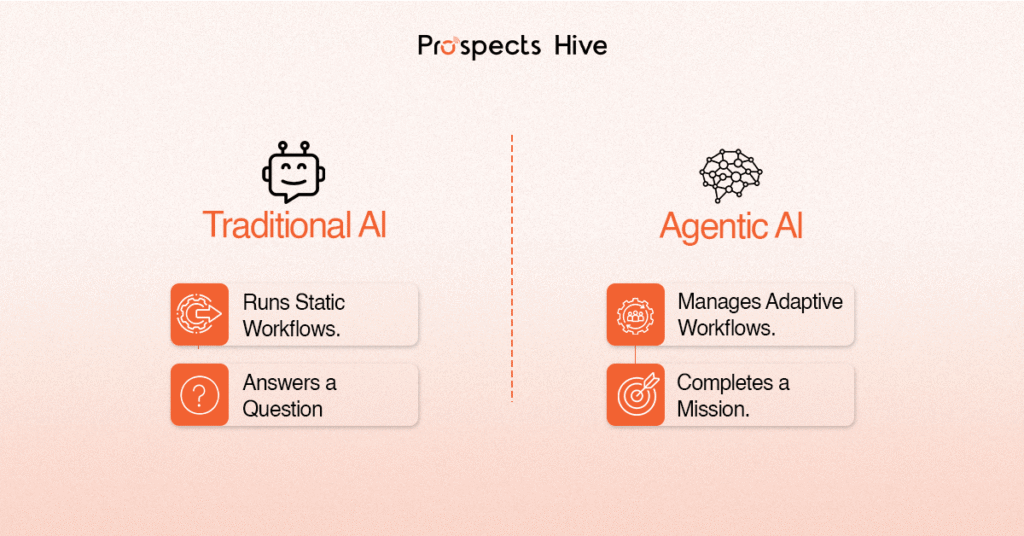
Traditional AI systems are typically narrow and reactive. They perform predefined tasks:
- Classifying images
- Predicting churn
- Flagging suspicious activity
They operate within fixed boundaries and rarely adapt outside their programming.
Many prompt-response assistants also fall into this reactive category. They respond when asked but do not independently plan or take initiative.
Agentic AI works differently. It can:
- Break down high-level goals into steps.
- Use multiple tools across systems.
- Adapt when conditions change.
- Learn from feedback
Quick Comparison Summary
| Attribute | Traditional AI | Generative AI | AI Agents | Agentic AI |
| Primary Role | Prediction or classification | Content creation | Task execution | Goal-driven execution |
| Autonomy | Low | Low to moderate | Moderate (task-specific) | High (goal-oriented) |
| Behavior | Reactive | Reactive | Semi-autonomous | Proactive and adaptive |
| Workflow Type | Static | Single-step output | Task-focused | Multi-step, coordinated |
| External Systems | Limited | Limited (some RAG) | Yes | Yes, across multiple tools |
| Goal Management | Predefined task | Output defined by user | Task-based | Defines and executes action plan |
For modern B2B teams, this distinction matters. If your objective is to generate content, generative AI is enough. If your objective is to execute complex, multi-step workflows across tools and adapt in real time, that is where agentic AI begins to make sense.
How Does Agentic AI Work? The 5-Step Loop
At its core, agentic AI operates in a structured loop. It does not simply respond once and stop. It moves through a cycle of observing, deciding, acting, and improving. This loop allows it to handle multi-step goals rather than single prompts.
Here is the process in simple terms.
Step 1: Perceive
Every agentic system begins by gathering context. It pulls signals from multiple sources:
- User inputs
- Databases and CRMs
- APIs and SaaS platforms
- Logs, documents, and dashboards
- Sensors or system events
⚡How to Use Intent Signals to Get More B2B Sales
These inputs can be structured, like rows in a database. Or unstructured, like emails, PDFs, or support tickets.
The goal of this stage is simple: understand the current state of the environment. Without accurate context, the rest of the loop breaks.
Step 2: Reason and Plan
Once the system understands the situation, it needs to decide what to do.
This is where large language models often act as the reasoning engine. They interpret the goal, analyze constraints, and break a high-level objective into smaller, executable steps.
For example, instead of “Increase customer retention,” the system may break it into:
- Identify at-risk accounts
- Review recent engagement history.
- Draft personalized outreach
- Schedule follow-up tasks
At this stage, the system also selects which tools it needs. It determines whether it must query a database, update a CRM, send a message, or trigger a workflow.
Planning is what separates agentic systems from simple automation. They do not just follow a fixed script. They generate a plan based on context.
Step 3: Act (Tool Execution)
After the plan is defined, the system executes.
This usually involves interacting with external systems through APIs or integrated tools. Actions may include:
- Updating records in a CRM
- Sending emails or messages
- Running queries
- Triggering workflows
- Generating and storing documents
Guardrails are often built into this stage. Certain actions may require approval or fall within predefined limits.
Unlike generative AI, which stops at producing output, agentic AI performs real operations inside software systems.
Step 4: Learn and Reflect
Execution is not the end of the loop.
After acting, the system evaluates the result. Did the action move it closer to the goal? Did something fail? Was the outcome better than expected?
This feedback loop allows the system to:
- Correct errors
- Adjust its strategy
- Improve future decisions
Over time, performance can improve through continuous evaluation and refinement. This learning process makes the system more effective in dynamic environments.
Step 5: Orchestration
As workflows grow more complex, a single agent is often not enough.
Orchestration is the coordination layer that manages multiple agents working together. One agent may specialize in planning. Another may focus on execution. A third may monitor performance.
In more advanced setups, a supervisor agent oversees specialist agents. The supervisor assigns tasks, monitors progress, and ensures alignment with the overall goal.
Orchestration becomes necessary when:
- Tasks span multiple systems.
- Workflows require different types of expertise.
- Scale increases beyond simple automation
This coordination layer enables agentic AI to handle enterprise-grade workflows rather than isolated tasks.
In essence, agentic AI works through a continuous loop: perceive, reason, act, learn, and orchestrate. This structure enables it to move from simple responses to goal-driven execution across systems.
What is an Agentic AI System Made of?
If agentic AI is more than a chatbot, what actually powers it?
At a system level, agentic AI is not just a large language model. It is a coordinated stack of components that allows it to perceive context, reason through goals, act across tools, and improve over time.
Understanding these building blocks helps technical and semi-technical teams evaluate what is real and what is marketing.
Core Components
- LLM (The Reasoning Engine)
At the center of most agentic systems is a large language model.
The LLM acts as the reasoning layer. It interprets instructions, understands context, breaks goals into steps, evaluates options, and decides what to do next. Without this reasoning engine, the system would behave like static automation.
However, the LLM alone is not the system. It is the “brain,” not the entire organism.
- Tools and Integrations
Agentic AI becomes powerful when it can interact with external systems. Tools may include:
- CRM platforms
- Marketing automation software
- Databases
- File systems
- Internal APIs
- Analytics dashboards
Tool calling allows the agent to move from thinking to doing. It can fetch real-time data, update records, trigger workflows, or execute code. This is what separates generative output from operational execution.
- Memory (Short-Term and Long-Term)
Memory allows the system to maintain context.
- Short-term memory handles active tasks and conversation context.
- Long-term memory stores structured knowledge, historical interactions, and learned insights.
Long-term memory may use knowledge bases, embeddings, or indexed data to improve future decisions. Without memory, the system becomes stateless and repetitive.
- Retrieval and Context (RAG)
Retrieval-augmented generation helps ground the system in accurate, relevant information.
Instead of relying only on pre-trained knowledge, the agent can pull in:
- Company-specific documents
- Product databases
- Policy files
- Real-time data
This improves reliability and reduces hallucinations. It ensures decisions are based on the current context, not just general training data.
- Policies and Permissions
Autonomy without boundaries creates risk. Agentic systems rely on clearly defined policies:
- What actions are allowed
- What thresholds require approval
- What data can be accessed?
- What systems can be modified?
Permissions act as guardrails. They prevent unintended or unsafe execution.
- Monitoring and Logging
Every action should be traceable. Monitoring systems log:
- Decisions made
- Tools invoked
- Data accessed
- Errors encountered
- Outcome metrics
This layer supports governance, debugging, and compliance. Without observability, teams cannot trust or scale agentic workflows.
- Human-in-the-Loop Controls
Even highly autonomous systems need escalation paths. Human-in-the-loop mechanisms allow:
- Approval for high-impact actions
- Review of critical decisions
- Override capabilities
- Threshold-based intervention
This is especially important in finance, healthcare, cybersecurity, and enterprise operations.
Architecture Patterns
Agentic AI systems can be structured in different ways depending on complexity.
Single-Agent Systems
One autonomous entity manages perception, reasoning, planning, and action. This model works well for:
- Well-defined workflows
- Narrow use cases
- Controlled environments
It is simpler to deploy but may struggle with highly complex tasks.
Horizontal Multi-Agent Systems
Multiple agents operate as equals. Each agent specializes in a narrow function, such as:
- Research
- Planning
- Execution
- Monitoring
They share information and collaborate toward a shared objective. This structure increases flexibility but requires strong coordination.
Vertical (Hierarchical) Multi-Agent Systems
A supervisory agent oversees specialized subordinate agents. The “conductor” agent:
- Defines high-level goals
- Assigns subtasks
- Monitors progress
- Resolves conflicts
This architecture is effective for complex enterprise workflows where task decomposition and coordination are critical.
What Most Teams Underestimate
Many discussions stop at LLMs and planning. The real challenges appear elsewhere.
Tool Permissions: Unrestricted tool access can lead to errors or unintended actions. Defining scoped permissions is critical.
Error Handling: What happens when an API fails? When is data incomplete? When does a tool return unexpected output? Robust fallback logic is essential.
Observability: Without detailed logging and performance tracking, teams cannot diagnose failures or improve outcomes.
Governance: Agentic systems must align with organizational policies, regulatory requirements, and ethical standards. Governance is not optional at scale.
Agentic AI Capabilities (and the Limits)
Agentic AI is powerful. But it is not magic.
Its strength lies in structured autonomy. When goals are clear and systems are well-defined, it can outperform manual workflows. When inputs are messy or guardrails are weak, it can fail just as fast.
Understanding both sides is critical.
What Agentic AI is Good At
Today, 73% of customers expect businesses to understand their unique needs, and agentic AI enables that level of real-time personalization.
Multi-Step Workflows
Agentic systems excel at breaking complex objectives into smaller tasks. Instead of handling one instruction at a time, they can:
- Analyze a goal
- Create a plan
- Execute steps sequentially
- Adjust along the way.
This makes them ideal for workflows that require coordination across multiple stages, such as resolving support tickets, qualifying leads, or investigating alerts.
Cross-Tool Execution
Agentic AI can operate across software systems. Studies show AI adoption can reduce operational costs by up to 30%, according to Emergen Research.
It can:
- Pull data from a CRM.
- Update an ERP
- Send notifications
- Query analytics dashboards
- Trigger automated processes
This ability to move between systems closes the gap between insight and execution. It transforms AI from advisor to operator.
Handling Exceptions (With Guardrails)
Well-designed agentic systems can respond to unexpected events. If a task fails or data changes, the system can:
- Reassess the situation
- Adjust the plan
- Retry with different inputs.
- Escalate to a human if needed.
When combined with guardrails, this flexibility enables agentic AI to operate in dynamic environments such as IT operations or cybersecurity monitoring.
Continuous Improvement Loops
Agentic AI improves through feedback. By evaluating outcomes and learning from results, it can refine its decision-making over time. In operational settings, this leads to:
- Faster resolutions
- More accurate prioritization
- Reduced manual intervention
The feedback loop is what moves the system from static automation to adaptive execution.
Where Agentic AI Struggles
Autonomy introduces new risks.
Unclear Goals
Agentic systems depend on well-defined objectives.
If a goal is vague, conflicting, or poorly scoped, the system may pursue the wrong outcome. Unlike humans, it cannot infer organizational nuance or hidden priorities.
Missing or Dirty Data
Agentic AI relies heavily on data quality.
Incomplete records, inconsistent formats, or outdated information can distort decisions. In automated environments, these errors propagate quickly.
Ambiguous Tool Permissions
When agents have access to powerful tools, unclear permission structures become dangerous.
Without defined constraints, a system might:
- Modify the wrong records.
- Trigger unintended actions
- Access sensitive data improperly
Careful permission design is essential.
High-Stakes Decisions Without Oversight
In regulated environments such as finance or cybersecurity, fully autonomous action can create compliance risks.
For example, an AI that blocks transactions or quarantines systems without human review may cause unintended disruption. Human-in-the-loop checkpoints reduce this risk.
Hallucinations Becoming Actions
Generative models can produce incorrect outputs. In an agentic system, those outputs may trigger real-world actions.
If unchecked, hallucinated reasoning can lead to:
- Incorrect updates
- Faulty escalations
- Misguided remediation steps
This is why monitoring, logging, and validation layers are critical.
Agentic AI is most effective when autonomy is paired with structure. It performs best in well-defined, measurable environments where goals are clear, data is reliable, and oversight mechanisms are in place.
Agentic AI Examples (Real-World + B2B)
The best way to understand agentic AI is to watch it work. Not as a chatbot. Not as a copy generator. But as a system that takes ownership of a goal and sees it through.
Here are 4 real-world B2B scenarios.
1. Sales Research Agent (B2B Outbound)
Situation
A sales team wants to target high-fit accounts without spending hours on manual research.
What the agent does
- Scans ICP criteria and filters accounts by industry, size, and tech stack
- Detects trigger signals like funding, hiring, or product launches.
- Pulls recent company updates and relevant context
- Draft personalized outreach based on those signals.
- Updates the CRM with enriched data
- Schedules follow-ups automatically
What changes
Instead of reps spending 20 minutes per account researching, the system prepares fully enriched, context-aware leads in the background.
In fact, 83% of marketers report having more time for creative and strategic work when using AI.
The team focuses on conversations.
The agent handles preparation and sequencing.
2. Lead Routing + Follow-Up Agent (RevOps)
Situation
Inbound leads are coming in, but response time is inconsistent.
What the agent does
- Classifies each inbound lead based on ICP fit and urgency
- Assigns the correct account executive
- Logs the opportunity in the CRM
- Triggers personalized email sequences
- Sets reminders and follow-up tasks
- Moves inactive leads into nurture flows
What changes
- No lead sits untouched.
- No manual routing.
- No dropped follow-ups.
The workflow runs automatically from form submission to the first conversation.
3. End-to-End GTM Workflow Agent
This is where agentic AI becomes a growth engine.
Situation
A B2B company wants to increase demo bookings from a specific region. Instead of hiring more SDRs, they deploy an agentic GTM workflow.
⚡AI GTM in Outbound Marketing 2025: Strategies, Benefits & Tools
What the agent does
Step 1: Audience Intelligence
- Identifies ICP-fit accounts
- Detects real-time buying signals
- Prioritizes based on readiness
Step 2: Personalization at Scale
- Drafts signal-based email and LinkedIn outreach.
- Adjusts messaging based on industry and trigger event
Step 3: Execution
- Launches campaigns across outreach tools
- Updates CRM automatically
- Logs engagement signals
Step 4: Optimization
- Monitors open, reply, and booking rates
- Refines messaging based on performance
- Reallocates effort toward high-performing segments
What changes
Outbound becomes a system. Not just sending emails. Not just generating content.
Teams using structured, agentic workflows have reported up to 7× higher conversion rates compared to traditional outbound methods.
⚡The Future of Outbound Sales: How Automation is Changing the Game
But continuously:
- Identifying opportunity
- Acting on it
- Learning from results
- Improving the next cycle
This is where agentic AI shifts from an automation tool to an autonomous growth infrastructure.
Want to see how this looks in real life?
Here’s how Paradino moved from outreach chaos to a clean, automated pipeline using structured workflows and automation:
Conclusion
The Agentic AI market is expected to grow from $7.84B in 2025 to $52.62B by 2030, showing how fast businesses are moving toward autonomous systems.
Agentic AI is not just smarter software. It is a goal-driven system that can plan, act, and improve across tools with minimal supervision. At its core, what is agentic AI really about? It is the shift from generating outputs to delivering outcomes.
For B2B teams, the opportunity is real, but adoption must be thoughtful. Start small. Pick one measurable workflow. Test, observe, refine.
If you’re exploring where agentic AI fits inside your GTM engine, Prospects Hive can help you design it the right way.
FAQ
1. Is ChatGPT an Agentic AI?
No, ChatGPT is a generative AI model; it becomes agentic only when connected to tools, memory, and autonomous workflows.
2. What is an Agentic AI System?
An agentic AI system is a goal-driven AI that plans, executes, and adapts across tools with minimal human intervention.
3. What are Examples of Agentic AI in Business?
Examples include sales outreach automation, IT ticket resolution, fraud detection, and end-to-end marketing workflow execution.
4. Do All Automations Need to be Agentic?
No, only complex, decision-heavy workflows benefit from agentic AI; simple tasks work fine with rule-based automation.
5. What is the Difference Between an LLM and Agentic AI?
An LLM generates content, while agentic AI uses an LLM plus tools and memory to execute real-world actions.
6. What is Agentic AI vs AI?
Traditional AI predicts or classifies, while agentic AI autonomously plans and executes multi-step goals.
7. How to Build Agentic AI?
Build it by combining an LLM, tool integrations, memory, guardrails, monitoring, and human oversight around a clear workflow.
8. What is the Best Agentic AI?
The best agentic AI is the one that reliably executes your specific workflow with measurable ROI.