Outbound is harder than ever. Buyers are flooded with emails, DMs, ads, and notifications every day. Attention is limited. Trust is fragile. And generic outreach gets ignored fast.
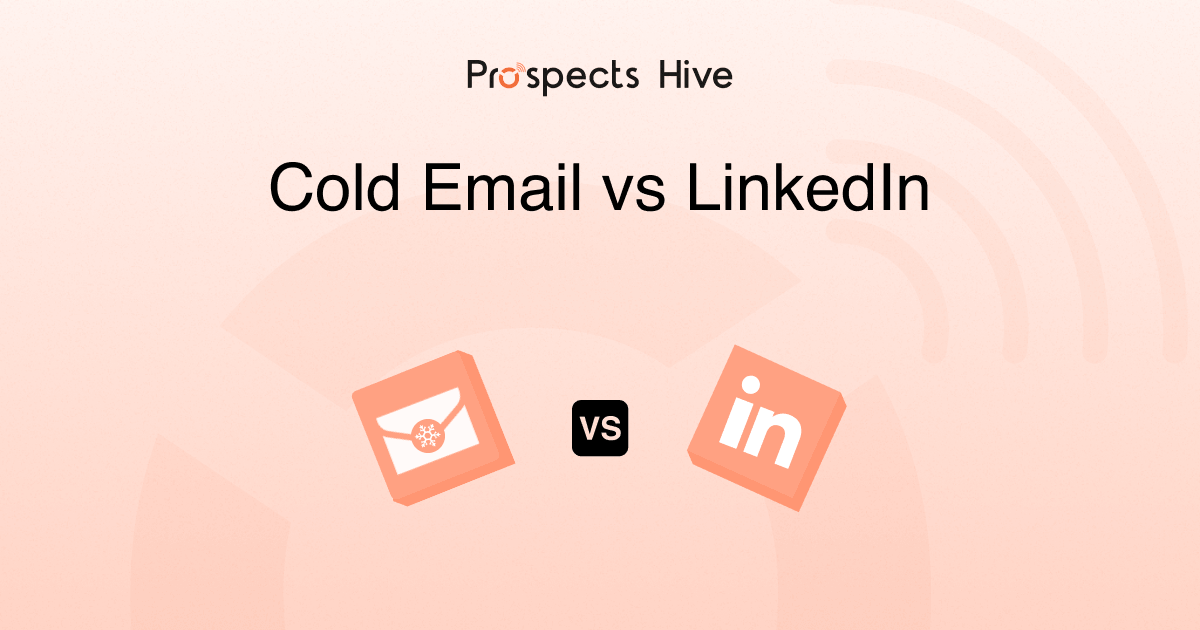
So the real question is not “Cold Email vs LinkedIn: which is better?”
It’s this: Which channel fits your ICP, your offer, and your ability to scale?
In this guide, you’ll get a clear side-by-side comparison, a simple 5-minute decision framework, and a practical hybrid playbook you can apply immediately. No theory. Just what actually works in modern B2B outbound.
Quick TL;DR for Busy Founders
- Cold email = scale + targeting precision
- LinkedIn = trust + context
- Email struggles with deliverability
- LinkedIn struggles with volume limits
- Reply rate ≠ booked meeting rate
- The best outbound teams use both strategically
What is Cold Email?
Cold email is a scalable way to start conversations with people who don’t yet know you.
At its best, it’s built for high-volume outreach, precise ICP targeting, and structured follow-ups. It works especially well in short-to-mid sales cycles, where buyers actively check their inboxes.
But cold email breaks fast when the setup is weak. Poor deliverability, bad data, generic messaging, no CRM tracking, or sending too much too quickly can kill results.
It’s the smart first move when your market is large, you need a predictable pipeline, and your buyers are inbox-driven professionals.
💡 When a Brand Decides to Use Email Marketing
What are LinkedIn Messages?
LinkedIn messages are direct conversations inside a professional network. Unlike email, your message sits next to your profile, content, and shared connections. That context builds trust before you even say a word.
‘From CEOs to department heads, LinkedIn is where key stakeholders actively engage.’
LinkedIn is best used as a warmer first touch. It helps you build familiarity before pitching, especially when targeting high-level roles or selling into long B2B sales cycles. It works well when relationships matter more than volume.
But it has limits. There are weekly caps on connection requests and DMs. Weak profiles reduce credibility. Over-automation triggers restrictions. And generic connection requests get ignored fast.
⚡How Do I Develop an Email List from Linkedin Contacts?
Cold Email vs LinkedIn: Head-to-Head Comparison That Actually Helps
When comparing cold email and LinkedIn, most marketers focus on reply rates. That’s not enough. You need to compare how each channel behaves in real outbound systems.
Let’s have a quick look at the head-to-head comparison table.
| Factor | Cold Email | LinkedIn Outreach |
| Best for | Large TAM, broad prospecting | High-value, targeted accounts |
| Speed to first reply | Slower, depends on inbox behavior | Often faster due to platform activity |
| Scale potential | Very high with multiple mailboxes | Limited by weekly caps |
| Built-in trust | Low initially | Higher due to profile context |
| Risk | Spam filtering, domain damage | Account restrictions, action limits |
| Cost per contact | Very low | Higher (time or premium tools) |
| Effort required | Technical setup + list building | Profile optimization + manual engagement |
| Ideal use case | Predictable pipeline generation | Relationship-first, enterprise outreach |
Cold email gives you reach and control. LinkedIn gives you context and trust. The trade-off is scale versus warmth.
Why Reply Rates Are Misleading
A 10% reply rate on LinkedIn does not automatically mean 10% booked meetings. Many replies are casual, exploratory, or redirect you elsewhere.
On the other hand, a 2% email reply rate at scale can generate more meetings and revenue simply because volume multiplies impact.
The metric that matters is not reply rate. It’s booked meetings and the cost per acquisition. Serious teams track meetings, pipeline value, and conversion to revenue. Replies are just an early signal.
Pros and Cons
Pros and cons of cold email are,
| Pros | Cons |
| Highly scalable | Deliverability risk |
| Precise targeting | Inbox fatigue |
| Full control over sequence and timing | Technical setup required |
Pros and Cons of LinkedIn are,
| Pros | Cons |
| Profile context builds trust. | Weekly limits |
| Higher initial engagement | IPlatform enforcement risk |
| Easier access to high-level roles | Slower to scale |
Each channel has strengths. Neither is universally better.
Best Practices
Best practices of Cold Email are,
- Warm up domains before scaling.
- Use 3–5 follow-ups minimum.
- Keep emails under 125 words.
- Include one clear, simple CTA.
- Configure SPF, DKIM, and DMARC properly
- Keep it relevant, short, and meaningful because one personalized note always wins over ten generic pitches.
⚡ How to Write a Cold Email That Gets Replies
Best practices of LinkedIn are,
- Optimize your profile before sending messages.
- Engage with content before pitching.
- Keep DMs short and direct.
- Reference something specific and real.
- Avoid pitching in the first message.
Current Trends
- Deliverability is the Real Bottleneck: Spam filters are more advanced than ever. Infrastructure now matters as much as copy.
- LinkedIn is Saturated: Generic connection requests and copy-paste DMs are ignored quickly.
- Multichannel is Becoming Standard: Top teams layer email and LinkedIn instead of choosing one.
- Personalization Must be Real: AI can assist with research and structure. But surface-level AI spam gets filtered or ignored.
The future of outbound isn’t about picking a side. It’s about building a controlled, multi-touch system that respects both scale and trust.
Use This Decision Framework to Pick the Right Channel in 5 Minutes
Most people ask, “Which is better?”
A better question is, “What fits my situation right now?”
Use this quick diagnostic to decide.
▶ ️ If your market is large → Start with email.
When your TAM (Total Addressable Market) runs into thousands, email gives you reach and control. You can segment tightly, run sequences, and scale without hitting weekly platform caps.
▶ ️ If your market is small → Start with LinkedIn.
In niche markets, every contact matters. LinkedIn helps you build familiarity first and approach prospects in a warmer, more contextual way.
▶ ️ If you sell high-ticket → LinkedIn first.
Enterprise or $50K+ deals usually require trust, multiple stakeholders, and longer cycles. LinkedIn creates visibility and credibility before the pitch.
▶ ️ If you need volume fast → Email first.
Cold email allows structured follow-ups and predictable activity. When the pipeline is the priority, scale wins.
▶ ️ If both are failing → Fix your ICP before blaming the channel.
Low reply rates often indicate poor targeting, weak positioning, or unclear value. Channels amplify strategy. They don’t fix it.
The Hybrid Playbook (What Top Teams Actually Do)
The best outbound teams don’t argue about channels. They orchestrate them.
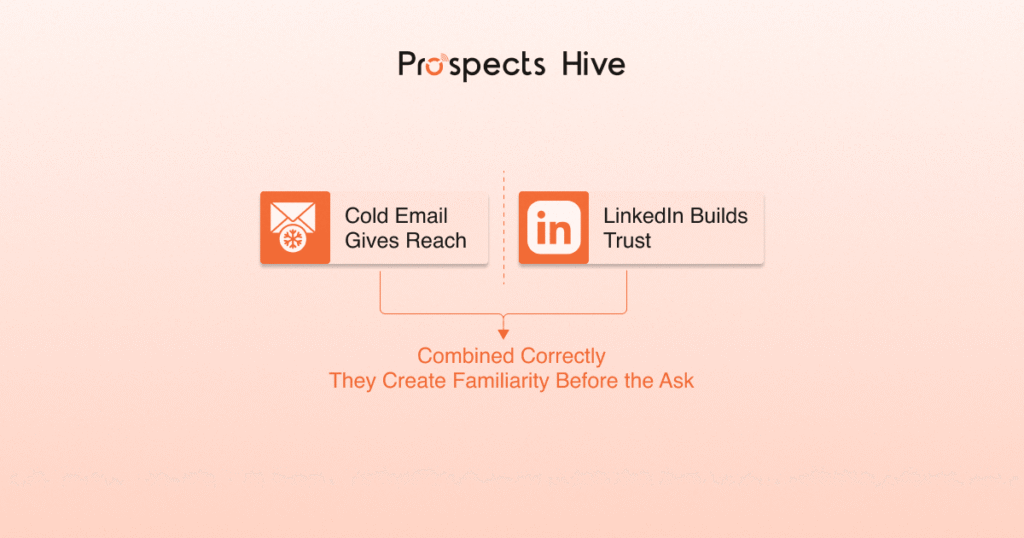
Cold email gives reach.
LinkedIn builds trust.
Combined correctly, they create familiarity before the ask.
This is where structured systems win. And it’s exactly how modern outbound teams, including Prospects Hive, operate.
The Simplest 14-Day Sequence That Works Without Looking Spammy
Here’s a clean cadence that feels intentional, not aggressive:
Day 1: Email #1 (based on a relevant trigger + one clear question)
Day 3: LinkedIn profile view + light engagement (like or thoughtful comment)
Day 5: LinkedIn connection request (context-based, not a pitch)
Day 7: Email follow-up (short, polite bump)
Day 10: LinkedIn DM referencing previous touch
Day 14: Final email with direct, clear CTA
Why this works psychologically:
- It creates multiple light touchpoints, not one heavy push.
- It builds familiarity before asking for time.
- It mirrors how real relationships form across channels.
Why it doesn’t feel spammy:
- Each step has context.
- You’re not blasting the same message everywhere.
- The timeline feels natural, not desperate.
And most importantly, tracking matters. Without CRM visibility across email and LinkedIn, this sequence quickly becomes chaotic.
⚡ Best CRMs for B2B Outbound Sales
When NOT to Use a Hybrid Sequence
A hybrid system only works if the foundation is solid. Don’t use it if:
- You don’t have a clearly defined ICP.
- Your offer is vague or generic.
- Your team can’t manage LinkedIn manually at key touchpoints.
- You can’t track every touch in one CRM
Multichannel amplifies strategy. It doesn’t fix weak positioning.
How Prospects Hive Automates This
The key isn’t automation for its own sake. It’s structured control. At Prospects Hive, hybrid outbound is built around:
- Signal-based list building + enrichment
Targeting based on triggers, not just job titles. - Sequencing across email + LinkedIn with guardrails
Volume limits, timing logic, and human-like pacing. - Centralized CRM logging + follow-up enforcement
No missed touches. No duplicated outreach. - Quality control loops
Copy testing, reply classification, deliverability monitoring, and continuous optimization.
That’s the difference between “using both channels” and running a true outbound system.
Top teams don’t choose between cold email and LinkedIn. They design a sequence where each touch strengthens the next.
Conclusion
Cold email = scale.
LinkedIn = trust.
Hybrid = leverage both when tracked properly.
The debate on cold email vs. LinkedIn misses the real point. Channels don’t create a pipeline. Systems do.
Stop choosing platforms based on trends or reply screenshots. Start aligning your channel with your ICP, deal size, and execution strength.
If you want a predictable pipeline without burning domains or LinkedIn accounts, let Prospects Hive handle your outbound engine. We design, execute, and optimize multichannel systems so you can focus on closing deals rather than chasing replies.
FAQs
1. Is Cold Email Better Than LinkedIn for B2B?
Neither is universally better. Cold email wins on scale and targeting. LinkedIn wins on trust and relationship-building.
2. What Gets More Replies, LinkedIn DMs or Cold Emails?
LinkedIn DMs usually get higher reply rates (often 10–20%+). Cold emails typically average 5-10%, depending on targeting and deliverability.
3. What Gets More Booked Meetings?
It depends on execution and volume. Cold email can book more meetings at scale. LinkedIn often books higher-quality conversations.
4. Is LinkedIn Safer Than Cold Emails?
LinkedIn avoids spam filters but has platform restrictions. Cold email carries deliverability risks but gives more control if set up properly.
5. How Many Emails Can I Send Per Day?
Safely, around 30–50 emails per mailbox per day. Scaling requires multiple warmed domains and inboxes.
6. How Many LinkedIn Invites Per Week?
Typically 80–100 connection requests per week per account, depending on acceptance rates and account health.
7. Should I Connect on LinkedIn Before Emailing?
Not always. For enterprise or high-ticket outreach, warming up on LinkedIn first can increase response likelihood.
8. Why are My Cold Emails Going to Spam?
Common reasons: no domain warm-up, poor SPF/DKIM/DMARC setup, low-quality lists, high bounce rates, or repetitive templates.
9. What is the success rate of LinkedIn messages?
Reply rates commonly range from 10–25% when personalized. Acceptance and meeting rates vary by ICP and message quality.
10. What are the costs of using InMail compared to email?
InMail costs roughly $1–$3 per credit depending on plan. Cold email costs pennies per send but requires infrastructure setup.