Struggling to convert interested leads into paying customers?
You might be targeting the wrong people or engaging with the right ones at the wrong time.
In 2026, leveraging powerful indicators called intent signals that reveal a prospect’s readiness to buy, has become a game-changer for B2B sales teams. Buyer intent signals help you focus on high-potential leads at the right stage of their journey.
In this blog, you’ll learn how to identify intent signals, prioritize leads, and use data-driven strategies to transform those leads into customers with the help of smart tools, real-life examples, and actionable insights.
The 60-second guide to intent signals
- Intent signals help B2B teams identify where prospects are in the awareness, consideration, or decision stage.
- Different intent signals indicate different levels of buying intent and should be prioritized accordingly.
- When sales and marketing teams operate using shared intent data, deal cycles shorten significantly.
- Tools like Demandbase, ZoomInfo, and Apollo.io help automate signal tracking, scoring, and outbound workflows.
- When intent data is aligned with GTM strategy, it creates a scalable engine for converting high-potential leads into customers.
What Are Intent Signals and Why Are They Important for B2B Sales?
Intent signals (also called buying signals) are clues that show someone might be interested in buying your product or service.
These signals help you figure out where your ideal prospect is in their decision-making journey:
- Awareness – They realize they have a problem
- Consideration – They start looking for ways to solve it
- Decision – They’re ready to buy
Some examples of intent signals:
- Visiting your website
- A company hiring new team members
- Moving to a bigger office
- Merging with another company
- Using new software or tools
These signals help sales and marketing teams reach out to people at the right time, when they’re most likely to be interested, making it easier to start conversations and close deals.
In B2B sales, traditional methods like cold calls or mass email outreach are no longer enough. Buyer intent has become the most valuable currency in sales today. By using intent data, sales teams can ensure they’re reaching out to the right people, at the right time, with the right message.
4 Types of Intent Signals for B2B Marketing With Examples
1. Engagement Intent Signals
Engagement intent signals are signals that can be tracked when your prospect seems to interact with your content. This generally indicates an interest in what you offer.
These signals help you understand when a prospect might be exploring your solutions or considering making a purchase.
Examples:
- A prospect clicks on multiple links within your email campaigns.
- A prospect signs up for a webinar or download a resource from your website.
- A lead opens and interacts with your content in a newsletter or blog.
2. Research Intent Signals
Research intent signals can be found when your prospects are in their research stage. That means they are browsing the internet, gathering information, looking for suitable solution providers to solve their problems.
These signals suggest that the prospect is in the discovery phase and considering your product or service as a potential solution.
Examples:
- A lead searches for specific product-related terms or competitors on Google.
- A prospect compares your product features to others via online reviews or forums.
- A visitor reads product case studies or customer testimonials on your website.
3. Hiring/Recruiting Intent Signals
As the name itself suggests, hiring intent signals occur when a company is expanding its team, often indicating that they may need new solutions or technology to scale.
These signals are valuable when a company might be searching for a product or services that you offer.
Examples:
- A company posts new job openings for roles related to your solution (e.g., marketing, sales, product development).
- A business hires executives or decision-makers in areas like operations or technology.
- A company adds positions in growth-oriented departments (e.g., sales or customer success) that might require automation or CRM tools..
4. Technographic Intent Signals
Technographic intent signals are based on the technology stack a company is using.
When a company updates, changes, or adopts new technologies, it could indicate a need for complementary products or services that align with those tools.
Examples:
- A company adopts new CRM software like HubSpot, which may indicate a need for additional marketing automation tools.
- A prospect switches from one cloud service provider (e.g., AWS) to another, signaling potential tech infrastructure changes.
- A prospect installs or trials new analytics software, possibly signaling the need for better reporting and data management tools.
Where Intent Signals Come From?
Intent signals come from various sources. To effectively collect them, the right tools must be leveraged. Below are 4 main sources of intent signals:
- Website Analytics: Tools like Google Analytics or HubSpot intent tracking show which pages your prospects are visiting and how often.
- Social Media: Prospects engaging with your brand on platforms like LinkedIn or Twitter can signal interest.
- Content Consumption: Downloads, clicks, and video views can show what content prospects are engaging with, indicating areas they are interested in.
- Intent Data Providers: Providers offer deeper insights into intent signals, including search behaviors and company-level signals.
By using intent data tools and platforms, businesses can gather the necessary intent signals to effectively guide their outreach strategies as well as expand their intent database.
How to Use Intent Signals to Drive B2B Sales
Using intent signals effectively is the key to improving your sales process. Here’s how to do it effectively:
1. Identify Key Intent Signals
Your sales process requires you to determine which intent signals serve as the most important indicators.
Determine whether you want to find buyer intent signals through your website visitor behavior. Or are you focusing on contextual signals such as new funding or leadership changes in your target accounts?
2. Prioritize and Segment Leads
All intent signals possess different levels of importance. Some signals indicate stronger buying intent than others.
For example, a demo request serves as a stronger indication of purchasing intent than merely visiting your pricing page. Use lead scoring to determine lead importance based on their actual intent.
3. Personalize Outreach
The process of outreach begins after you complete lead identification and lead ranking according to their intent signals.
For instance, you should tailor your email to connect with prospects who downloaded your SEO optimization whitepaper. That particular tailoring shows that you understand their pain points through your reference to specific content.
4. Optimize Sales and Marketing Alignment
Sales teams and marketing teams should base their operations on the same intent signals.
For example, your prospect’s experience becomes seamless when your teams share insights from HubSpot intent tools because both teams share the same objective of faster deal closures.
5. Leverage Tools and Data Sources
Automate the collection and analysis of intent data through tools which include Clay, Apollo or HubSpot. The tools enable you to run your operations smoothly while keeping track of all important intent signals.
5 Best Intent Signals Tools for B2B Sales
Below listed are the top 5 intent signals softwares that every B2B team must have in their tech stack to ramp up their marketing strategies:
1. Demandbase
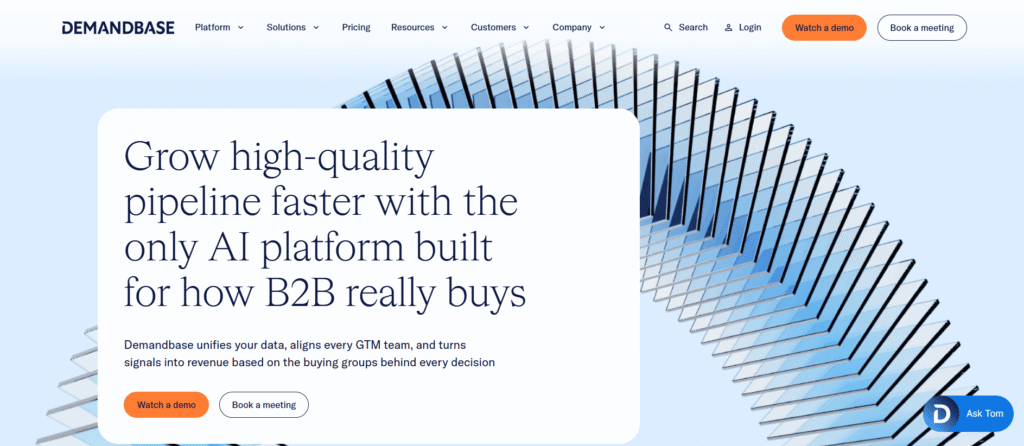
Pricing: Although no fair trial is available, it offers custom enterprise pricing with starting price from $18,000-$65,000+ per year.
Best For: Enterprise ABM teams running multi-channel, account-based programs.
Overview
Demandbase is a full-scale account-based go-to-market platform designed for enterprise revenue teams. It combines account intelligence, advertising, sales insights, and intent data into a unified system.
Instead of just giving you contact data, it focuses on identifying which accounts are actively researching your category and helps orchestrate coordinated engagement across marketing and sales.
Key Intent Signals
- Third-party account-level topic intent
- First-party website engagement
- Buying group activity signals
- Predictive scoring based on account behavior
Pros and Cons of DemandBase
| Pros | Cons |
| Strong ABM orchestration | Expensive for SMBs |
| Enterprise-grade integrations | Complex onboarding |
| Deep account visibility | Requires mature GTM team |
2. ZoomInfo
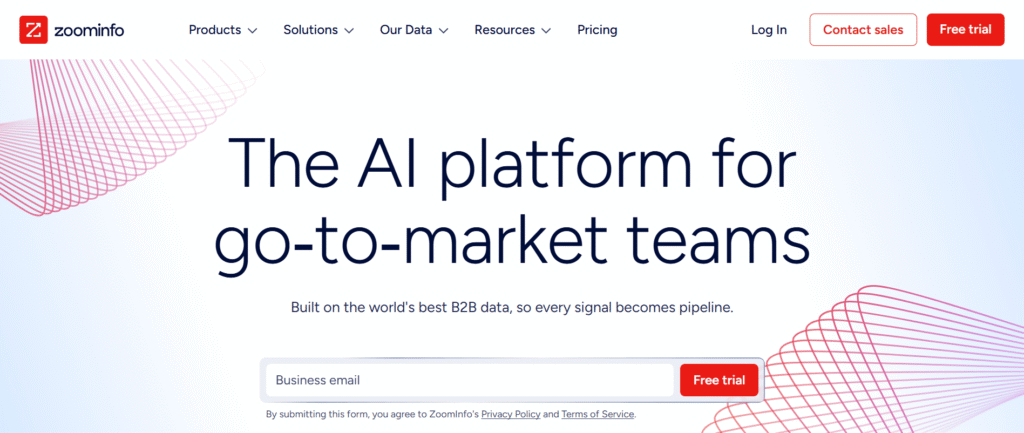
Pricing: Offers quote-based pricing, with annual contracts typically starting around $14,995–$15,000 for the Professional tier, $24,995+ for Advanced, and $35,995–$45,000+ for Elite.
Best For: Sales teams needing both contact data and intent signals in one platform.
Overview
ZoomInfo is primarily a large B2B data intelligence platform that layers intent data on top of its massive contact database.
It allows teams to identify companies researching specific topics, enrich those accounts with decision-maker contacts, and push them into outreach workflows.
Key Intent Signals
- Topic-level buyer intent trends
- Website engagement tracking
- Technographic changes
- Organizational growth signals
Pros and Cons of Zoominfo
| Pros | Cons |
| Massive global database | High cost |
| Combines data + intent | Pricing transparency low |
| Strong CRM integrations | Data accuracy can vary |
3. Apollo.io
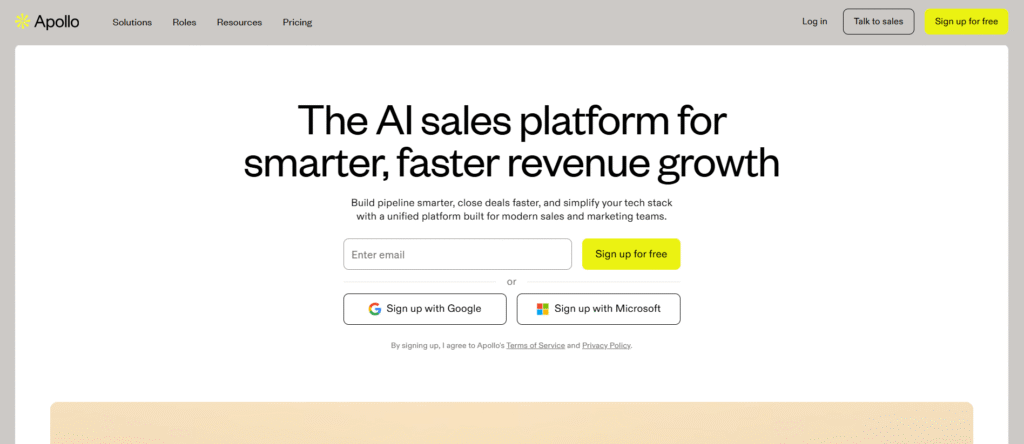
Pricing: Free plan available with paid plans starting from ~$49/user/month.
Best For: Startups and SMB teams combining prospecting and outreach affordably.
Overview
Apollo.io is an all-in-one sales engagement and intelligence platform that includes a large B2B contact database, enrichment capabilities, and built-in email sequencing.
Its intent layer is lighter compared to enterprise ABM platforms, but it offers useful behavioral and firmographic signals for prioritization.
💡 How SaaS Companies Can Scale Faster by Combining ABM and Allbound Marketing
It’s ideal for teams that want a cost-effective way to run outbound campaigns without buying separate intent and engagement tools.
Key Intent Signals
- Website visit tracking (limited)
- Job changes and hiring signals
- Technographic filters
- Engagement tracking within sequences
Pros and Cons of Apollo
| Pros | Cons |
| Affordable and scalable | Intent depth limited |
| Built-in sequencing | Data quality varies by region |
| Easy to use | Not enterprise-grade ABM |
4. RB2B
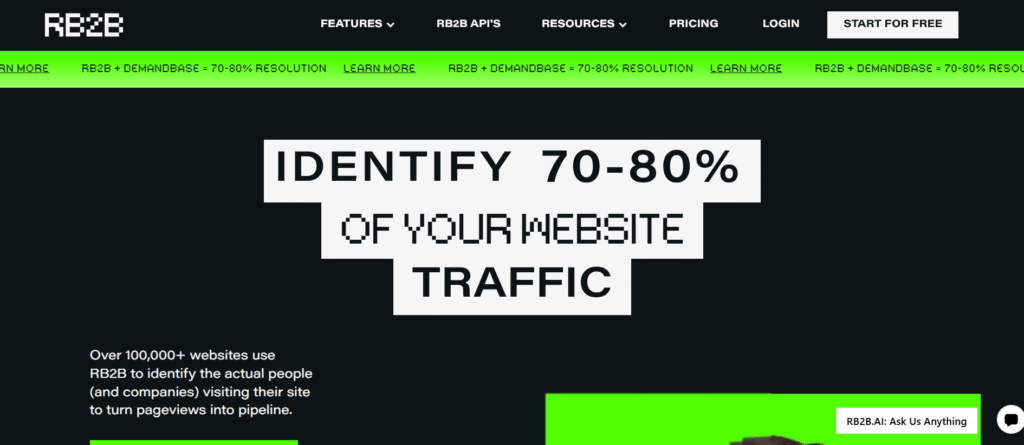
Pricing: Offers 7 day free trial with starter plans starting from around ~$149/month (varies).
Best For: Teams wanting to identify anonymous website visitors.
Overview
RB2B focuses on revealing companies and sometimes individuals visiting your website. It helps turn anonymous traffic into identifiable accounts so your sales team can follow up quickly.
Unlike broad market intent platforms, RB2B works purely on first-party signals. It’s best used to capture and act on high-intent website visitors rather than predict demand across the wider market.
Key Intent Signals
- Anonymous visitor identification
- Company-level traffic detection
- Contact matching and enrichment
- Real-time alerts
Pros and Cons of RB2B
| Pros | Cons |
| Great for capturing inbound intent | Not market-wide intent |
| Simple setup | Limited predictive scoring |
| Useful for SDR follow-ups | Narrow scope |
5. Maximise.ai
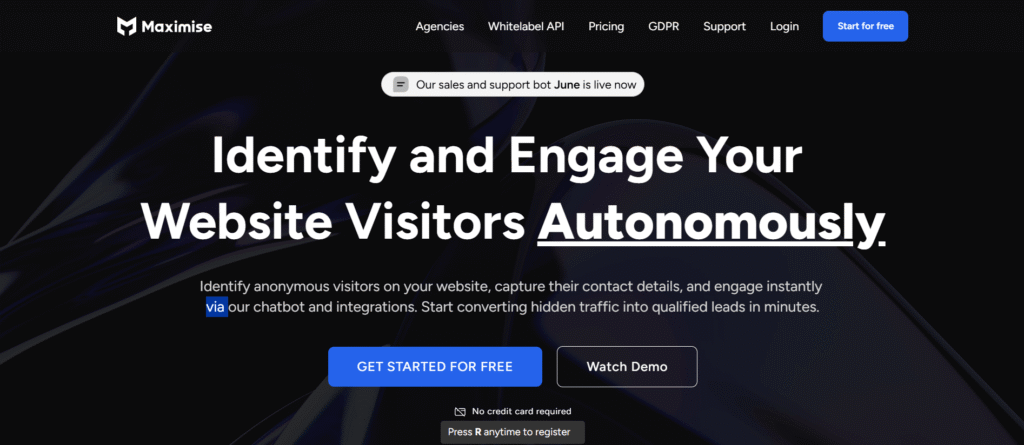
Pricing: Offers 30 days no restriction free trial with starter plans beginning from $59/month.
Best For: AI-driven outbound teams prioritizing predictive signals.
Overview
Maximise.ai focuses on AI-driven sales intelligence and automated outbound workflows. It aggregates behavioral signals and uses predictive models to surface accounts most likely to convert.
It’s built for teams that want to combine machine learning insights with automated prospecting rather than manually reviewing intent dashboards.
Key Intent Signals
- Predictive scoring models
- Behavioral buying triggers
- Engagement-based prioritization
- Automated sequencing integration
Pros and Cons of Maximise.ai
| Pros | Cons |
| AI-focused prioritization | Limited public benchmarks |
| Workflow automation emphasis | Not widely reviewed |
| Good for scaling outbound | Best suited for data-mature teams |
A Simple “Signal-to-Outbound” Workflow
Reaching the right prospects at the right time is the ultimate goal that defines sales success. Targeting high-value leads more effectively through a streamlined outreach becomes easier when buyer intent signals are integrated into your Go-To-Market (GTM) strategy.
This is exactly what Prospects Hive helps businesses like yours to build: a seamless workflow using buyer intent with automated outbound marketing to drive consistent, high-quality sales.
Here is a simple signal-to-outbound workflow to streamline your B2B outreach and target high-value leads more effectively:
1. Capture Intent Signals
Track key buying signals like interaction with content, research activities, job changes by using advanced intent data tools (e.g., Clay, LinkedIn Sales Navigator). This helps you identify prospects with high purchase intent.
2. Segment and Prioritize Leads
Based on these captured intent signals, segment prospects using high-priority lists. These lists contain leads that show clear inclination towards your solution, so they are the best candidates for outreach.
3. Develop Targeted GTM Strategies
Create a personalized GTM strategy that aligns with your buyer’s needs and challenges.
Related: AI GTM in Outbound Marketing 2025: Strategies, Benefits & Tools
Using segmentation and intent data, tailor your outreach messages in a way that connects your solution with each lead’s specific pain points.
4. Automated Outreach
Onboard Prospects Hive’s outbound automation services to craft personalized cold emails, LinkedIn messages, and run multi-channel campaigns, targeting the identified prospects.
5. Track Engagement & Refine
Monitor the engagement metrics through integrated tools like Attio and Make.com. Use this data to continuously polish your outreach sequences, to make sure you stay aligned with evolving buyer intent.
6. Close Deals
Move engaged prospects seamlessly into your sales pipeline in Attio, where automated workflows, lead scoring, and deal routing help convert them into paying customers.
Final Thoughts
Incorporating intent signals in your B2B sales strategy functions as a vital component that enables you to advance from cold outreach methods toward implementing a precise sales process based on data.
Your sales team achieves faster deal closures through their ability to identify relevant intent signals and rank leads while creating customized outreach strategies. The combination of intent data, sales and marketing team alignment, and optimal tool usage helps you maintain a competitive advantage persistently.
Ready to start using intent signals in your sales strategy? Prospects Hive is here to help you build a predictable, scalable system that turns signals into sales.
FAQs
1. What is intent marketing?
Intent marketing is a marketing tactic that uses buyer research signals to identify and engage in-market prospects with timely, relevant outreach.
2. How to measure the ROI of intent signals in B2B sales?
Measure ROI of intent signals in B2B sales by tracking metrics like conversion rates, average deal size, and sales cycle length.
3. Can small B2B teams use intent signals without a big budget?
Yes, small B2B teams can use intent signals without a big budget by starting with free or low-cost first-party tools, owned channel data, and basic integrations.
4. How to integrate intent signals with existing GTM and CRM systems?
Integrate intent signals with GTM and CRM systems via APIs, automation platforms like Prospects Hive, and combining them with behavioral/CRM data for real-time workflows and lead scoring.
5. Are there privacy or compliance risks with intent signals data?
Yes, intent signals data carries privacy and compliance risks like GDPR/CCPA violations from third-party tracking, requiring consent management and data anonymization
6. What can be done with consumer intent data?
With consumer intent data, you can personalize marketing, optimize ad targeting, predict purchases, and drive retargeting campaigns.
7. How do intent signals differ from traditional lead scoring in B2B?
Intent signals differ from traditional lead scoring in B2B by focusing on real-time behavioral indicators of active buying interest, rather than static demographic or firmographic fit.