You have a target account list. You have a CRM. You have a marketing team sending emails and a sales team making calls. And yet, three months in, nobody can say for sure if any of it is working.
That’s usually a data problem, not a strategy problem.
Data helps account-based marketing (ABM) by replacing guesswork with evidence at every stage. It tells you which accounts to go after, who inside those accounts actually makes the buying decision, when they’re ready to hear from you, and whether your campaigns moved real pipeline or just generated activity. Without it, ABM is just cold outreach with a fancier name.
This guide walks through exactly how data powers ABM, the specific data types that matter, where most programs quietly break down, and what to check before you trust the data you already have.
Table of Contents
ToggleWhat Counts as “Data” in ABM?
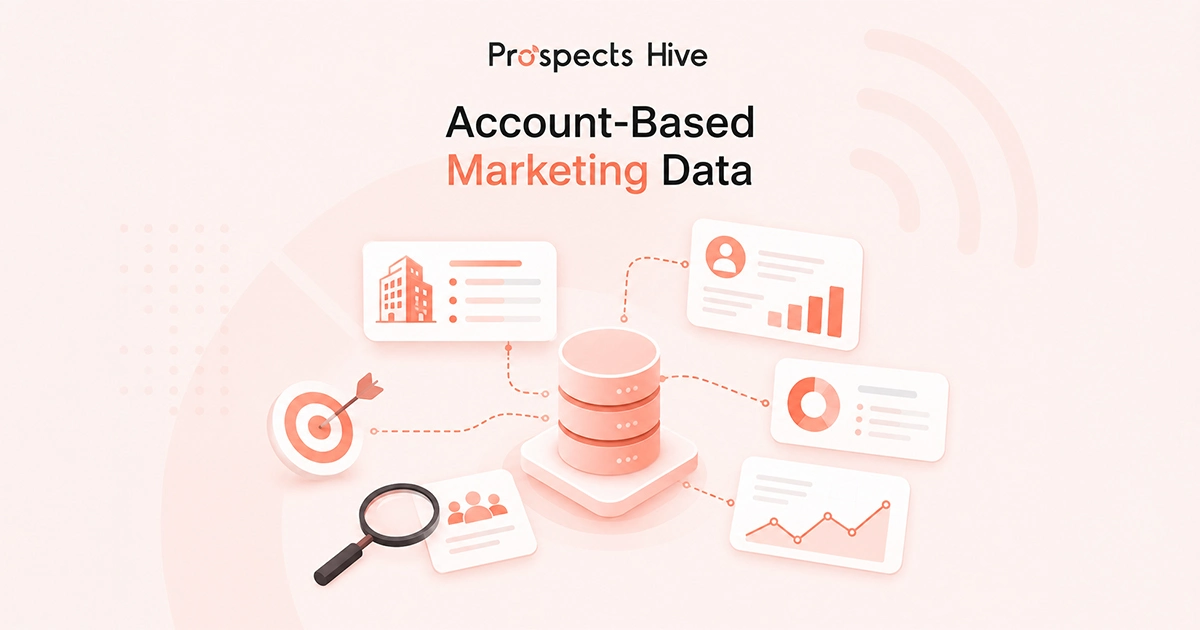
In regular marketing, data usually means individual leads: names, emails, form fills. ABM works differently. The unit of analysis is the account, not the person.
That means your data has to answer questions at the company level first.
- Does this company fit our ideal customer profile?
- Is anyone there researching a problem we solve?
- Who are the actual decision-makers, and are we reaching more than one of them?
Six data types answer these questions together:
- Firmographic data
- Technographic data
- Intent data
- Engagement data
- Buying group data
- Identity and enrichment data
Each one plays a different role. Together, they turn ABM from a list of company names into a working system.
Why ABM Falls Apart Without Good Data
ABM asks you to spend more time and resources on a smaller group of companies. That only works when you are confident those companies deserve the attention.
Poor data changes that quickly.
Validity’s State of CRM Data Management report found that 37% of CRM users have lost revenue directly because of poor data quality, and 76% said less than half their CRM data is accurate and complete. Numbers like that turn into missed opportunities fast once an ABM program is built on top of that same shaky data.
In an ABM program, those problems can show up as:
- High-value accounts missing from the target list
- Poor-fit companies receiving expensive one-to-one outreach
- Emails going to people who changed jobs months ago
- Multiple CRM records for the same company
- Buying signals sitting under the wrong account
- Sales contacting one person while missing the real decision-makers
- Marketing seeing engagement that sales cannot see
- Account scores based on stale or incomplete information
The campaign can still look busy. Ads get impressions. Emails get opened. Content gets downloaded.
But activity is not the same as account progress. Bad data makes it difficult to tell the difference.
The Types of Data That Power ABM
Here is what each type of account-based marketing data does and the decision it helps you make.
Firmographic Data
Firmographic data covers the basic facts about a business. It includes industry, company size, annual revenue, location, business model, and growth stage.
It is usually one of the first filters used when building an ideal customer profile (ICP) and target account list.
Use it to answer a basic question: Does this company actually fit what we sell?
A 50-person retailer and a 5,000-person enterprise may have completely different budgets, buying processes, risks, and expectations. Firmographic data stops your team from treating both accounts the same.
It also helps you remove companies that were unlikely to become good customers in the first place.
Technographic Data
Technographic data shows the software, platforms, and technologies a company already uses.
This information can help in several ways:
- Identify accounts using a competitor
- Find companies using technology your product integrates with
- Spot outdated systems your service may replace
- Segment accounts by their existing tech stack
- Shape outreach around a specific integration or workflow
Intent Data
Intent data indicates that people from an account may be researching a topic, problem, product category, or competitor related to what you sell.
It usually falls into two groups.
First-party intent data comes from activity you can see through your own channels. Examples include service-page visits, webinar registrations, content downloads, demo requests, and repeat website activity.
Third-party intent data comes from activity observed outside your owned channels. It can help identify research happening before an account directly engages with your business.
The value of intent data is timing.
A company may have matched your ICP for two years. If its research activity suddenly increases around a problem you solve, there may now be a better reason to look at the account again.
But intent is not proof of a purchase.
Someone researching a topic does not tell you whether there is an approved project, available budget, executive support, or a buying timeline. That is why intent data works better when you combine it with fit and direct engagement.
Engagement Data
Engagement data tracks how a target account interacts with your company.
It may include:
- Website visits
- Key page views
- Email responses
- Content downloads
- Webinar attendance
- Ad engagement
- LinkedIn interactions
- Demo requests
- Sales conversations
The useful part is not simply the total number of interactions. Look at recency, depth, and spread.
Recent activity usually matters more than activity from six months ago. A pricing-page visit may deserve more attention than a short blog visit.
Engagement across several relevant buying roles can also tell you more than activity concentrated around one contact.
Buying Group Data
Nobody signs off on a B2B deal alone anymore. Forrester’s latest research on business buying puts the typical purchase decision at 13 internal stakeholders and nine external influencers, and that number climbs even higher for larger or more complex deals.
Buying group data maps the actual roles inside an account: who controls budget, who evaluates the technical fit, who influences the decision without ever holding the pen.
Firmographic and intent data help you find the right account. Buying group data is what helps you find the right people once you’re actually inside it.
Identity and Enrichment Data
This category connects anonymous activity back to a known account. Someone visits your pricing page without filling out a form, and that visit would normally vanish into your analytics unnoticed.
Identity resolution tools match that activity back to a company, and sometimes even a specific contact, so real interest doesn’t slip through the cracks just because nobody clicked submit.
How Data Powers Each Stage of ABM
Data is not something you collect once before launching an ABM campaign. It supports decisions throughout the entire process.
| ABM Stage | How Data Helps | Data Types Involved |
| Target Account Selection | Builds your ICP and ranks accounts by fit | Firmographic, technographic |
| Account Prioritization | Separates good-fit accounts from accounts showing active interest | Firmographic, intent, engagement |
| Buying Group Mapping | Identifies the roles involved in the purchase | Buying group, enrichment |
| Personalization | Shapes messaging around account needs and role-specific priorities | Firmographic, engagement, CRM, trigger data |
| Timing and Outreach | Shows when an account deserves closer attention | Intent, engagement, trigger data |
| Sales Handoff | Gives sales the account history and reason for follow-up | CRM, engagement, buying group |
| Measurement | Shows whether target accounts are progressing toward pipeline and revenue | CRM, opportunity, revenue data |
Here’s a quick example of these working together.
Intent data shows three companies researching “vendor consolidation” this month. Firmographic data confirms two of them fit your ICP. Buying group data shows an existing contact in IT at one of them, but nobody in finance.
That combination points to exactly who to add to the campaign, and exactly what angle to use, instead of sending one generic email to the whole list.
Signal vs Proof: Why Not All Data Should Be Trusted Equally
Here’s where a lot of ABM programs quietly go wrong. They treat every data point as equally trustworthy, and it isn’t.
Downloading a piece of content counts as a signal, not proof that someone’s ready to buy. A topic surge in third-party intent data means research activity around that subject has increased. It does not tell you whether a specific person searched for it, whether budget exists, or whether a buying project has been approved.
Treat every signal like a green light for outreach, and your messaging starts feeling premature. Prospects notice, and it costs you trust before the conversation even starts.
The safer move is weighting signals instead of reacting to any single one. Three different people at an account engaging with different content over two weeks is a far stronger case than one person opening the same email twice.
Layer intent data over firmographic fit and real engagement depth before you decide an account is genuinely ready for outreach.
How to Tell If Your ABM Data is Actually Good Enough
You do not need a perfect database before starting ABM. You do need data that is trustworthy enough for the decision you are making.
Run these checks before building a campaign around it:
- Is the data recent, or six months old and quietly decaying?
- Does sales actually agree with the accounts sitting on your target list?
- Do leads reliably match back to the right account, or do duplicates let them fall through the cracks?
- Have you and sales agreed, in writing, on what “engaged” and “influenced” actually mean?
- Can you trace each important account signal back to its source and when it was last updated?
Common Mistakes Teams Make with ABM Data
Even good data becomes less useful when the team handles it badly. Here are some of the most common mistakes.
- Treating every intent signal as equally actionable, instead of weighting it against real engagement depth
- Tracking only one contact per account, missing the rest of the buying committee entirely
- Letting the target account list sit untouched for months after the campaign launches
- Collecting more data than the team can realistically act on
- Measuring success with vanity metrics like impressions instead of pipeline actually influenced
How Prospects Hive Helps You Put ABM Data to Work
Good ABM data isn’t a one-time setup. It has to stay clean and connected while your team is busy running actual campaigns, which is genuinely hard without someone dedicated to watching it.
Here’s how our process supports the framework in this guide:
- Verified prospect data built around your real ICP, not a scraped list bought off the shelf
- Multichannel engagement tracking across email, LinkedIn, and outreach, so activity doesn’t disappear into three separate tools
- CRM automation that logs every touch automatically, keeping your buying group data current without manual entry
- Reporting that connects campaign activity, replies, conversions, and pipeline progress instead of relying only on opens and clicks.
Bottom Line
To sum up, data helps in account-based marketing by answering four practical questions: Which accounts matter? Who matters inside them? When should we act? What should happen next?
Firmographic and technographic data help establish fit. Intent and engagement data help with timing. Buying group, identity, enrichment, and CRM data give sales and marketing the context needed to act.
But the best ABM teams do not blindly follow every signal. They combine different data points, check the quality behind them, and turn useful signals into clear actions. That is what makes ABM data valuable.
Frequently Asked Questions
What data do I need to start account-based marketing?
Most ABM programs use firmographic, technographic, intent, engagement, buying group, identity, enrichment, and CRM data. You do not need every possible data source. Start with the information required to select accounts, identify buyers, understand engagement, and decide when to act.
Why is data important in account-based marketing?
Data helps sales and marketing decide which companies deserve attention and what is happening inside those accounts. It improves account selection, prioritization, personalization, buying group mapping, outreach timing, and sales handoffs.
What’s the difference between firmographic and technographic data?
Firmographic data describes the company itself, covering industry, size, revenue, and location. Technographic data describes the tools and software that company already uses, showing whether your product actually fits their setup.
How much of ABM’s success depends on data quality versus strategy?
More than most teams expect. A strong strategy built on stale or duplicate data still produces weak results, since sales ends up chasing the wrong accounts or missing the right ones, which is exactly why clean data and good strategy have to work together.
How does data improve ABM personalization?
Data gives you context about the company, its technology, recent changes, previous interactions, and the role of the person you are contacting. That context helps you explain why your offer is relevant instead of relying on generic personalization