You’re getting traffic, running ads, and posting content. But sales still aren’t following.
The problem might not be your product. It might be that you have no funnel.
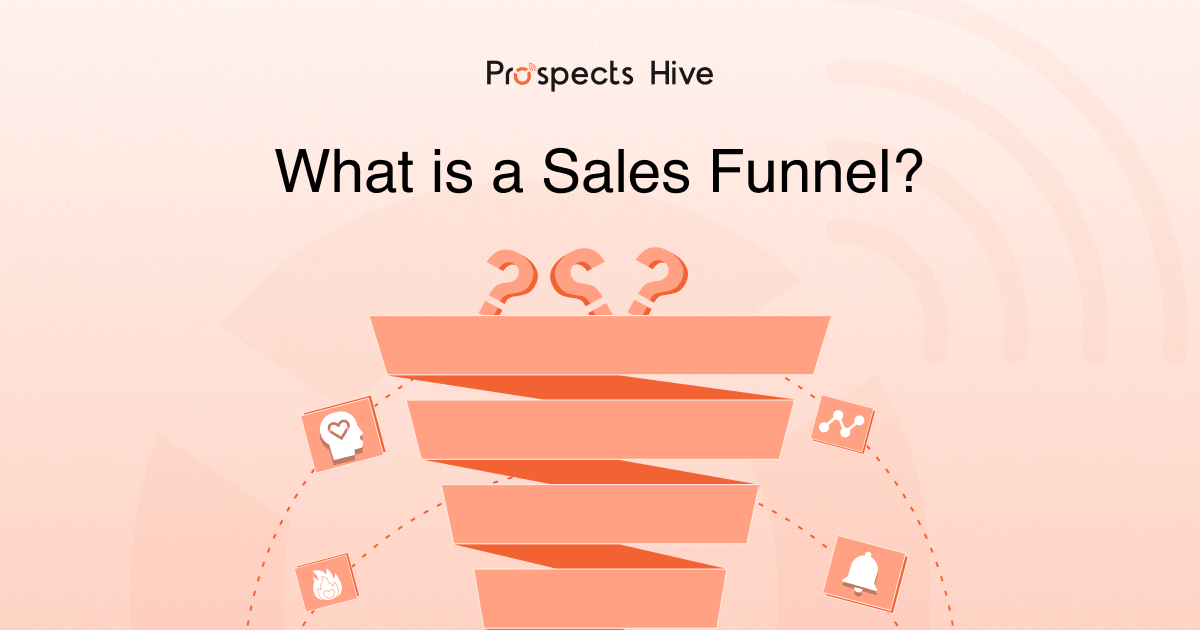
A sales funnel is the structured path that takes a stranger and turns them into a paying customer. Think of it as a filter: wide at the top, narrow at the bottom. Many people enter, but only the most interested ones convert.
In this guide, you’ll learn exactly what a sales funnel is, how each stage works, real-world examples, and how to build one from scratch.
Key Takeaways
- A sales funnel is a structured pathway that guides prospects from awareness to purchase, ensuring predictable growth.
- The 6 funnel stages: Awareness, Interest, Evaluation, Intent, Purchase, and Loyalty; each requires tailored tactics and optimization.
- Common mistakes such as weak messaging, poor follow-ups, or friction at checkout can cause funnel leakage and lost opportunities.
- Sales funnels differ from sales pipelines: funnels track conversion rates, while pipelines focus on seller actions.
What is a Sales Funnel and Why Does it Matter?
A sales funnel is a step-by-step model that maps your customer’s journey from first discovering your brand to making a purchase.
It is called a “funnel” for a simple reason: a large number of people enter at the top, but only a fraction make it all the way to the bottom and buy.
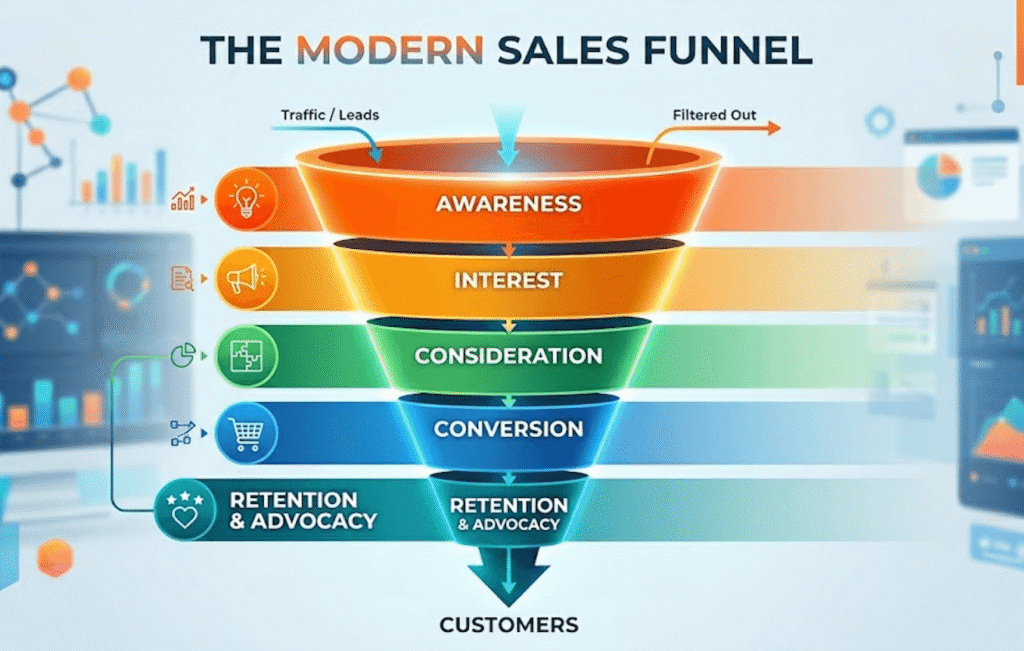
Not every person who sees your ad is ready to buy. Not every visitor who reads your blog is a qualified lead. The funnel helps you accept that and work with it.
But here is where most businesses miss the point. A sales funnel is not just a marketing diagram. It is a model of human behavior. It reflects how people actually make decisions slowly, with research, comparison, and hesitation. Understanding that changes how you sell.
Without a defined funnel, you are essentially winging it. You cannot tell if your messaging is failing at the awareness stage or if people are dropping off right before checkout.
With a funnel in place, the picture changes completely. You can spot exactly where customers are dropping off and fix those weak points. Your marketing and sales teams stop working in silos. Marketing fills the top, sales close the bottom.
You can set up automated email sequences that move leads through stages while you focus on other things. And once you know your conversion rate at each stage, you can forecast revenue with real confidence.
💡 The Ultimate Guide to Email Conversion Rate
The Stages of a Sales Funnel: What’s Actually Happening at Each Step?
Every funnel has a story. Here is how it unfolds.
Stage 1: Awareness (They Just Found You)
This is the “handshake” stage. The prospect did not know you existed 5 minutes ago. Now they do.
They found you through a Google search, a social media post, a YouTube video, a paid ad, or a friend’s recommendation. They have not made any commitment. They are simply aware.
What the customer is thinking:
“Hmm, this looks interesting. Let me see what this is about.”
What works here:
- Blog posts and SEO content
- Short-form video (TikToks, Reels, YouTube Shorts)
- Infographics and social media posts
- Paid ads (Google, Meta)
- Word of mouth and referrals
Your goal at this stage: Get noticed. Nothing more. Do not try to sell here.
Stage 2: Interest (They’re Curious, Not Committed)
At this stage, the prospect is paying attention. They clicked your link, read your blog, or followed your page. They are not ready to buy, but they want to know more.
This is where the mindset shifts from passive to active. They start comparing. They read reviews. They consume your content to decide if you are worth their time.
What the customer is thinking: “This might solve my problem. Let me dig deeper.“
What works here:
- Email newsletters
- How-to guides and tutorials
- Case studies
- Comparison content (“X vs. Y”)
- Webinars and free resources
Your goal at this stage: Build trust and capture contact information. A lead magnet (a free guide, checklist, or template) offered in exchange for an email address is one of the most effective tools here.
Stage 3: Consideration (They’re This Close to Buying)
The prospect is serious now. They are not just browsing. They are evaluating. They are looking at your pricing page, reading your testimonials, and comparing you to competitors.
This is where purchase intent is highest, and where most businesses lose deals by going quiet or failing to provide the right information.
What the customer is thinking:
“Is this the right choice for me? Can I trust them?“
What works here:
- Free trials and product demos
- Discount codes or limited-time offers
- Customer testimonials and case studies
- Detailed FAQ pages
- Live chat and direct sales outreach
Your goal at this stage: Prove you are the best choice. Use trust signals and social proof to remove doubt. A strong, clear call to action (CTA) is essential.
Stage 4: Action (The Finish Line)
The prospect clicks “Buy Now.” The deal is done. They are officially a customer.
But this stage is not just about celebration. It is about execution. A clunky checkout process, a confusing payment page, or a slow-loading site can kill a sale that was already won.
What the customer is thinking:
“Okay, I’m doing this. Please make it easy.“
What works here:
- Streamlined checkout process
- Multiple payment options
- Clear order confirmation and next steps
- Immediate onboarding or delivery
Your goal at this stage is to remove every possible barrier to purchase. Friction is your enemy.
Stage 5: Retention (The Stage Most Blogs Skip)
Acquiring a new customer costs 5 times as much as retaining an existing 1. Yet most businesses pour all their energy into the top of the funnel and neglect what happens after the sale.
Retention is where real profitability lives. A customer who buys 2x is more valuable than 2 customers who each buy 1x. And a customer who refers others? That is the flywheel model in action.
The flywheel reimagines the funnel as a cycle. Instead of the journey ending at purchase, a great post-purchase experience turns customers into advocates who bring new people into the top of your funnel for free.
What works here:
- Post-purchase email sequences
- Loyalty programs and exclusive offers
- Proactive customer support
- Referral programs
- Regular check-ins and product updates
Your goal at this stage is to turn buyers into loyal customers. Then turn loyal customers into advocates. That is how customer lifetime value (CLV) grows and how sustainable businesses are built.
A Real-World Sales Funnel in Action
Theory is useful. Examples make it stick. Here are 3 real scenarios across different business types.
Example 1: E-Commerce
| Funnel Stage | What Happens | Numbers |
| Awareness | 1,000 people see a Facebook ad for running shoes | 1,000 |
| Interest | 200 click through to the product page | 200 |
| Consideration | 50 add the shoes to their cart | 50 |
| Action | 10 complete the purchase | 10 |
| Retention | 3 return to buy again within 90 days | 3 |
Overall conversion rate: 1%
The funnel tells you exactly where to focus. If 200 people visited but only 50 added to the cart, your product page needs work. If 50 is added to the cart but only 10 are bought, your checkout process has friction.
💡 Email Conversion Rate Benchmarks (2026): What Actually Drives Results
Example 2: B2B / SaaS
This is a longer cycle. B2B decisions involve multiple stakeholders and higher stakes.
- A marketing manager downloads a whitepaper on “improving sales team productivity” (Awareness)
- They attend a live webinar on the topic (Interest)
- They sign up for a 14-day free trial (Consideration)
- A sales rep follows up with a personalized demo (Decision)
- They convert to a paid subscription (Action)
- They renew annually and refer two colleagues (Retention + Advocacy)
B2B funnels are slower, but the deal sizes are larger. The nurturing phase, from whitepaper to demo, can take weeks or months. This is why lead nurturing through email marketing and CRM software like HubSpot or Salesforce is critical in B2B.
💡 When a Brand Decides to Use Email Marketing
Example 3: Content Marketing (Blog to Email to Sale)
This is the most common funnel for solo entrepreneurs, coaches, and content-driven businesses.
- A person searches “how to grow an email list” and finds your blog post (Awareness)
- They read the post and download your free “Email Growth Checklist” in exchange for their email (Interest, Lead Magnet)
- Over the next week, they will receive a 3-part email sequence with tips and a demo video of your course (Consideration)
- On Day 7, they receive a limited-time offer: 20% off your email marketing course (Action)
- They buy, complete the course, and leave a testimonial (Retention + Social Proof)
This entire flow can run on autopilot with the right marketing automation tools.
How to Build a Simple Sales Funnel (Even if You’re Starting from Zero)
Here is a practical, beginner-friendly process.
Step 1: Define Your Target Audience
You cannot build a funnel without knowing who you are funneling. Start with one specific customer type.
- What are their pain points?
- What are they searching for?
- What does success look like for them?
The more specific you are here, the more effective every stage of your funnel will be.
Step 2: Create Awareness Content
Pick 1 or 2 channels where your audience already spends time. Write blog posts optimized for search. Run targeted ads. Post consistently on the social platform that fits your audience.
You do not need to be everywhere. You need to be visible where it counts.
Step 3: Capture Leads with a Lead Magnet
Drive your audience to a dedicated landing page. Offer something valuable for free. Such as a checklist, template, guide, or mini-course. In exchange for their email address via an opt-in form.
This is how you move someone from a passive visitor to a known lead.
Step 4: Nurture With Email Sequences
Once you have their email, the relationship begins. Set up an automated sequence of 3-5 emails. Each email should deliver value first, then move the reader one step closer to your offer.
Do not sell in every email. Educate, build trust, and solve small problems. The sale follows naturally.
Step 5: Convert with a Strong Offer
When the timing is right, make your offer. Be clear about what they get, what it costs, and why now. Use a strong CTA. Offer a free trial, demo, or discount if appropriate.
Make the decision as easy as possible.
Step 6: Retain and Delight
After the sale, do not go quiet. Send a welcome sequence. Check in after 7 days. Ask for feedback. Offer a loyalty discount on the next purchase. Introduce a referral program.
This is where your funnel becomes a flywheel.
Bonus: you know, you can take a break if you let us take over your burden. From scratch to client retention, prospects hive handles without any ifs and buts. On top of that, you don’t have to pay for multiple tools across multiple steps. We cover everything.
Your Funnel is Your Business’s Growth Engine
A sales funnel is not a buzzword. It is the difference between guessing and knowing, knowing where your customers are, what they need, and what it takes to convert them.
Every business already has a customer journey. The question is whether you have designed it intentionally or left it to chance.
Build your funnel. Measure it. Improve it. That is how you grow.
Ready to build a funnel that actually converts? Explore Prospects Hive and start turning your traffic into revenue.
FAQs
1. What is funnel leakage?
Funnel leakage refers to the points in your sales funnel where potential customers drop off and stop moving forward.
2. What is a B2B sales funnel?
A B2B (business-to-business) sales funnel follows the same core stages but operates on a longer timeline. Purchases typically involve multiple decision-makers, larger budgets, and more due diligence.
3. What is TOFU, MOFU, and BOFU in a sales funnel?
TOFU (Top of the funnel) is awareness-stage content, blog posts, social media, and ads. Goal: reach new audiences.
MOFU (Middle of Funnel) is nurturing-stage content, case studies, email sequences, and webinars. Goal: build trust and move leads closer to a decision
BOFU (Bottom of Funnel) is conversion-stage content, demos, free trials, pricing pages, and discount offers. Goal: close the sale.
4. What is the difference between a sales funnel and a sales pipeline?
They are related but different. Both are useful. The funnel tells you where your customer is. The pipeline tells you what your team should do about it.
💡 Sales Funnel vs Sales Pipeline: A Clear Guide for Sales Teams
5. What is the difference between a B2B sales funnel and a B2C sales funnel?
B2B buyers need more information and more time. B2C buyers are often driven by emotion and convenience. Your funnel strategy should reflect which audience you are serving.