In B2B sales, the words ‘funnel’ and ‘pipeline’ get tossed around so often that it’s easy to think they mean the same thing. But while the terms sound alike, they play very different roles in your sales strategy and mixing them up can cost you heavily.
Knowing the difference when it comes to the sales funnel vs sales pipeline conversation can make or break your long-term growth results. Grasping the nuances is crucial for designing a sales strategy that keeps your prospects engaged from discovery to deal.
In this article, we explain all the key differences between a sales pipeline and a funnel, as well as when to use which one and how these go hand in hand for the growth of any business.
Key Takeaways
- A sales funnel shows the buyer journey, while a sales pipeline shows the sales team’s deal process.
- Funnels track buyer behavior. Pipelines track sales activity.
- Funnels generate qualified leads. Pipelines turn those leads into revenue.
- Funnel metrics measure marketing performance. Pipeline metrics measure sales efficiency.
- Growth improves when marketing and sales align on definitions, metrics, and tools.
Sales Pipelines vs Sales Funnels: Where the Difference Lies
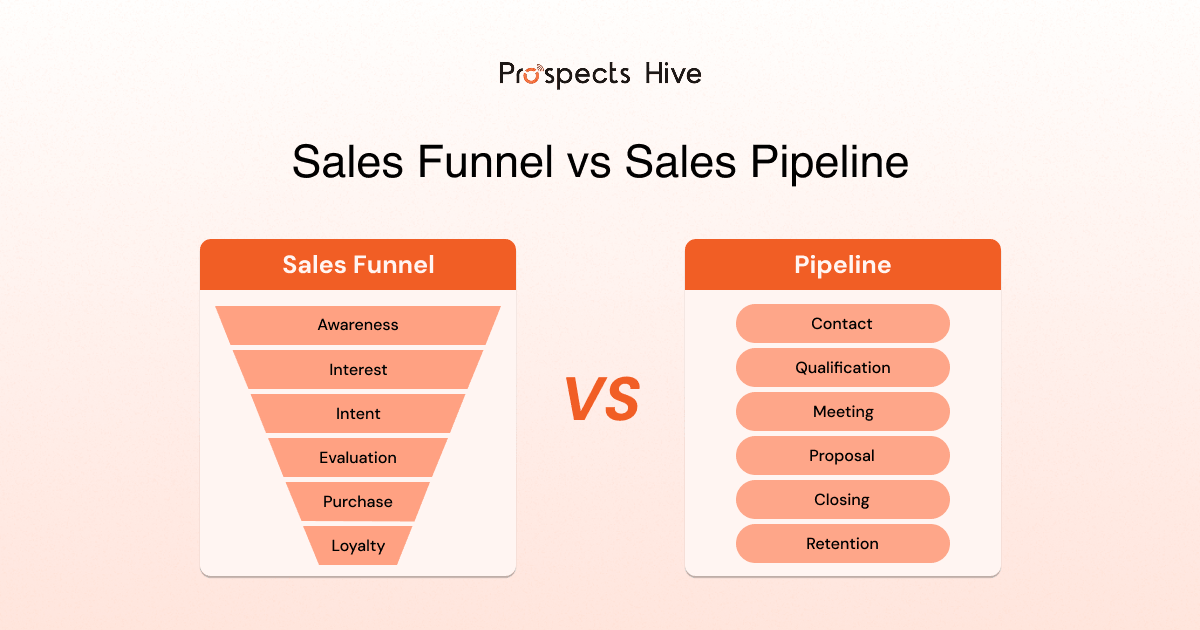
A sales funnel shows the buyer’s journey while a sales pipeline maps the internal sales steps reps take to close deals.
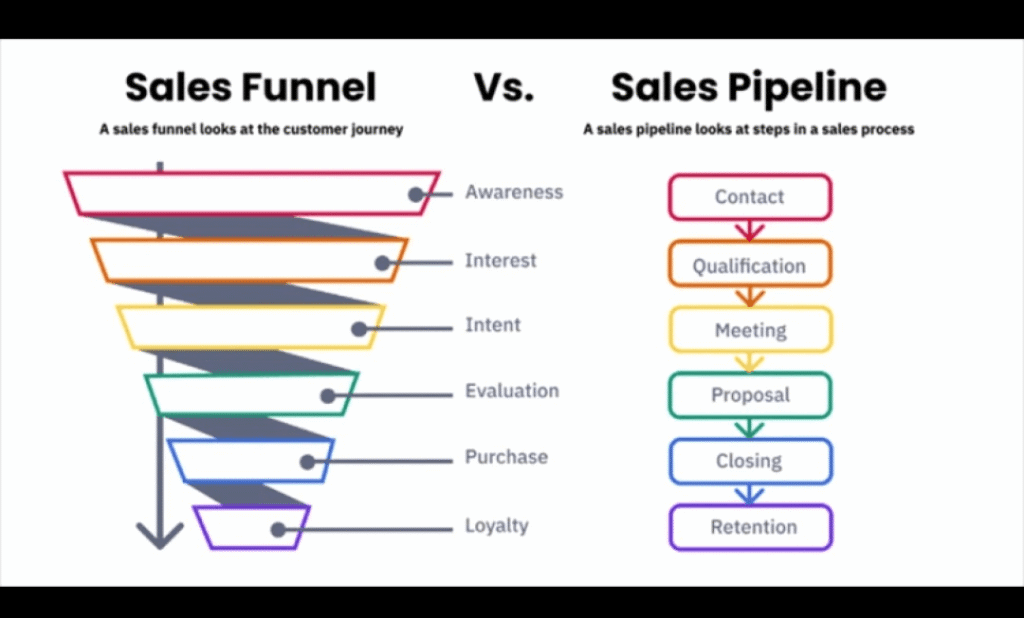
While the sales pipeline and funnel are closely related, they serve distinct purposes and focus on different aspects of the sales process.
What is a Sales Funnel?
The sales funnel is a customer-focused model that maps the buyer’s journey from awareness to purchase.
It mainly:
- Represents how leads progress through different stages of interaction with your business.
- Highlights the buyer’s perspective rather than internal sales activities.
- Shows how prospects engage with your brand at each stage.
- Tracks how many leads remain as they move toward purchase.
- Helps identify gaps or drop-offs in the customer journey.
The funnel highlights the prospect’s perspective and helps you understand where and why people drop off, enabling you to refine your marketing and sales strategies to improve conversions.
Different Stages of the Sales Funnel
Awareness
- This first, widest stage is where people learn about the company and what the product even is.
- Awareness comes from blogs, social media posts, ads or short campaigns.
Interest
- This one is crucial if you want prospects to actually turn into customers.
- Usually it starts when you share more product detail using webinars, newsletters or email sequences.
- Testimonials and case studies help build that curiosity and trust at the same time.
Intent
- Here the prospect shows real intent to make a purchase, like adding to cart or asking for more information.
- This is where your sales team steps in, handles queries, and steers them towards buying.
Evaluation
- In the evaluation stage, prospects compare their options, weigh value and decide if your service matches their needs or not.
- Sales teams may help with demonstrations, trial access, or deeper explanations that feel more clear.
Purchase
- This is the final and narrowest step where the prospect actually purchases the product.
- A smooth checkout, quick issue resolution, and helpful post-purchase benefits can really build loyalty in the post purchase stage.
Loyalty
- Loyalty is more about keeping customers, through strong service and the ongoing post-purchase engagement.
- It pushes repeat buying and long term brand advocacy, not just one time usage.
For example, the funnel tracks how a prospect moves from discovering your product to making a purchase decision (e.g. first becoming aware, requesting a callback).
What is a Sales Pipeline?
The sales pipeline is an essential internal step-by-step framework for managing and optimising your sales process.
It mainly:
- Visualises the stages your sales team follows from initial contact to a closed deal.
- Focuses on your sales activities rather than customer behavior.
- Helps your team manage workflow efficiently.
- Enables prioritisation of efforts for higher conversion.
- Provides a clear way to measure performance and progress.
Think of the pipeline as a map of actions your sales team must take to move opportunities through the process. It’s about what your team does to close more deals.
Different Stages of the Sales Pipeline
Lead Generation
- Attracting potential customers and turning them into paying customers
- Methods: cold emails, calls, social media engagement
- AI tools increasingly used for personalization and higher-quality leads
Lead Qualification
- Filtering leads to assess potential based on time, need, and budget
- Helps eliminate low-potential prospects and saves time for the sales team
Contact
- Reaching out to qualified leads to address queries and offer solutions
- Personalized communication increases conversion chances
- Shapes the prospect’s impression of future customer service
Negotiation
- Customers may request discounts, perks, or propose terms
- Includes discussions on contracts, pricing, and delivery
- Sales team must balance persuasion with customer needs for a win-win outcome
Closing the Deal
- Final stage where the prospect agrees to purchase
- A smooth closing process leaves the customer satisfied
- Builds the foundation for long-term business relationships
For example, the sales pipeline tracks what the sales rep does to move a lead to the next stage (e.g. calls, appointments, formal proposals).
Sales Funnel vs Sales Pipeline: Key Differences
Here is what sets a sales funnel apart from a sales pipeline:
| Attribute | Sales Funnel | Sales Pipeline |
| Perspective | Customer’s | Sales Representative’s |
| Focus | Buyer’s journey and decision-making | Sales team activities and deal progression |
| Stages | Awareness, interest, evaluation, intent, purchase, loyalty | Prospecting, lead qualification, meeting setup, proposal sent, negotiation, deal closing |
| Visualization | The gradual narrowing of leads through the journey | The stages of various deals being worked on |
| Purpose | Understand customer behavior and conversion rates | Manage and track sales activities |
| Goal | Enhance the customer’s buying experience | Optimize the sales team’s activities |
| Tracking | Conversion rates between stages, retention, satisfaction, CLV | Revenue forecast, deals closed, sales performance metrics |
| Tools | Marketing automation platform, content management system, sales engagement platform | CRM (Customer Relationship Management) system, sales enablement tools |
Both of these provide incredible value for sales team efficiency, but the real magic happens when your sales team combines them together.
In doing this, the sales team gains a 360-degree view of your sales process empowering your team to close more deals while refining the buyer journey to improve conversion rates.
How Sales Funnel and Pipeline Work Together for Growth
A sales funnel and sales pipeline work best when they are connected. The funnel shows how buyers move toward interest, while the pipeline shows how sales teams turn that interest into revenue.
Here’s how they support each other:
1. Clear Stage Definitions
Both teams need to agree on what each stage means.
For example, marketing may define when a lead becomes qualified, while sales defines when that lead becomes a real opportunity. This keeps unqualified leads out of the pipeline and helps sales focus on the right prospects.
2. Smooth Lead Handoff
The funnel feeds the pipeline.
Research shows that each quarter sales funnels keep 25–35% of prospects moving forward, which directly feeds a stable, well-covered pipeline
Once a lead shows enough interest or meets the right criteria, marketing passes it to sales. Sales then follows up, qualifies the opportunity, and moves it through the pipeline.
A clear handoff process prevents leads from being missed or contacted too late.
3. Shared Metrics and Reporting
Funnel data shows where leads come from and how they convert.
Pipeline data shows which leads become opportunities, deals, and revenue.
When both are tracked in one CRM, marketing and sales can see the full journey from first touch to closed deal.
Also read: 10+ Best CRM for Outbound Sales
4. Better Content and Sales Enablement
Marketing can use funnel insights to create content for each buyer stage.
Sales can then use that content inside the pipeline to answer questions, handle objections, and move deals forward faster.
5. Stronger Feedback Loops
Pipeline results help improve the funnel.
If sales notices that certain leads are not converting, marketing can adjust targeting, messaging, or nurturing. If a source produces high-quality deals, both teams can invest more into that channel.
6. Joint Revenue Planning
Growth becomes easier to forecast when funnel and pipeline data work together.
Sales teams can see win rates increase over 30% and cycle times shorten by more than 40% when they optimize funnel-stage engagement.
Marketing can plan how many qualified leads are needed, and sales can estimate how many of those leads are likely to become customers.
Together, the funnel creates demand and the pipeline turns that demand into revenue.
Common Mistakes When Managing Sales Pipelines & Funnels
Managing sales pipelines and funnels well helps improve conversions, but a few common mistakes can slow growth including:
1. Treating Pipelines and Funnels as the Same
A sales pipeline tracks your team’s deal process, while a sales funnel tracks the buyer’s journey.
How to avoid it: Use the pipeline to improve sales activity and the funnel to improve buyer experience.
2. Ignoring Data
Without tracking the right metrics, it becomes harder to see where prospects drop off or deals slow down.
How to avoid it: Monitor conversion rates, drop-off points, sales cycle length, and pipeline velocity regularly.
3. Not Nurturing Leads
Many leads are not ready to buy immediately. Without follow-up, they may lose interest or choose a competitor.
How to avoid it: Use personalized follow-ups, retargeting, and nurture sequences to keep leads engaged.
4. Focusing Only on Closing
Closing is important, but growth also depends on retention, repeat business, and referrals.
How to avoid it: Stay connected after the sale and build stronger customer relationships.
How Prospects Hive Builds a Smarter Sales System Connecting Your Funnel and Pipeline
Managing a funnel and pipeline separately often creates gaps between marketing and sales.
Prospects Hive helps connect both sides into one clearer sales system, so your team can see where leads come from, how they move, and what needs to happen next.
Funnel Visibility
Prospects Hive helps you:
- Track how leads move from awareness to decision
- Identify where prospects drop off or lose interest
- Compare lead sources, campaigns, and buyer personas
- Monitor email, content, and website engagement
- Use performance data to improve messaging and campaigns
Pipeline Management
Prospects Hive helps your sales team:
- Organize deals by stage, from prospecting to closing
- Track follow-ups, tasks, and next steps
- See deal value, probability, and revenue potential
- Improve forecasting with real-time pipeline visibility
- Keep sales and marketing aligned on qualified leads
This builds a connected system where funnel activity feeds the pipeline, and pipeline insights help improve future growth.
Conclusion
Both the sales pipeline and sales funnel are key to a successful sales strategy. Businesses are using smart automation, personalized customer interactions and AI-powered lead scoring throughout the buyer’s journey to improve efficiency and increase conversions.
Now that you understand how funnels and pipelines work and how they complement each other, the next step is to put this knowledge into practice.
With Prospects Hive, you can visualize your funnel, track pipeline stages, and forecast revenue in one platform.
Book a strategy call today to see how we can help streamline your growth.
FAQs
1. Why do businesses confuse sales funnels and pipelines?
Because they’re closely linked, funnels generate leads, and pipelines convert those leads into deals. Teams working in silos often use the terms interchangeably.
2. Should I prioritize a sales funnel or a sales pipeline for my business?
You need both. The funnel improves marketing and lead quality, while the pipeline ensures your team can convert those leads efficiently into revenue.
3. How can I align my funnel and pipeline for better results?
Use shared definitions, a unified CRM, and clear lead handoff rules. Aligning marketing and sales goals ensures funnels generate quality leads and pipelines convert them effectively.
4. Which KPIs show if my funnel is healthy compared to my pipeline health?
A healthy funnel shows strong visit-to-lead and lead-to-opportunity conversion rates, while a healthy pipeline shows balanced stage distribution, steady velocity, and consistent win rates.
5. How do I build my first sales funnel and pipeline from scratch?
Start by mapping your buyer journey (awareness to closed-won), turn each step into a funnel stage, then mirror those stages as pipeline steps in your CRM with clear entry/exit criteria.
6. How often should I review or update my sales funnel and pipeline stages?
Review both at least quarterly, and adjust stages whenever you change your sales process, messaging, ICP, or see persistent drop-offs in the same stage.