
Ever paused at your dashboard, wondering what is a good email conversion rate? You’re not alone. It’s one of the most searched and misunderstood email metrics.
Benchmarks float around without context: one Reddit reply says 2% is great; another says you should aim higher. No one explains why.
This guide is here to cut through that noise. We’ll break down what conversion rate actually means, what “good” looks like in real business scenarios, and why chasing surface-level numbers often leads teams in the wrong direction.
Most importantly, we’ll focus on improving outcomes without obsessing over vanity metrics.
Key Notes
- There’s no single “good” email conversion rate. Context matters more than averages.
- Conversion rates vary by email type: cold, warm, and lifecycle emails behave very differently.
- Cold emails usually convert in low single digits.
- Warm email campaigns often reach mid single digits.
- Lifecycle emails can convert at higher rates, depending on timing and relevance.
- Audience intent and business model shape what’s realistic.
- Conversion rate is not the same as open rate or reply rate.
- Benchmarks without context are misleading and often misused.
What is Email Conversion Rate?
In email marketing, conversion rate measures how many recipients take the intended action after receiving an email. A conversion is not the email itself. It’s what happens after the email does its job.
In simple terms:
Conversion = the desired action after an email is received.
That action depends on the email’s goal. Common examples include:
- Booking a demo
- Submitting a form
- Completing a purchase
- Signing up for a trial or newsletter
Many teams optimize opens or clicks and assume progress. But reporting on the wrong metric leads to the wrong decisions. Conversion rate keeps performance tied to outcomes rather than activity.
What is a Good Email Conversion Rate?
A good email conversion rate depends on who you’re emailing, why you’re emailing, and what you’re asking them to do. There isn’t a single number that works across every business or campaign. Context matters more than averages.
A good email conversion rate depends on,
- The intent of the audience
- The goal of the campaign
- The stage of the funnel
General benchmark ranges (high level)
Used carefully, benchmarks can help set expectations. Most email conversion rates fall into these broad ranges:
- Email marketing campaigns: often land in the low single digits, depending on offer and audience
- Cold email campaigns: usually lower, since recipients have no prior relationship
- Automated lifecycle emails: tend to convert higher due to timing and relevance
These are reference points, not performance targets.
You might ask, why there is no single “perfect” number
Conversion rates vary widely based on:
- Business model and pricing
- Deal size and sales cycle length
- Traffic and list quality
- List age and engagement history
Ultimately, a conversion rate is only meaningful when measured against your unique context. What’s strong for one business could be weak for another.
Email Marketing Conversion rate Formula and Calculation
Email conversion rate tells you how often your emails lead to a meaningful action. To avoid confusion, it’s important to calculate it correctly.
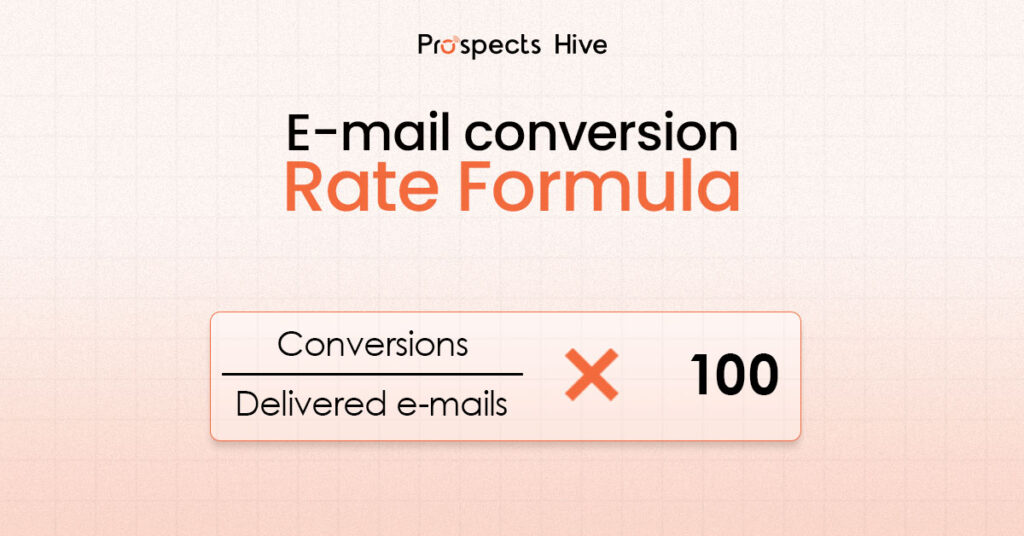
The email conversion rate calculation formula is simple:
Email Conversion Rate = (Number of Conversions ÷ Number of Delivered Emails) × 100
- Numerator (conversions): the number of people who completed the intended action
- Denominator (delivered emails): emails that actually reached inboxes
Delivered emails matter because bounced messages were never seen. Including them inflates results and hides real performance.
Some teams use different approaches, which is where confusion starts.
- Delivered vs sent emails: Always use delivered emails for accuracy.
- Click-based vs action-based conversions: Clicks show interest; conversions reflect outcomes.
Both can be tracked, but they should not be labeled the same.
Email marketing Conversion Rate Benchmarks by Industry
There is no single “correct” benchmark. Conversion rates vary widely by industry, email type, and audience awareness.
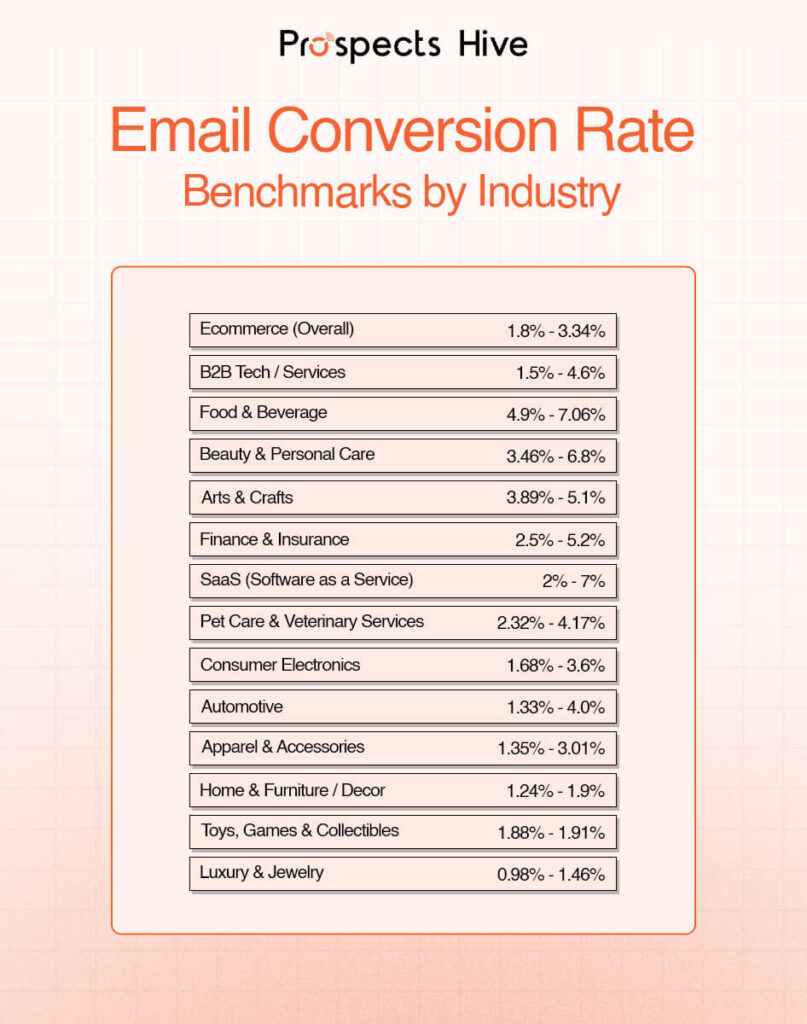
Below are realistic email conversion rate benchmarks by industry based on current B2B and B2C performance patterns:
| Industry | Email conversion rate |
| Ecommerce (Overall) | 1.8% – 3.34% |
| B2B Tech / Services | 1.5% – 4.6% |
| Food & Beverage | 4.9% – 7.06% |
| Beauty & Personal Care | 3.46% – 6.8% |
| Arts & Crafts | 3.89% – 5.11% |
| Finance & Insurance | 2.5% – 5.2% |
| SaaS (Software as a Service) | 2% – 7% |
| Pet Care & Veterinary Services | 2.32% – 4.17% |
| Consumer Electronics | 1.68% – 3.6% |
| Automotive | 1.33% – 4.0% |
| Apparel & Accessories | 1.35% – 3.01% |
| Home & Furniture / Decor | 1.24% – 1.9% |
| Toys, Games & Collectibles | 1.88% – 1.91% |
| Luxury & Jewelry | 0.98% – 1.46% |
Source: Optimonk
How to Improve Email Conversion Rate
Increasing your email conversion rate requires a combination of strategic steps that align with your recipients’ behavior, interests, and needs.
Here’s how you can get started:
1. Improve Relevance First
Relevance is the largest lever you can pull to increase your email conversion rate. The more tailored the content, the better the chances of conversion.
Segmentation allows you to divide your audience into smaller groups based on factors such as lifecycle, interests, behavior, location, or even device usage. By doing so, you can deliver highly personalized content that resonates with each group’s needs.
For example, if you’re a B2B business, sending relevant offers based on the prospect’s industry or job title can dramatically increase engagement.
Emails that include personalized recommendations have a 29% higher open rate and a 41% higher click-through rate.
2. Clear Call-to-Action (CTA)
To drive conversions, ensure your email’s CTA is clear, direct, and easy to act on. It’s crucial to focus your email on a single main CTA to avoid overwhelming the reader.
Phrases like “Get the demo,” or “Download the checklist” are action-oriented and guide the recipient toward the next step.
Mailchimp reports that emails with a single CTA see a 371% higher click-through rate than those with multiple competing actions. Ensure the CTA is prominently placed, especially on mobile devices where real estate is limited.
3. Reducing Post-Click Friction
Often, the conversion rate breaks after the click, so it’s essential to align the email promise with the landing page. Your landing page should reflect the same offer and message from the email, minimizing distractions and maintaining consistency.
For example, if your email offers a downloadable guide, the landing page should immediately provide a clear option to download it, without unnecessary steps or confusing elements.
4. Testing and Optimizing for Better Results
Continuous improvement through A/B testing is essential for email conversion optimization. Test elements like subject lines, CTAs, and offers. Start by testing one variable at a time, so you can understand what truly drives conversion.
For example, BigSea found that testing subject lines in B2B cold emails can lead to a 56% higher response rate, just by tweaking how the message is framed. Testing helps you understand what works best for each segment of your audience.
5. Protecting Deliverability and List Quality
To maintain a high email conversion rate, it’s essential to manage your email list and protect your deliverability. A clean list reduces the risk of bounces and complaints, improving your sender reputation.
Managing your list effectively can increase your engagement rate by up to 35%.
Avoid spammy subject lines and regularly clean your list by removing inactive subscribers. This ensures that your emails reach an engaged audience, and your conversion rate remains high.
💡 How Do I Develop an Email List from Linkedin Contacts?
Common Email Marketing Mistakes
Most low email conversion rates aren’t caused by bad copy or weak offers. They’re usually the result of structural mistakes that quietly compound over time.
Frequent mistakes that hurt conversion
One of the biggest issues is treating inbound and outbound as separate systems. When email campaigns don’t reflect prior engagement, intent, or behavior, messages feel disconnected and irrelevant.
💡 How Can Email Marketing Fuel Your Overall Inbound Strategy
Another common mistake is one-size-fits-all messaging. Sending the same email to every contact ignores differences in needs, timing, and awareness. Even small mismatches reduce trust and action.
Many teams also optimize for opens instead of outcomes. High open rates look good in reports, but they don’t guarantee demos booked, forms submitted, or revenue generated.
These problems stick around because of tool-driven thinking. Platforms encourage surface metrics, not system-level outcomes. Add metric vanity and the pressure to show quick wins, and conversion takes a back seat.
Without clear ownership of the full email system, performance stalls quietly.
Button: Hire Prospects Hive to take over your email marketing headache seamlessly.
Other Email Marketing Metrics
Conversion rate is the outcome metric, but it doesn’t tell the whole story on its own. To understand why emails convert or don’t, you need a small set of supporting metrics that explain what’s happening between send and action.
Metrics that support conversion analysis
- Click-to-open rate (CTOR):
CTOR shows how compelling your message was after the email was opened. It isolates content quality from subject line performance and helps diagnose relevance.
- Reply quality:
Especially in B2B and outbound, not all replies are equal. Positive, intent-driven responses matter more than raw reply volume.
- Time to conversion:
Some emails convert immediately. Others influence decisions weeks later. Tracking time-to-conversion prevents false negatives in performance reviews.
- Revenue per email (when applicable):
This connects email activity directly to business impact. It’s one of the clearest ways to evaluate ROI beyond percentages.
Metrics that often distract
- Raw open rate:
Opens indicate visibility, not value. Privacy changes have made this metric increasingly unreliable.
- Total sends:
Volume alone doesn’t signal success. More emails can just as easily reduce performance.
- Clicks without intent:
Clicks are only useful when they lead to meaningful action. Engagement without outcomes creates false confidence.
Strong email programs treat these metrics as intent signals, not scores. They support conversion analysis instead of replacing it.
Grounded, Reassuring, Action-Oriented
Benchmarks are useful, but they’re not a scorecard. Knowing what a good email marketing conversion rate is starts with understanding your context, not chasing industry averages. Different audiences, offers, and sales cycles naturally produce different results.
Sustainable growth comes from building reliable systems that connect intent, messaging, and timing, not from short-term hacks or surface-level tweaks.
If your numbers feel unclear, it may be time to look beyond optimization and examine how your email engine is designed end-to-end.
Want help building that system? Talk to Prospects Hive.
FAQ
1. What is the Conversion Rate?
Conversion rate is the percentage of recipients who complete a desired action after receiving an email.
2. What is the Average Email Marketing Conversion Rate?
The average email marketing conversion rate typically ranges between 1% and 5%, depending on industry and intent.
3. What is a Realistic Email Conversion Rate?
A realistic email conversion rate is one that aligns with your audience intent, offer complexity, and sales cycle.
4. What is the 60/40 Rule in Email?
The 60/40 rule suggests results depend 60% on audience and offer, and 40% on copy and execution.
5. What is the 30/30/50 Rule for Cold Emails?
The 30/30/50 rule attributes success to targeting (30%), messaging relevance (30%), and follow-up timing (50%).
6. What is the 12 Second Rule for Emails?
The 12 second rule means readers decide whether to continue reading an email within the first few seconds.
7. What Does Cold Email Conversion Rate Mean?
Cold email conversion rate measures how many recipients take a desired action without prior relationship.
8. What is the Difference Between Response Rate and Conversion Rate?
Response rate measures replies, while conversion rate measures completed outcomes like bookings or purchases.
9. Is a Higher Open Rate Always Better?
No, higher open rates don’t matter if they don’t lead to meaningful actions or conversions.
10. What Metrics Matter Most for Email Performance?
Conversion rate, click-to-open rate, reply quality, and revenue per email matter more than opens alone.