A prospect accepts your LinkedIn connection request. You send a message, but no reply comes back. A few days later, you follow up. Still nothing.
Good LinkedIn outreach starts with the right prospect and a clear reason to contact them. Your message should be short, relevant, and easy to answer. Generic pitches make it much harder to start a real conversation.
Sending more connection requests will not fix poor targeting. More messages will not fix weak copy either. A smaller list of well-matched prospects can give you better opportunities to start useful conversations.
Timing also matters. A new role, hiring push, LinkedIn post, funding event, or company update can give you a timely reason to reach out.
This guide explains 12 LinkedIn outreach strategies you can use to find better-fit prospects, personalize your messages, improve replies, and create more qualified B2B meetings.
What is LinkedIn Outreach?
LinkedIn outreach is the process of contacting selected prospects on LinkedIn to start a business conversation. It can include connection requests, direct messages, InMail, comments, and follow-up messages.
B2B teams often use LinkedIn outreach to reach founders, executives, managers, and other decision-makers. The goal is not to collect as many connections as possible. It is to start conversations with people whose role and company fit what you offer.
LinkedIn outreach is also more than sending cold DMs. You can engage with a prospect’s content before messaging them. You can also use InMail when you are not connected.
What Makes a LinkedIn Outreach Strategy Effective?
An effective LinkedIn outreach strategy reaches the right prospect with a relevant message at the right time. Sending more messages will not help if the targeting or message is wrong.
Five factors usually shape the quality of your outreach:
- The right prospect
- A credible LinkedIn profile
- Good timing
- Real personalization
- One clear question or CTA
The prospect should quickly understand why you contacted them. The message should connect to their role, company, recent activity, or another clear business event.
Your first message should ask for one simple response. Asking for a long sales call before the conversation starts can make the message easier to ignore.
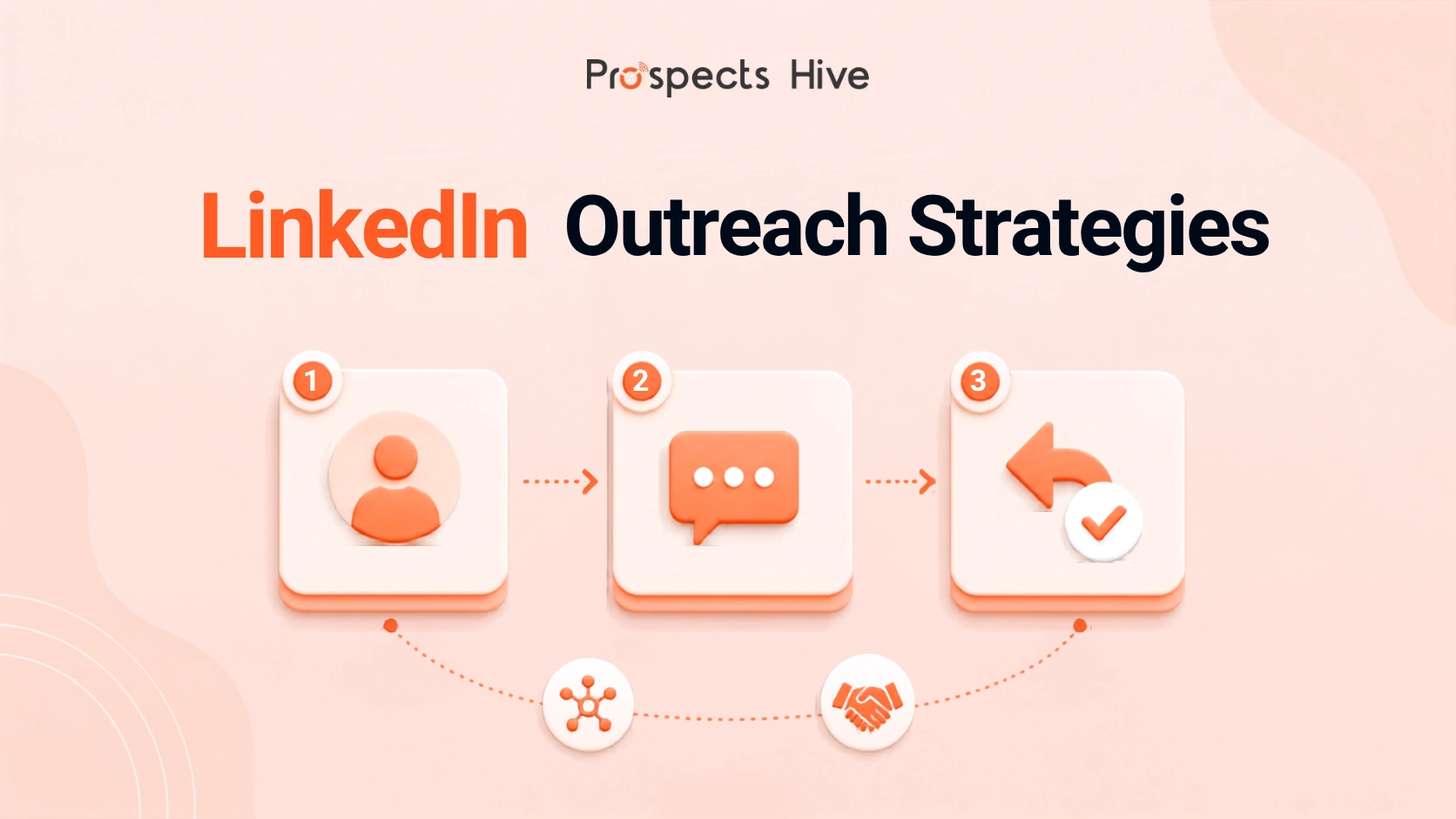
A simple LinkedIn outreach flow looks like this:
ICP-matched Prospect → Role, Company, or Trigger Context → Connection Request or Message → Reply or Follow-Up → Qualified Conversation
The work starts before you write the first DM. You need to understand who the prospect is and why the conversation could matter to them.
12 LinkedIn Outreach Strategies for B2B Prospecting
The 12 approaches below cover prospect targeting, LinkedIn activity, personalization, messaging, and follow-up. Use the ones that match the prospect and the reason for reaching out.
1. OptimizeYour LinkedIn Profile Before Starting Outreach
Your LinkedIn profile should build trust before a prospect decides whether to reply. Many people will check your profile after seeing your connection request or message.
They want to know who contacted them and whether that person’s work is relevant. Your profile should quickly answer who you work with, what problems you understand, and why your experience matters.
Focus on:
- A clear professional photo
- A specific headline
- A useful About section
- Relevant experience
- Clear achievements
- Recommendations
- Case studies or resources in Featured
Avoid headlines such as “Helping businesses unlock growth.” That tells the prospect very little. A stronger headline explains the market you work with or the problem you help solve.
Your ‘About’ section should support the same message. Keep it focused on your experience and the problems you understand instead of turning it into a long company brochure.
Social proof can strengthen the profile too. Relevant recommendations, results, and examples help prospects see that your message comes from someone with real experience.
2. Define the Right Prospects Before Building Your List
Strong LinkedIn outreach starts with a clear Ideal Customer Profile (ICP). Good copy cannot fix a prospect list full of people who have little reason to care about your offer.
Start with the company criteria that matter to your campaign. Then identify the roles that are closest to the problem you solve.
Useful criteria may include industry, company size, location, business model, job function, seniority, and current role. You should also define the specific problem or use case behind the outreach.
Do not target people only because their job titles match a keyword. A VP of Sales at a 30-person SaaS company may face very different problems from someone with the same title at a global enterprise.
Seniority alone is not enough either. Someone may have the right title but little involvement in the problem you want to discuss.
Better targeting saves time later. It also gives you stronger information for research and personalization.
3. Use LinkedIn Sales Navigator to Find Better-Fit Prospects
LinkedIn Sales Navigator can help you narrow broad searches into more relevant prospect lists. Its filters help you remove weak matches before you start outreach.
You can filter by details such as:
- Geography
- Industry
- Company headcount
- Function
- Seniority
- Current role
You can also save leads and accounts for later research. This makes it easier to watch people you may want to contact later.
Sales Navigator currently provides alerts for several changes across saved leads and accounts. These include job changes, posts, senior hires, company growth, increased hiring, funding, and mergers or acquisitions.
These alerts can improve your timing. A new role, funding event, or hiring push may give you a clear reason to research someone before reaching out.
Do not use Sales Navigator only to build a bigger list. Use it to make the list more relevant.
4. Prioritize Prospects Who Are Active on LinkedIn
People who actively use LinkedIn are often more practical targets for LinkedIn outreach. They are more likely to see activity on the platform than someone who rarely uses it.
Look at recent posts, comments, reactions, job updates, and shared content. Current activity can also show what the person is discussing now.
For example, a Head of Sales may post about scaling an SDR team. That gives you more information than their job title alone.
Activity should not replace your ICP. Someone can post every day and still have no need for your offer.
Check fit first. Then use LinkedIn activity to decide which good-fit prospects deserve more attention.
5. Use Trigger Signals to Improve Outreach Timing
Trigger signals give you a timely reason to contact one prospect before another. They can also help you choose a more specific opening message.
Useful signals may include:
- A new job
- A promotion
- A senior hire
- Company hiring
- Funding
- A new product or service
- A relevant LinkedIn post
- Event participation
- Expansion into a new market or location
For example, a company may start hiring several SDRs. That change could create new prospecting, data, onboarding, or workflow problems.
Now you have a specific reason to research the company further. You are not contacting them only because they match an industry filter.
A trigger does not prove that someone wants to purchase something. It simply tells you that something has changed.
Your message still needs to connect that change to a real business issue. Do not force an unrelated offer into a recent company update.
6. Warm Up High-Priority ProspectsBefore Messaging Them
Genuine engagement can make your name more familiar before you send a LinkedIn message. This can work well when the prospect is valuable enough to justify extra research.
Read the prospect’s recent posts first and follow them if the topics are relevant. If you have something worth adding, leave a thoughtful comment.
A useful comment might add an example, question, or different point of view. Empty comments such as “Great post” or “Love this insight” rarely show that you understand the topic.
You do not need to warm up every prospect. A recent role change, post, or company event may already give you a clear reason to send a direct message.
Use the warm-up step when it improves the conversation. Do not add it simply because a sequence tells you to.
7. Personalize LinkedIn OutreachwithReal Context
Good personalization shows why you chose that specific prospect. Adding their name and company to the same message you send everyone else is not enough.
Use information connected to the person’s work. Their role, recent activity, company situation, or a current business problem can all give you stronger context.
| Personalization Level | Example |
| Basic | Name, title, company |
| Profile | Current responsibility |
| Activity | Recent post or comment |
| Company | Hiring, growth, funding, launch |
| Problem | A challenge linked to their role |
| Trigger + problem | A current change linked to a relevant challenge |
Basic details show that you checked the profile, but they do not explain why the conversation matters. Recent activity or company changes can give the message a much clearer reason.
The strongest personalization often connects a current trigger with a business problem. That explains both why this prospect and why now.
Keep the research professional. Do not use unrelated personal details simply because you found them online.
8. Use Connection Request Notes Only When They Add Context
A connection request note should give the prospect a clear reason to connect. It should not hide a sales pitch inside a short message.
A note can make sense when you have:
- A mutual contact
- A shared event
- A previous conversation
- A relevant LinkedIn post
- A clear professional reason to connect
For example, “Hi ‘X’, saw your post on SDR ramp time. I work with B2B outbound teams too and thought it made sense to connect.” This gives the prospect a clear reason for the request without turning the note into a sales pitch. That is a better fit for a first interaction.
LinkedIn currently says Basic members can add a personalized note to up to three connection requests per month, with a limit of 200 characters per note. Premium members can add personalized notes to all connection requests, although normal connection-request limits can still apply.
9. KeepYourFirst LinkedIn Message Short and Relevant
Your first LinkedIn message should be easy to understand in a few seconds. The prospect should quickly see why you contacted them.
Start with relevant context and explain why you reached out. Then make one clear point and ask one simple question.
Avoid putting your company history, complete service list, several case studies, multiple links, and a calendar request into the same message. The first DM only needs to start the conversation.
For example, “Hi, saw your team is hiring more SDRs this quarter. How are you handling prospect research as the team grows?” – the message gives the prospect a clear reason for the outreach. It also asks one question that is easy to answer.
Short does not mean empty. “Hey, would love to chat” is brief, but it gives the prospect almost no reason to reply.
10. Lead with Relevant Value Before Asking for a Meeting
Give the prospect something useful before asking for a meeting or sales call. The value should connect directly to the situation behind your message.
You could share a short observation, benchmark, framework, idea, or resource. You can also ask a useful question that helps the prospect think through a current problem.
For example, a prospect may post about slow account research. You could share one simple way to prioritize accounts before the research team spends time on them.
That is more relevant than sending the same ebook to every new connection. A free resource is not automatically valuable.
Your first CTA should also stay simple. A question is often easier to answer than an immediate request for a 30-minute meeting.
11. Match Your Message to the Prospect’s Situation
Cold, warm, and triggered prospects should not receive the same LinkedIn message. What has already happened should shape what you say next.
| Prospect Type | Better Outreach Approach |
| Cold prospect | Start with clear relevance |
| Cold prospect with a trigger | Lead with the trigger |
| Content engager | Continue the topic they engaged with |
| Mutual connection | Use the shared context naturally |
| Previous conversation | Continue from that conversation |
| Previous “not now” | Reconnect when timing changes |
| High-value prospect | Use deeper research |
A completely cold prospect knows little about you, so keep the opening message simple. Someone who already engaged with your content has more context and should not receive the same introduction.
The same rule applies to previous conversations. Read the earlier messages before reaching out again.
Do not send a fresh cold pitch to someone who already told you “not now.” Use what they told you and reconnect only when the timing or situation changes.
12. Follow Up Without Repeating Yourself
A good LinkedIn follow-up gives the prospect a new reason to respond. It should not repeat your first message with slightly different wording.
People miss messages and get busy. Sometimes the first question simply was not important enough for them to answer.
Your next message could add:
- A different observation
- A useful example
- A relevant resource
- New account context
- A simpler question
- Clarification of why you reached out
Actually, each follow-up should give the prospect something new to respond to.
Avoid sending “just checking in” several times. That reminds the person you want an answer but gives them no new reason to reply.
There is no universal LinkedIn rule for the ideal number of follow-ups. Continue only while each follow-up adds new information. Stop if the prospect declines or you have nothing relevant left to add.
How to Build a Simple LinkedIn Outreach Sequence
A LinkedIn outreach sequence should move from a relevant connection or message into a real conversation. Each message should have a clear purpose, and the planned sequence should stop when the prospect replies.
| Stage | What to Do |
| Connection request or opening message | Give the prospect a clear reason for reaching out |
| First message | Focus on one relevant issue and ask one question |
| Follow-up | Add a new example, insight, or question |
| Final follow-up | Keep it brief and stop if there is no interest |
Do not force every prospect through the same sequence. A recent trigger may justify a direct message, while a high-value prospect may deserve more research before you reach out.
Once the prospect replies, respond to what they actually said. Do not continue sending scheduled messages after a real conversation begins.
How AI Can Support LinkedIn Outreach
AI can reduce the manual research needed before LinkedIn outreach, but the final message still needs human judgment. It can help organize prospect data, summarize recent activity, identify trigger signals, and prepare message drafts.
AI can also help rank prospects by fit or recent activity. This gives the team more time to research high-fit prospects and prospects showing current trigger signals.
The final message should still be checked by a person. A fact may be accurate but still have little relevance to the prospect or the reason for reaching out.
How to Measure LinkedIn Outreach Performance
LinkedIn outreach should be measured by the quality of the responses, not message volume alone. Sending more messages means little if the right prospects do not engage.
Useful metrics include:
- Connection acceptance rate
- Reply rate
- Positive reply rate
- Qualified conversations
- Meetings booked
- Qualified meetings
Connection acceptance helps you evaluate your targeting, profile, and connection request. Reply rate shows whether people answer, but not whether those replies are positive. A “not interested” response still increases the raw reply rate.
That is why positive reply rate matters. Qualified conversations go one step further by showing whether the people who respond are worth continuing with.
| Result | What to Review |
| Low connection acceptance | Targeting, Profile, connection request |
| Good acceptance but few replies | First-message relevance |
| Many replies but little interest | ICP, problem fit, offer |
| Positive replies but few meetings | CTA or conversation handling |
| Meetings with poor-fit prospects | Prospect selection and qualification |
Do not copy a public benchmark and assume your campaign should match it. Industry, seniority, offer, market, and prospect quality can all change the result.
Your own comparable campaigns usually provide a better baseline. Review similar audiences and offers before making major changes.
Common LinkedIn Outreach Mistakes That Reduce Replies
Most LinkedIn outreach mistakes make the message less relevant or harder to answer. Fixing those problems usually matters more than finding another template.
Common mistakes include:
- Targeting prospects only by job title
- Ignoring company fit
- Pitching immediately after connecting
- Using shallow personalization
- Writing long first messages
- Asking several questions at once
- Sending the same resource to everyone
- Ignoring recent LinkedIn activity
- Missing relevant trigger signals
- Repeating identical follow-ups
- Treating every reply as qualified
- Continuing after a clear rejection
- Using prohibited automation to increase volume
Templates can still help by giving your team a consistent structure. The final message should still contain a clear reason for contacting that particular prospect.
How Prospects Hive Runs LinkedIn Outreach for B2B Teams
Prospects Hive runs LinkedIn outreach around precise targeting, personalized messaging, follow-up, and campaign improvement. The focus is on reaching relevant decision-makers and starting qualified conversations.
- Target the Right Prospects: Define the ICP and find decision-makers by role, industry, company size, and buying intent.
- Optimize LinkedIn Profiles: Improve the profile so it supports the message prospects receive during outreach.
- Personalize Connection Requests: Personalize connection requests, DMs, and InMail around the prospect and business context.
- Use Voice and Video When Relevant: Add voice or video outreach for selected prospects when a more personal approach makes sense.
- Nurture and Follow Up: Continue conversations with relevant follow-ups instead of repeating the same message.
- Track Replies and CRM Activity: Keep replies and prospect activity organized for follow-up.
- Test and Optimize Campaigns: Review replies, test messaging, and adjust targeting based on campaign results.
The goal is to turn LinkedIn outreach into a repeatable way to reach better-fit prospects, start relevant conversations, and generate qualified meetings.
Bottom Line
The best LinkedIn outreach strategies focus on relevance before volume. Start with prospects whose role and company match your target profile, then look for a real reason to contact them.
A credible profile supports trust, while recent activity and trigger signals can improve timing. Personalization should explain why the conversation matters to that specific person.
Keep the first message short and ask one simple question. Follow up when you have something new to add, and stop when the prospect clearly says no.
Finally, track positive replies and qualified conversations instead of message volume alone. Those numbers tell you much more about whether your LinkedIn outreach is actually reaching the right people.
Frequently Asked Questions
What is a LinkedIn Outreach Strategy?
A LinkedIn outreach strategy is a planned way to find relevant prospects and start conversations on LinkedIn. It covers targeting, messaging, personalization, follow-up, and measurement.
What is the Best LinkedIn Outreach Strategy?
There is no single LinkedIn outreach approach that works for every prospect. Start with an ICP-matched prospect, use a specific reason for reaching out, and keep the opening message easy to answer.
How Do You Start Outreach on LinkedIn?
You can start LinkedIn outreach by defining who you want to reach and making sure your profile supports your message. Then research the prospect and choose the right way to reach out, such as a connection request, DM, InMail, or relevant comment.
What Should I Write in a LinkedIn Outreach Message?
A LinkedIn outreach message should briefly explain why you contacted the prospect and ask one simple question. Keep the message tied to their role, company, recent activity, or another relevant trigger.
Should I Add a Note to a LinkedIn Connection Request?
Add a note when it gives the prospect a clear reason to connect. A mutual contact, shared event, previous interaction, or relevant post can make the request feel more natural.
How Many Times Should I Follow Up on LinkedIn?
There is no universal rule for the ideal number of follow-ups. Send a small number of useful follow-ups, and stop if the prospect declines or you have nothing new to add.
Can LinkedIn Outreach Be Automated?
Supporting tasks around LinkedIn outreach can be automated, but LinkedIn prohibits unauthorized third-party tools that scrape or automate activity on LinkedIn. Use automation for research, enrichment, scoring, reporting, and CRM updates while keeping LinkedIn activity within the platform’s current rules.
How Do I Know If My LinkedIn Outreach is Working?
Track connection acceptance, positive replies, qualified conversations, and meetings. These metrics show whether your targeting and messages are creating useful responses.