
Cold email is not as useless as you might think it to be at the moment.
What’s ineffective is sending generic messages that request time without earning attention.
In 2026, inboxes are crowded with AI-generated outreach, LinkedIn automation, and recycled templates.
The teams who are still getting replies are using a simpler but harder approach. They’re creating cold emails that establish relevant connections with their prospects while showing respect for their time.
This blog shows you how to write a cold email that actually gets replies. Not just opens or vanity metrics, rather real responses.
TL;DR for Busy Readers
- Cold emails fail because of relevance, not copy.
- Who you email and why now matter more than clever wording.
- One cold email should make one clear promise.
- Follow-ups are often the gamechanger rather than the first send.
- Cold email works best as part of a broader cold outreach strategy, not in isolation.
What is a Cold Email?
A cold email is a first-time outreach message sent to someone who does not know you yet.
In B2B, cold email is used for:
- Sales conversations
- Business development
- Partnerships
- Networking
- Market discovery
What a cold email is not used for:
- Email marketing or newsletters
- A sales pitch disguised as an introduction
- A mass message sent without context
The goal of every cold email you send is simple, that is to start a conversation. Not to close a deal or to book a demo immediately. Just earn a response.
💡The Ultimate Guide to Email Conversion Rate
Before You Write: The 3 Things That Decide Your Reply Rate
Before thinking about subject lines or templates, get these 3 things right. They decide most of your reply rate.
1) Who You Email
Even a well-written cold email fails if it’s sent to the wrong person. No matter how exceptional your copy is, that cannot fix bad targeting. Before writing anything, be clear on who should receive the email.
Cold emailing works best when the email reaches someone who:
- Feels the impact of the problem directly.
- Can recognize the relevance quickly.
- Knows where the conversation should go next, even if they’re not the final decision-maker.
This applies whether you’re writing a cold email for business, for sales, or for B2B SaaS sales. Choosing the right person is often more important than choosing the perfect words.
You can determine whom to cold email by asking these simple questions before getting started with your email copy such as:
- Does this person actually experience the problem I solve?
- Do they influence or own the decision?
- Is this relevant to their role today?
2) Why Now
Timing is everything in cold outreach.
Good “why now” signals include:
- Hiring for specific roles
- Recent funding
- Product launches
- Tech stack changes
- Expansion into new markets
Without a reason to care now, your email becomes background noise.
3) One Clear Promise
A good cold email makes one promise. Bad cold emails try to do everything at once. When an email sticks to one clear point, it’s easier to understand, respond to, and far more likely to start a conversation.
Offer one clear promise like:
- A useful insight
- A relevant comparison
- A clearer way to think about a problem
Trying to explain everything is often the fastest way to get ignored and end up straight in spam.
How to Write a Cold Email That Works (With Examples)
Once you’ve determined who you’re emailing, why now, and what promise you’re making, the writing becomes much easier.
Considering that you’ve already got your email list and segmentation done, here is a detailed step-by-step framework that shows you how to write a cold email that gets replies in 2026:
Step 1: Research Your Prospects
Every cold email you write is for a specific person, and not a market segment. You must confirm that the person you intend to email faces the specific problem which you plan to discuss before you start writing the first line.
Make sure:
- The account fits your ICP.
- The person feels the pain.
- There is a clear reason you chose them.
Titles alone are misleading. Two people with the same role can have completely different priorities depending on company size, growth stage, and internal structure. A good cold email for B2B SaaS sales targets someone who not only has the right title, but also feels the pain today.
If the prospect is wrong, no amount of personalization or copywriting will save the email. Cold email success begins with relevance, not writing skill.
Step 2: Use a Credible, Human “From” Line
Your “from” line decides trust before the subject line.
The “from” line is the first trust signal your prospect sees. Even before they read your subject line or message, your prospects tend to subconsciously decide whether you look like a real person or if this is just another automated outreach.
Using a real name or adding your company name can help provide authenticity, context, especially in business or sales outreach, but it should never feel promotional. The goal is to look like a professional reaching out to another professional, not a brand broadcasting a message.
A clean, human “from” line reduces skepticism and increases the chance your email even gets opened.
For example, there are at least 5 possible forms of “from” line that you can use:
- First name (Kamrul)
- First name + Last name (Kamrul Islam)
- First name + Last name, Title (Kamrul Islam, Co-Founder)
- First name + Company name (Kamrul at Prospects Hive)
- First name + Last name + Company name (Kamrul Islam at Prospects Hive)
Always keep in mind that people reply to people, not brands.
Step 3: Write a Subject Line That Signals Relevance
Your subject line does not need to be extraordinary. It just needs to be clear.
In 2026, most buyers scan subject lines and quickly decide in seconds whether something is worth opening. A good subject line signals relevance by referencing and a role-specific challenge, a recent change, or a meaningful signal related to the recipient’s business.
- Under 40 characters
- Specific and value first, not clever
- Place natural urgency, not hype or urgency bait
Avoid vague phrases that look automated. Instead, write subject lines that feel like something you’d send to a colleague. If the subject line sets honest expectations about what the email contains, you earn the open without applying any other tricks.
This step is critical when learning how to write cold emails that get replies, and not just opens.
Some good examples are:
- Quick question about {{team’s goal}}
- Noticed {{signal}} at {{company}}
- Thought on {{role-specific challenge}}
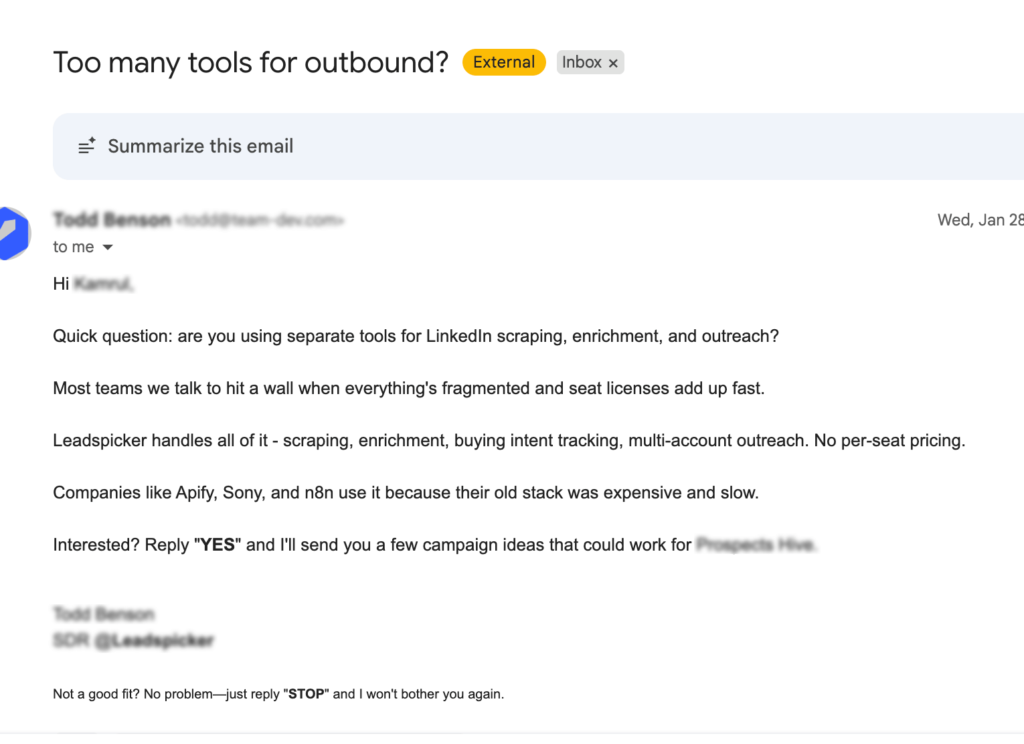
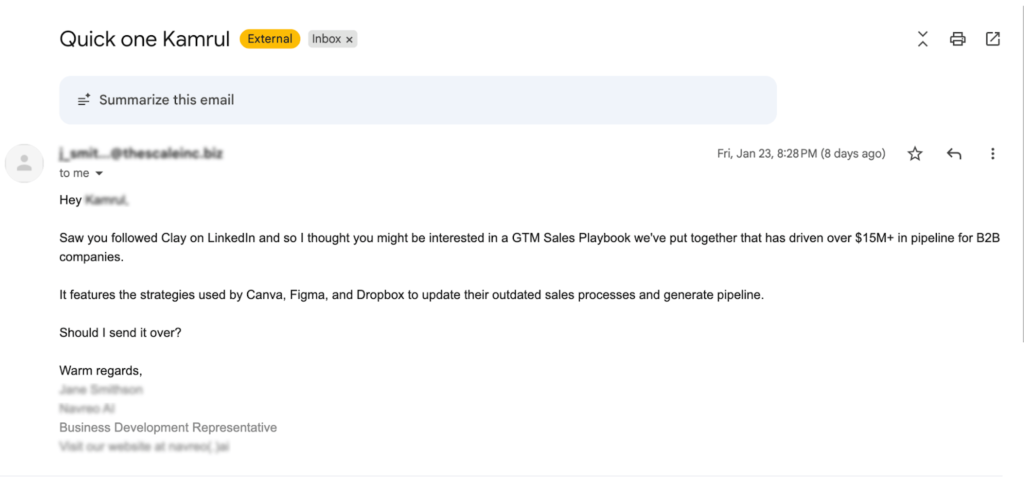
Some real examples straight from my inbox:
Example 1:
Example 2:
Step 4: Start With a Personalized Opening Line
This is where most cold emails fail.
The first sentence of your cold email establishes the reason you contacted the recipient.
The purpose of personalization exists beyond making the reader feel good and overwhelming them with information in the email. 80% of readers prefer cold emails where senders personalize their experiences.
The key purpose is to explain the situation to the reader. A strong opening line shows that you understand something about your prospect’s pain points and that your outreach is intentional, not random.
This could be triggered by hiring, growth, tooling changes, or a role-specific responsibility. The main objective requires you to connect the signal with a practical problem which the prospect probably encounters.
When done right, the reader immediately understands why the email exists. This is the foundation of how to write a personalized cold email that feels human.
Example:
‘Saw you’re hiring for RevOps. Teams usually run into attribution gaps right after that stage.’
This is how you can write a personalized cold email without sounding forced.
Step 5: Present a Clear Value Proposition
Your value proposition should not explain everything you do. It should explain why continuing the conversation is worth the prospect’s time.
Your value proposition should:
- Connect their situation to a problem or opportunity
- Show pattern recognition
- Stay short
You should present one specific advantage which connects to the problem you described earlier. Whatever you’re offering in your email copy functions as a hypothesis which you need to support with evidence.
In a nutshell, show that you’ve seen this problem before and that you might be able to help or provide an effective solution they are searching. .
In cold email outreach, clarity beats completeness. One sharp idea is far more effective than a long explanation, especially for busy sales, marketing, or business leaders.
Example:
‘We help B2B teams fix this without adding more tools or manual reporting.’
That’s enough.
This is true whether you are writing a cold email for sales, for marketing, or for business development.
Step 6: Keep It Short
In cold email, attention is the real currency and you’re borrowing it for a few seconds at best. Most prospects skim emails on their phone, between meetings, or mid-task. If your message looks wordy, it will be ignored before it’s even read. Length matters more than most people think.
A good cold email:
- Can be read in under 15 seconds.
- Uses short paragraphs.
- Sticks to one idea per section.
Long explanations often indicate uncertainty. Short, direct messages signal that you understand your value and respect the reader’s time, this understanding increases trust. If the reader has to work to understand your message, they won’t reply. Brevity shows respect for attention.
Rule of thumb: If a sentence doesn’t move the reader closer to replying, cut it.
Keep in mind, your cold emails aren’t essays. They’re invitations.
Step 7: End With a Single, Low-Friction Call to Action
This is one of the most overlooked aspects of cold emailing.
Your goal is not to close a deal. It’s to invite a response. That means the CTA should feel easy, optional, and respectful of time. Asking for small next steps lowers resistance and increases replies.
Avoid stacking multiple calls to actions or pushing for large commitments. Closing with a single, clear question makes it easy for your prospect to make a decision and increases the chance of engagement.
Some good CTAs are
- Open to a quick chat to see if this is relevant?
- Worth a short exchange to compare notes?
- Should I send a quick breakdown?
Some real CTA examples straight from my inbox:
Example 1:

Example 2:

Example 3:

Step 8: Use a Professional, Lean Signature
A professional signature provides just enough information to establish credibility without distracting from the message. It should support the email, not overpower it.
Overly designed signatures, images, or excessive links can trigger spam filters and reduce readability.
💡How to Keep Your Campaigns Out of Spam and Land in the Inbox
In cold outreach, simplicity builds confidence and keeps focus where it belongs.
Include:
- Name
- Role
- Company
- One link if needed
- Headshot (optional)
Example:

Step 9: Proofread Thoroughly before Sending
Typos, awkward phrasing, or unclear sentences stand out more when the reader doesn’t know you.
Always proofread keeping the reader’s perspective in mind. Reading the email out loud helps catch unnatural language and overly complex sentences. If something sounds odd when you’re speaking it, it will for sure feel odd when reading it.
This step helps to protect the credibility you worked so far to establish in the earlier steps.
Before sending, read the email out loud.
Ask yourself:
- Does this sound like a real person?
- Would I reply to this?
- Is anything unclear or unnecessary?
Step 10: Plan a Follow-Up Sequence
Most cold email replies do not come from the first email. They come from thoughtful follow-ups. Typically, the ideal number of follow-ups is 4-9.
The follow-up sequence requires different messages instead of repeating the same message. It needs to show your original intention through new information and evidence and different problem-solving methods. Planning this in advance prevents desperate or reactive messaging.
Knowing how to write a followup cold email is just as important as writing the first email. Follow-up emails can only lead to success when it provides additional value to your readers instead of creating pressure for them.
How to Follow Up on a Cold Email Without Sounding Annoying
If you want to know how to write a followup cold email, below is a simple structure to get you started. Before starting, keep in mind that follow-ups should add value, not repeat the same message.
Before sending any follow-up, remember:
- Don’t repeat the same message
- Don’t guilt the reader for not replying
- Always add a new reason to respond
Below is a simple, proven structure you can use for most cold email outreach and B2B cold sales scenarios:
Follow-Up 1: Clarify
Purpose: Make your message easier to understand and respond to.
What to do:
- Keep it very short
- Restate the core idea in simpler terms
- Reduce friction in the ask
This follow-up assumes the prospect saw the email but didn’t have time to process it.
Example angle:
- “Just wanted to clarify what I meant in my note below…”
- “In case my last message wasn’t clear…”
This is often enough to get a response on its own.
Follow-Up 2: Add Proof
Purpose: Reduce uncertainty and build confidence.
What to do:
- Add one relevant example or insight
- Reference a similar company, role, or situation
- Keep it lightweight and specific
Good proof looks like:
- A short result
- A pattern you’ve seen
- A small observation, not a full case study
This follow-up works well when prospects are interested but cautious.
Follow-Up 3: Reframe
Purpose: Offer a different way to think about the problem.
What to do:
- Introduce a new angle
- Frame the problem differently
- Highlight a risk or opportunity they may not be considering
This is not about pushing harder. It’s about showing depth of understanding. This follow-up often re-engages people who ignored the original angle.
Follow-Up 4: Permission to Close
Purpose: Respect their time and create an easy out.
What to do:
- Acknowledge they may not be interested
- Ask if it’s not relevant
- Give them permission to say no
Examples:
- “If this isn’t a priority right now, no worries.”
- “Happy to close the loop if this isn’t relevant.
Ironically, this follow-up often gets replies because it removes pressure.
Cold Emailing Strategy in 2026 (Beyond Your Cold Email Copy)
Cold email does not work well in isolation anymore.
High-performing teams combine:
- Cold email outreach
- LinkedIn touches
- CRM context
- Content and social proof
- Clear follow-up logic
This is where cold email becomes part of a modern B2B cold outreach system, not a standalone tactic.
At Prospects Hive, this is exactly how we help teams run cold email alongside LinkedIn, signals, and CRM workflows so outreach feels coordinated instead of random.
Cold Email Isn’t Dead. Bad Cold Email Is.
Cold email is very well alive in 2026. But it can only do wonders for your cold outreach when:
- The message is relevant.
- The timing makes sense.
- The request is reasonable.
- The sender respects attention.
If your cold emails are not getting replies, the fix is not just using a new template to write your copies, rather it’s better thinking.
Learning how to write a successful cold email in 2026 is all about thoughtfully mapped out communication. Begin with treating your cold email as a conversation starter, not a transaction. That’s how replies happen.
FAQs
1. How Long Should A Cold Email Be?
A cold email should ideally be 50–125 words, short enough to scan in under 30 seconds.
2. What Reply Rate Should I Expect for My Cold Email?
A good cold email reply rate typically ranges between 5–15%, depending on targeting and personalization.
3. What’s The Best Time to Send Cold Emails?
The best time to send cold emails is midweek (Tuesday–Thursday) between 8–11 AM in the recipient’s local time.
4. What Is The 60-40 Rule in Cold Emailing?
The 60-40 rule means 60% of success comes from list quality and targeting, while 40% comes from the email copy.
5. Is Cold Emailing Illegal?
No. Cold emailing is legal in many countries if you follow regulations like CAN-SPAM or GDPR, include opt-out options, and contact business-relevant recipients.
6. What Is The 30/30/50 Rule for Cold Emails?
The 30/30/50 rule assigns 30% importance to the list, 30% to the offer, and 50% to the message and personalization.
7. Should You Use AI to Write Cold Emails?
You should use AI to assist with structure and ideas, but always human-edit to ensure relevance, tone, and personalization.