Email marketing still works. But most teams are still measuring the wrong metrics.
Your open rates are inflated. Clicks could be looking nice in reports. Yet neither tells you if your email is actually driving revenue or not.
That’s why knowing email conversion rate benchmarks matter. They shift the focus from activity to a specified outcome: not how many people opened your email, but how many took a meaningful action.
In this blog, we’ll break down what email conversion rates really mean in 2026, what the average email conversion rate looks like across industries, and what metrics to look after in terms of email without letting them limit your growth.
Read This in 60 Seconds
- Email conversion rate measures actions, not attention.
- A “good” email conversion rate depends on intent, audience, and offer.
- Industry benchmarks are useful, but context matters more.
- Cold email conversion rate benchmarks are very different from lifecycle or inbound emails.
- Improving conversion rate for email marketing is mostly about relevance and timing, not volume.
- Benchmarks guide direction. Systems drive revenue.
What Is Email Conversion Rate?
Email conversion rate is the percentage of recipients who complete a desired action after receiving your email.
That action could be:
- Booking a meeting
- Signing up for a demo
- Downloading a resource
- Making a purchase
- Replying to a cold email
💡 The Ultimate Guide to Cold Emailing for Beginners
In simple terms, it answers this question: How many people chose to perform a specific action (a “conversion”) after reading or clicking a link in your email?
Across channels including email marketing, conversion rate measures how efficiently attention turns into outcomes.
How to Calculate Email Conversion Rate?
The email conversion rate formula is simple:
Email Conversion Rate = (Number of Conversions ÷ Number of Delivered Emails) × 100
Example: If 1,000 emails are delivered and 25 people convert (by performing a specific action after opening your email), your email marketing conversion rate is 2.5%.
Some teams calculate conversion rate based on clicks or opens. That’s not wrong, but it changes the narrative. For revenue-focused teams, delivered emails to final action is the cleanest view.
If you prefer automation, an email conversion rate calculator inside your CRM or analytics stack can track this automatically using events and goals.
Email Conversion Rate Benchmarks by Industry in 2026
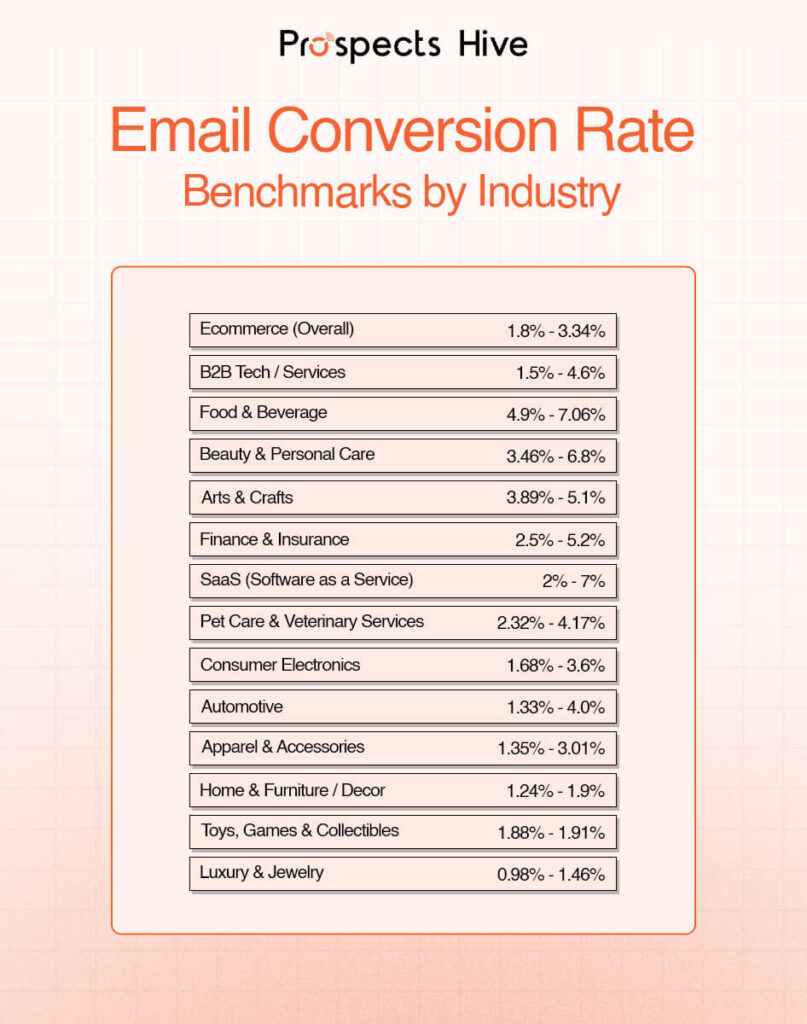
There is no single “correct” benchmark. Conversion rates vary widely by industry, email type, and audience awareness.
Below are realistic email conversion rate benchmarks by industry based on current B2B and B2C performance patterns:
| Industry | Email conversion rate |
| Ecommerce (Overall) | 1.8% – 3.34% |
| B2B Tech / Services | 1.5% – 4.6% |
| Food & Beverage | 4.9% – 7.06% |
| Beauty & Personal Care | 3.46% – 6.8% |
| Arts & Crafts | 3.89% – 5.11% |
| Finance & Insurance | 2.5% – 5.2% |
| SaaS (Software as a Service) | 2% – 7% |
| Pet Care & Veterinary Services | 2.32% – 4.17% |
| Consumer Electronics | 1.68% – 3.6% |
| Automotive | 1.33% – 4.0% |
| Apparel & Accessories | 1.35% – 3.01% |
| Home & Furniture / Decor | 1.24% – 1.9% |
| Toys, Games & Collectibles | 1.88% – 1.91% |
| Luxury & Jewelry | 0.98% – 1.46% |
Source: Optimonk
What Is a Good Email Conversion Rate for Your Business?
A good email conversion rate varies by industry, business type, and campaign goals, but typically ranges from 1% to 5% across most sectors.
Besides the percentages, a good email conversion rate generally depends on 4 factors:
- Audience temperature: Cold lists convert differently than warm subscribers.
- Intent alignment: Educational emails convert less than bottom-of-funnel offers.
- Offer friction: A demo request is harder than a content download.
- Traffic quality: List growth strategy directly impacts conversion rate marketing performance.
As a rule of thumb:
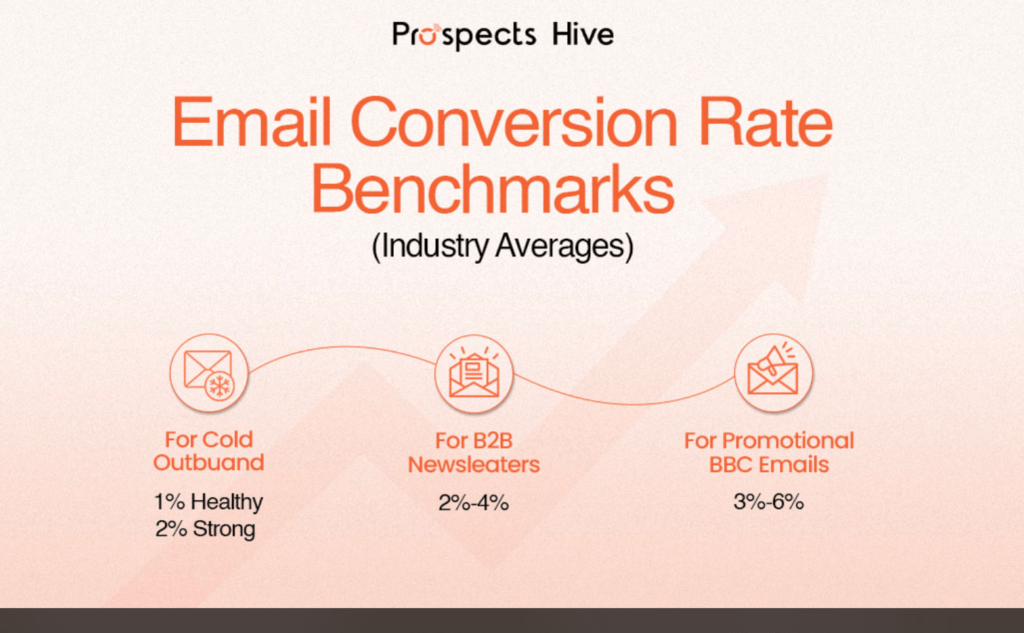
- For cold outbound: 1% is healthy, 2% is strong
- For B2B newsletters: 2%–4%
- For promotional B2C emails: 3%–6%
How to Improve Email Conversion Rate
Increasing your email conversion rate needs a combination of strategic steps, aligned with your recipients’ behavior, interests, and needs.
Below are 5 steps to help you get started:
1. Improve Relevance First
Relevance is the smartest tactic you can apply in order to increase your email conversion rate. The more tailored your content is, the better the chances of conversion.
Segmentation gives you the avenue to divide your audience into smaller groups based on factors such as lifecycle, interests, behavior, location, or even device usage. By doing so, you can deliver highly personalized content that resonates with each group’s needs.
For instance, if you are a B2B company, you can boost engagement by tailoring offers to a prospect’s industry or role instead of sending the same message to everyone.
Emails that include personalized recommendations have a 29% higher open rate and a 41% higher click-through rate.
2. Clear Call-to-Action (CTA)
To drive conversions, you need to make sure that your email’s CTA is clear, direct, and easy to act on. It’s important to frame your email around a single main CTA to avoid overwhelming or confusing the reader.
Phrases like “Get the demo,” or “Download the checklist” are action-oriented and can potentially guide the recipient towards the next step.
According to Porch Group Media, emails with a single CTA see a 371% higher click-through rate than those with multiple competing actions.
3. Reducing Post-Click Friction
More than often it appears that the conversion rate breaks after the click, so it’s essential to align the email promise with the landing page.
To make it easier for the recipient to perform the desired action, your landing page should reflect the same offer and message from the email. This in turn, also minimizes distractions and maintains consistency.
For example, if your email promotes a downloadable guide, the landing page should make that download option obvious and immediate, without extra steps or distractions.
4. Testing and Optimizing for Better Results
To optimize email conversion rate, you must continuously improvise your emails through A/B testing. Test elements like subject lines, CTAs, and offers. Start by testing one variable at a time, so that you can understand what truly drives conversion.
For instance, BigSea discovered that small subject line tests in B2B cold emails drove a 56% lift in responses, simply by changing how the message was framed. Testing shows what actually resonates with each audience segment and simply does not.
5. Protecting Deliverability and List Quality
To maintain a high email conversion rate, it’s essential to manage your email list and protect your deliverability. A clean list reduces the risk of bounces and complaints, improving your sender reputation.
Managing your list effectively can increase your engagement rate by up to 35%.
💡 How Do I Develop an Email List from Linkedin Contacts?
Avoid spammy subject lines and regularly clean your list by removing inactive subscribers. This ensures that your emails reach an engaged audience, and your conversion rate remains high.
How Prospects Hive Turns Your Benchmarks into Revenue
Most teams use benchmarks to justify performance, the teams who are currently leading use them to build systems.
Allbound marketing agency like Prospects Hive focuses on turning email conversion rate benchmarks into predictable growth by combining:
- Signal-based targeting instead of list blasting
- Outbound and inbound alignment under one GTM system
- CRM-driven attribution for accurate email conversion tracking
- Continuous optimization across cold email, nurture, and lifecycle flows
While benchmarks guide direction, execution is the ultimate factor that compounds results.
Benchmarks Are Reference Points, Not Growth Levers
Email conversion rate benchmarks are useful. But they are not the goal.
They help you:
- Spot underperformance
- Set realistic expectations
- Identify leverage points
But, they do not replace strategy. The teams that win in 2026 are not chasing averages. They are building systems that improve conversion rate over time, across channels, across intent levels.
When you use benchmarks as guardrails rather than targets, email shifts from a vanity metric to a real revenue driver. That’s the real difference.
FAQ
1. What is the Average Email Conversion Rate in 2026?
The average email conversion rate in 2026 typically ranges between 1.5%–2.5%, depending on industry, audience quality, and campaign type.
2. Is Email Response Rate a Conversion Metric?
No, email response rate measures engagement, while conversion rate measures completed desired actions such as sign-ups, purchases, or bookings.
3. What is Conversion Rate in Digital Marketing?
Conversion rate in digital marketing is the percentage of users who take a desired action after interacting with a digital marketing campaign.