
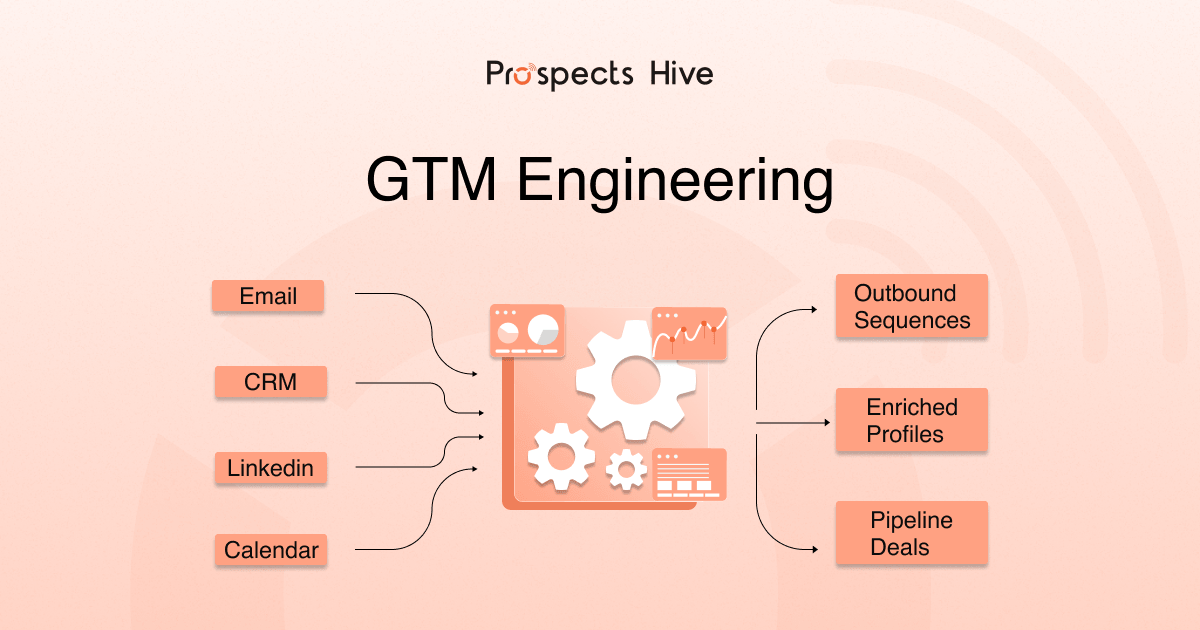
The traditional playbook for sales growth is collapsing.
Your company can’t hire its way out of the problem anymore. A sales team that doubled in size used to drive doubled revenue. That math broke somewhere around 2023.
Now you’re adding SDRs, paying them 40-50k per year each, and watching cold email reply rates crater to 3-5%. Meanwhile, your RevOps team is drowning in manual work just to keep your 15+ tools talking to each other.
Here, GTM engineering brings the solution to the door. Not as a buzzword. As a response to what actually changed.
What Changed Between 2024 and 2026
3 things happened simultaneously, and they all point to the same gap.
First, buyer behavior shifted. A 2024 Gartner survey of 632 B2B buyers found that 61% prefer an overall rep-free buying experience, and 73% actively avoid suppliers who send irrelevant outreach.
Your inbound channels are being squeezed not because your product doesn’t resonate, but because buyers want to self-educate before they ever talk to a human.
Second, cold outreach hit saturation. The average decision-maker now receives more than 100 sales emails per week. The overall average reply rate for cold emails is 3.43%, with top performers exceeding 10%, and 58% of all replies coming from the initial email.
The math is brutal: for every 100 emails you send, you might get 3-4 replies. Hiring more SDRs to solve this just multiplies the noise.
Third, your tech stack became unmanageable. The average mid-market B2B SaaS company runs 15 to 30 marketing tools, with a third of them not talking to each other and another third duplicating what the others already do.
B2B sales organizations now average 8.3 tools per SDR at roughly $187 per rep per month, and SDRs spend only 28% of their time actually selling; the rest is spent logging activities, switching between tools, and finding data.
Your RevOps team isn’t managing processes anymore. They’re managing chaos.
Into this gap stepped GTM Engineering.
GTM Engineering Isn’t RevOps, Growth, or Sales Engineering
It’s important to be precise here because the market is still confused.
RevOps manages existing processes. They ensure forecasting is accurate, pipeline hygiene stays clean, and handoffs between marketing and sales aren’t broken. They optimize the system you have.
GTM Engineers build new systems. They take a sales workflow that currently requires 4 manual steps and 3 tool integrations and turn it into an automated pipeline. They don’t optimize the broken system. They replace it.
They focus on product-led growth and build in-app funnels, referral loops, and activation workflows. A GTM Engineer’s customer is the revenue team.
Sales Engineers sell. They run demos, handle technical objections, and close deals. They’re quota-carrying. A GTM Engineer is a builder for sales, not a seller.
The practical difference: if your cold outreach is getting 2% reply rates because you’re sending generic emails to bad lists,
- RevOps might restructure your process.
- A GTM Engineer rebuilds the entire pipeline so each email is preceded by 5 minutes of research, anchored to a real signal, and followed by a multi-channel sequence that respects the prospect’s time.
What a GTM Engineer Actually Builds
Let’s talk about what this looks like in practice. A GTM Engineer typically owns 4 categories of work:
1. Systems Integration
This means connecting your CRM, marketing automation platform, enrichment tools, and sales engagement platform so data flows without human intervention.
💡 10+ Best CRM for Outbound Sales in 2026: The Ultimate Decision Framework
Modern buyers prefer self-serve digital experiences, yet most revenue teams still operate with disconnected tools and manual handoffs that create friction at every stage.
A GTM Engineer builds this:
When a prospect visits your pricing page 3 times in a week, the system automatically enriches them with firmographic data, scores them, routes them to the right account executive, and triggers a sequence. No Slack message. No manual CRM update. The data moves.
2. Data and Lead Enrichment Pipelines
This isn’t just pulling email addresses from a list. It’s building real-time data pipelines that feed business signals into your sales motion.
A real example:
A prospect’s company just closed a Series B funding round. That’s a signal.
18 hours later, your system has identified the 5 people at that company who matter most, pulled their LinkedIn profiles, scraped their recent job changes, and created a personalized research doc that sits in your CRM.
A GTM Engineer builds the automation that makes this happen without a human running each query manually.
3. Workflow Automation
Most teams have workflows. They’re just broken. Tasks get stuck. Emails don’t send. Manual follow-ups slip through the cracks.
A GTM Engineer designs logic that actually works.
If someone opens your email twice but doesn’t reply within 48 hours, the system sends them a LinkedIn message. If they reply but don’t schedule a call within 72 hours, a calendar invite gets sent. If they say “not a fit right now,” the system tags them for re-engagement in Q3.
This sounds simple in theory. It’s complicated in practice.
4. AI and Personalization at Scale
The GTM engineers commanding the highest salaries are not tool administrators. They’re systems thinkers who understand how data flows from source to CRM to sequence, and can build and debug that pipeline end-to-end.
Modern AI enables researching a prospect, generating a personalized first line for their specific situation, and sending it to 500 people in a week.
A GTM Engineer builds the system that does this without sounding generic. They understand the difference between “Hello [First_Name]” and actual personalization.
Why This Role Exploded in 2024-2025
The numbers tell the story.
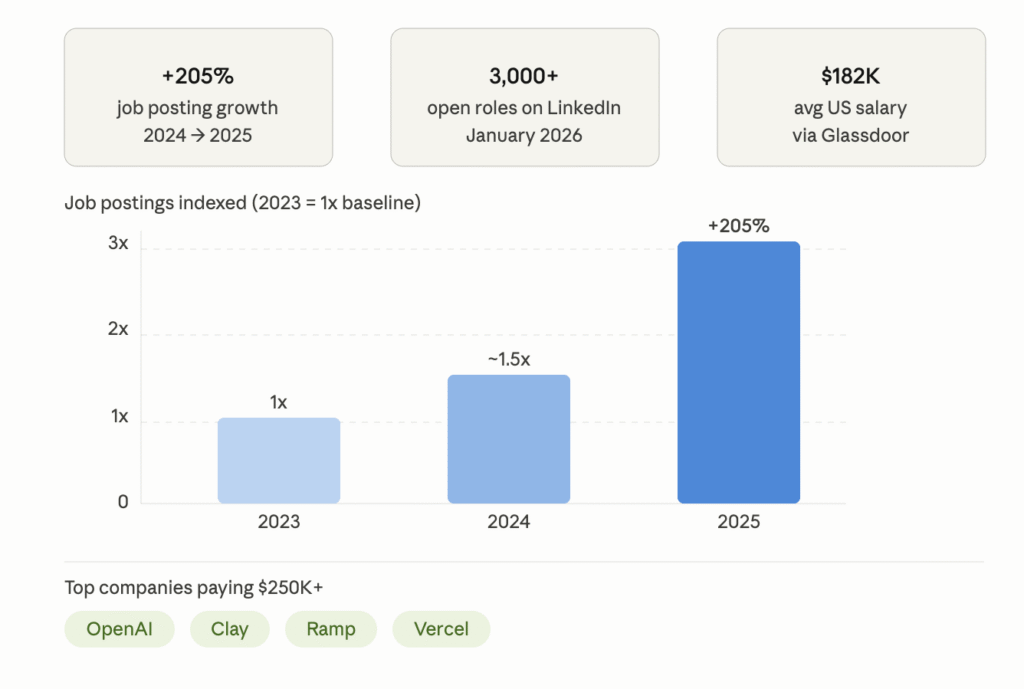
GTM engineering job postings grew 205% from 2024 to 2025, and in January 2026, LinkedIn listed over 3,000 open GTM Engineer positions. Glassdoor puts the average US salary at $182,000. (Source)
This isn’t temporary hiring. Companies like OpenAI, Clay, Ramp, and Vercel are paying $250K+ for the strongest candidates.
Why the premium?
Because GTM Engineers can make a 100-person company operate like a 1,000-person organization. They replace headcount with code and automation.
A single person can now do what used to take a team of 5:
- Automated outbound research that would take an SDR 40 hours per week.
- Real-time lead scoring that used to require a data analyst.
- CRM hygiene that used to be a RevOps job.
- Sequence orchestration that would require email marketing specialists.
- Integration management that’s usually buried in RevOps work.
The role emerged because the B2B tech stack outgrew the humans operating it. When the average company used 9 tools, 1 person could manage integrations.
At 15-30 tools, the coordination overhead became a specialized job. And only someone with technical skills could actually build the systems these tools need to work together.
The Core Skills That Command Premium Compensation
Not all GTM Engineers are created equal.
SQL and Python each appeared in 38% of GTM Engineer job postings. Indicating that more than a third of roles explicitly require programming skills, and the actual number is likely higher, since many companies assume it without stating it outright.
The divide is stark. A GTM Engineer who knows how to configure Zapier and manage HubSpot workflows will hit $100-120K. An engineer who can write Python, diagnose API integration failures, and build custom data pipelines? That’s $180-250K.
GTM engineers who can clearly show how they improve pipeline, lower CAC, and reduce the cost of getting lead data have a much stronger position when negotiating than those who just talk about the tools they use.
A resume line like “built waterfall enrichment pipeline, reducing data cost by 40%” beats “managed Clay and HubSpot workflows” at every salary band.
This matters because it tells you what companies are actually optimizing for. They’re not hiring tool administrators. They’re hiring engineers who understand data architecture and can measure revenue impact.
What The Modern GTM Stack Actually Looks Like
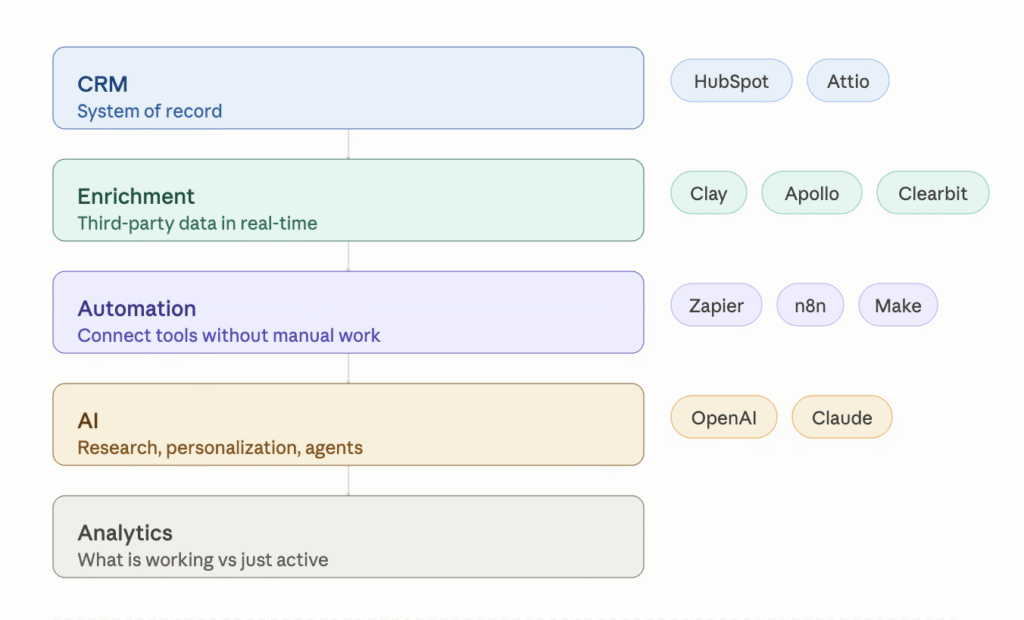
There’s no single “correct” stack. But the layers are predictable.
- You need a CRM as your system of record. Attio, HubSpot or Salesforce, depending on your stage.
- You need enrichment. Clay, Apollo, or Clearbit pulling third-party data into your pipeline in real-time.
- You need automation. Zapier, n8n, Make, or internal scripts connecting tools without constant manual work.
- You need AI. OpenAI, Claude, or specialized agents handling research and personalization.
- You need analytics. Something that tracks what’s actually working and what’s just generating activity.
The trap teams fall into: they collect tools rather than build systems. They add Lemlist for email, then Instantly for cold email, then Outreach for sequences, then… suddenly they’re paying for 6 things that do almost the same job.
A GTM Engineer’s job is to build systems that eliminate tool sprawl. They might use fewer tools, more deliberately. Or they might use more tools but orchestrate them so perfectly that the proliferation doesn’t create chaos.
How To Get Started if You’re Not Ready To Hire
Most companies can’t hire a full-time GTM Engineer right now. They’re expensive. And you need to know what problems they should actually solve before you bring one on.
Some teams build these systems internally with a full-time hire. Others partner with agencies like Prospects Hive that specialize in designing and implementing GTM systems from scratch.
The advantage: you get the expertise without the 6-month hiring process, and you can scale up or down as needed.
Either way, the first step is the same: audit your current stack. Map your current revenue processes and your tech stack side-by-side.
- Where does data get stuck?
- Where do you have manual handoffs?
- Where do you have duplicate tools?
Then ask which single workflow, if automated, would have the biggest impact on your team’s output. Not every problem needs GTM Engineering to solve. Some just need better process discipline.
If you’ve identified a workflow that would meaningfully impact the pipeline if it were automated, that’s where a GTM Engineer adds value. If your problem is “we’re not executing the process we have,” GTM Engineering won’t fix that. You need better process management first.
The common pattern: companies hire GTM Engineers when 3 problems converge:
- Their tech stack is fragmented,
- Their GTM process is defined, and
- Their team is hitting a ceiling on what they can execute manually.
Only then does automation engineering become ROI-positive.
The Questions You Should Actually Ask
If you’re evaluating whether GTM Engineering is right for your company:
- Do you have more than 12 tools in your revenue stack?
If yes, you probably have a sprawl problem worth addressing.
- Is your RevOps person spending more than 10 hours a month on integration maintenance?
If yes, there’s clearly a system being held together by manual work.
- Are your SDRs using more than 5 different tools daily?
If so, context switching is directly killing productivity.
- Do you have a defined, repeatable GTM process?
If not, don’t hire a GTM Engineer. Get process clarity first.
- Have you maxed out what you can do with manual execution?
If you’re still leaving money on the table because of pure laziness or lack of capacity, GTM Engineering can help. If you’re just not executing well, you need better discipline first.
- Ready to Build Your GTM System?
If you’ve answered yes to these questions, you’re ready for GTM Engineering. The next step is to audit your current stack and identify which workflows would move the needle most.
Prospects Hive helps B2B teams design and implement GTM systems that eliminate manual work and scale revenue without proportional headcount increases. Whether you’re building internally or partnering with an agency, the framework is the same.
The right GTM Engineer on the right team can move the needle. The wrong hire in the wrong situation becomes an expensive tool, with an administrator complaining about broken integrations all day.
Closing
GTM Engineering is real. It’s not a rebrand. It’s not Clay marketing a new job title. It’s a response to actual changes in buyer behavior, tool proliferation, and the economics of sales hiring.
But it’s not a silver bullet. You don’t hire a GTM Engineer because the role is hot. You hire one because you have a specific problem: your revenue systems are fragmented, your tools don’t talk to each other, and you’re losing pipeline velocity to manual work.
When those conditions are in place, GTM Engineering can genuinely transform how your team operates.
If they don’t, you’re just adding a payline.