AI is everywhere in marketing right now. More tools. More automation. More content than ever before. And somehow, less trust.
Buyers are overwhelmed. Inboxes are noisy. LinkedIn feels automated. Blogs keep getting published, but very few are actually read. The promise of AI-driven scale has arrived, but the outcomes GTM teams care about pipeline quality, speed of deal, and revenue efficiency haven’t improved at the same pace.
There’s a simple idea that cuts through the noise:
“Use AI for knowledge and leave the relationships to humans.”
That sentence should be the throughline for how GTM teams think about AI in marketing in 2026.
It’s not anti-AI or anti-automation. It’s a clear-eyed view of where AI creates leverage and where it quietly destroys trust.
What follows are GTM lessons you can actually apply, using an allbound marketing lens that connects strategy, execution, RevOps, and reality.
TL;DR: The 10 Biggest Takeaways
- AI accelerates insight, not trust.
- Marketing still requires both science and art.
- Fake personalization does more harm than generic messaging.
- AI is best used before the conversation, not during it.
- Deleting content often outperforms publishing more.
- LLMs reward authority, depth, and real experience.
- Events work when they drive pipeline acceleration, not badge scans.
- Lead scoring breaks when teams stop talking to customers.
- Data hygiene for AI matters more than adding another tool.
- Revenue per employee is one of the most honest GTM metrics.
What GTM Teams Get Right (and Where They Still Go Wrong)
Most modern GTM discussions get a few important things right.
First, AI has raised the bar, not lowered it. When everyone can publish “decent” content, decent stops working. The tolerance for average marketing is shrinking fast, especially in B2B.
Second, personalization at scale is not automatically a win. Pretending to care about someone when you don’t is worse than being honest and relevant at a segment or category level. This is why AI personalization vs authenticity has become a defining tension in modern GTM.
Where teams still go wrong is assuming tools will fix strategy. They automate before they clarify. They publish before they read. They rely on dashboards instead of conversations.
AI didn’t create these problems. It just exposed them faster.
The Allbound Lens: Turning Insight Into an Operating System
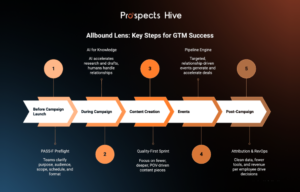
Allbound marketing only works when inbound trust and outbound relevance reinforce each other.
Inbound without relevance becomes passive content.
Outbound without trust becomes noise.
The lesson isn’t “do less marketing.” It’s to do marketing with intent, structure, and care and to use AI where it genuinely creates leverage.
Here’s what that looks like as an operating system:
Step 1: PASS-F Preflight
Before a campaign launches, before content gets written, and even before tools get involved, teams need clarity.
The PAS(S)-F framework forces that clarity:
- Purpose: Why does this campaign exist? What decision should it influence?
- Audience: Who is this really for? Not job titles, real buyers.
- Scope: How narrow or broad is the effort?
- Schedule: When does it launch, iterate, and stop
- Format: Blog, event, outbound sequence, workshop, asset?
Most GTM campaigns fail because one of these is vague. That’s why PASS-F campaign planning matters more than prompt engineering.
This is where AI helps. It can analyze markets, break industries into sub-verticals, map buying committees, and surface common pain patterns.
What AI cannot do is decide what matters most. That judgment stays human.
Step 2: AI for Knowledge, Not for Relationships
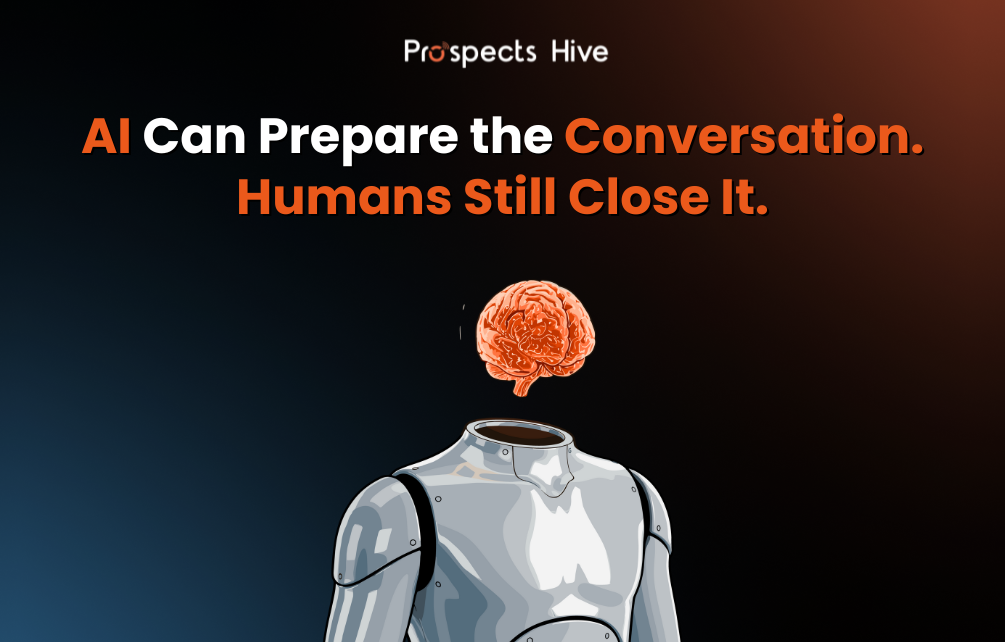
AI is excellent at getting you close to the conversation.
It can accelerate research, clarify ICPs, identify pain points, draft first versions, and compress weeks of analysis into hours.
What it cannot do is finish the interaction.
Relationships still require judgment, taste, context, empathy, and accountability. That’s why founder-led brand moments like direct conversations, clear POVs, and real presence continue to outperform polished automation.
A useful mental model is simple: you can set up the interaction, but you can’t force the relationship.
That’s how AI should be used in GTM. Let it do the heavy lifting before the interaction. Let humans handle what happens after.
Step 3: The Quality-First Content Sprint
One lesson that’s becoming hard to ignore:
Deleting content often improves performance.
This is no longer an edge case. It’s becoming standard as SEO quality vs quantity becomes the defining trade-off.
Search engines and AI systems increasingly reward first-hand experience, clear POV, depth over volume, and evidence of real understanding.
A quality-first sprint looks like this:
- Fewer pieces
- Stronger POV
- Bottom-of-funnel focus
- Subject-matter depth
- Founders and operators involved in review
If you wouldn’t click it yourself, don’t publish it.
Step 4: Events as a Pipeline Engine
Events are expensive. That hasn’t changed. What’s often missed is why they fail.
Events should do two things: generate pipeline and accelerate existing deals. Most only attempt the first, and poorly.
Events fail when meetings aren’t booked in advance, follow-up is generic, ownership is unclear, and expectations are unrealistic.
For smaller or bootstrapped teams, events work best when they’re targeted, relationship-driven, and designed for conversation, not volume.
A dinner with the right ten people beats a booth scanned by five hundred. That’s real pipeline acceleration.
Step 5: Attribution and RevOps Guardrails
Perfect attribution is a trap. Smart teams focus on attribution that answers one question: did this create or accelerate real opportunities?
Instead of obsessing over dashboards, focus on opportunity creation, sales conversations, deal velocity, retention, and expansion.
A few hard truths:
- Lead scoring is overrated when it replaces human judgment.
- Most teams already have too many tools.
- Everyone says their data is terrible, and they’re usually right.
This is where the real RevOps advantage lives. Clean data, fewer tools, clearer ownership, and better decisions.
One metric that cuts through the noise is revenue per employee. It exposes inefficiency fast and highlights where AI can actually help.
Where We Go From Here
AI will keep getting better. What won’t change is how trust is built.
The teams that win in 2026 won’t be the ones automating everything. They’ll be the ones who:
- Use AI to sharpen thinking
- Care enough to read their work
- Invest in relationships
- Execute with patience and clarity
AI doesn’t replace good GTM.
It exposes whether you ever had one.
If you want to build an allbound system that actually converts, that’s where to start.
At Prospects Hive, this is the work we focus on. Helping GTM teams turn AI-assisted insight into a practical operating system that connects content, outbound, RevOps, and real conversations. AI handles the preparation. Humans stay accountable for relationships, follow-ups, and decisions. This is the lens we bring to every GTM system we help build.
If you’re curious where your current GTM setup is helping or hurting this balance, we’re happy to walk through it with you.
FAQs
1. Where does AI beat humans in marketing today?
Research, segmentation, analysis, first drafts, and pattern recognition. Anywhere speed and synthesis matter.
2. How do I balance quality vs. quantity in content?
Start with quality. Publish less. Read everything. Build authority first, then scale what works.
3. Are events worth it if I’m bootstrapped?
Yes, if they’re small, targeted, and relationship-led. No, if they’re designed for volume without follow-up.
4. Is lead scoring still worth doing?
As a signal, yes. As a replacement for talking to customers, no.
5. How should an allbound team handle attribution without heavy tools?
Track opportunity creation and acceleration. If it doesn’t move pipeline, stop doing it.
6. What’s one metric every CRO should watch?
Revenue per employee.
7. Will chatbot-to-chatbot buying replace humans?
For transactional purchases, probably. For complex B2B decisions, humans will stay involved.
8. Why do AI tools underperform in real teams?
Too many tools, poor data hygiene, and unclear ownership.